
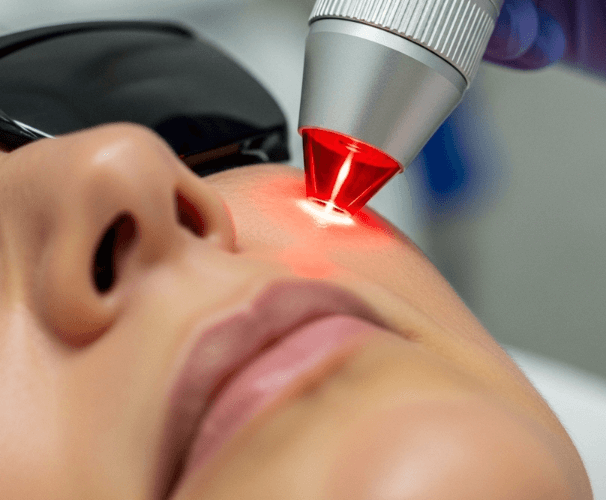
Treatment Overview
Ruby Laser Toning is a specialized pigmentation treatment in Korean dermatology that uses a 694 nm ruby laser wavelength to precisely target melanin deposits in the skin. It is particularly effective for freckles, age spots, lentigines, café-au-lait spots, and stubborn pigmentation that do not fully respond to standard Nd:YAG or Pico lasers.
Because of its strong melanin absorption, Ruby Laser is highly effective for localized dark spots and certain resistant pigment lesions. Korean dermatologists often use it in combination with Nd:YAG or Pico Toning for full-face brightening while using Ruby Laser for spot-focused pigment removal.
It belongs to the Skin Concerns: Pigmentation, Sunspots, Freckles, Age Spots family (Q-Switched Nd:YAG, Pico Toning, IPL, Aqua Toning, Excel V):
- Ruby Laser Toning: Best for stubborn freckles + localized dark spots.
- Q-Switched Nd:YAG (Laser Toning): Best for melasma and diffuse pigment.
- Pico Toning: Best for deep pigment + skin brightening.
- Excel V: Best for redness + vascular + some pigment.
- IPL: Best for mild pigmentation and photodamage.
Purpose & Benefits
- Freckle Removal: Targets superficial melanin clusters.
- Pigmentation Correction: Fades sunspots, lentigines, and age spots.
- Localized Spot Treatment: Strong absorption for stubborn dark lesions.
- Skin Brightening: Improves overall clarity when combined with toning lasers.
- Long-Lasting Results: Pigment lesions often permanently reduced after proper care.
- Synergy: Works well with Nd:YAG, Pico, or Aqua Toning for whole-face rejuvenation.
Ideal Candidates
Ruby Laser Toning in Korea is recommended for:
- Adults with freckles, sunspots, or lentigines.
- Patients with café-au-lait spots or resistant pigmentation.
- Individuals who want precise spot treatment rather than full-face toning only.
- Men and women seeking stubborn pigment correction with expert protocols.
Comparison with other treatments:
- Ruby Laser Toning: Best for freckles + sunspots + dark spots.
- Q-Switched Nd:YAG: Best for melasma and diffuse pigmentation.
- Pico Toning: Best for stubborn pigment and rejuvenation.
- IPL: Best for mild pigment and sun damage.
- Excel V: Best for vascular + mixed pigment issues.
Possible Risks & Complications
Ruby Laser is safe when performed in Korean dermatology clinics, but mild side effects may include:
- Redness or Swelling: Common, lasts 1–2 days.
- Crusting or Darkening: Pigment spots may temporarily darken before flaking.
- Dryness or Sensitivity: During healing phase.
- Rare Risks: Hypopigmentation or scarring (rare with expert care).
Surgical Techniques Used
Ruby Laser Toning involves melanin-targeted photothermolysis:
- Laser Device: 694 nm Q-switched ruby laser.
- Spot Precision: Focused energy targets pigmented lesions.
- Selective Absorption: Melanin absorbs energy, breaking down pigment granules.
- Combination Approach: Often paired with Nd:YAG or Pico for full-face treatment.
- Protocol: 2–4 sessions for spots, spaced 4–6 weeks apart.
Recovery & Aftercare
- Immediately: Mild redness, warmth, and slight swelling.
- 2–5 Days: Pigmented spots darken, form micro-crusts.
- 1–2 Weeks: Spots flake off, leaving clearer skin.
Aftercare Tips:
- Apply SPF 50+ daily to prevent recurrence.
- Avoid direct sun exposure.
- Use gentle, hydrating skincare during healing.
- Do not pick at crusts; allow natural healing.
- Follow-up sessions as advised by dermatologist.
Results & Longevity
- Immediate: Dark spots darken post-laser.
- Short-Term (1–2 Weeks): Spots flake off, revealing clearer skin.
- Medium-Term (1–3 Months): Pigmentation significantly reduced.
- Long-Term: Many spots permanently removed; melasma may need maintenance.
Treatment Process in Korea
- Consultation & Skin Analysis – Doctor examines pigmentation depth and type.
- Preparation – Cleansing and numbing cream (if needed).
- Laser Session – Ruby Laser applied precisely to pigmented lesions.
- Optional Add-Ons – Nd:YAG or Pico Toning for overall brightening.
- Post-Care – Cooling mask or soothing ointment.
- Follow-Up – Multiple sessions for stubborn pigmentation.
Why Korea is a Top Destination
- Korea is globally recognized for pigmentation laser expertise.
- Dermatologists use authentic KFDA-approved Ruby Laser devices.
- Combination therapy (Ruby + Pico/Nd:YAG) widely available for glass skin clarity.
- Affordable pricing compared to Western medspas.
- Seoul is known for spot-focused pigment protocols.
Cost Range (Detailed Breakdown)
Pricing for Ruby Laser Toning in Korea varies by clinic and pigmentation severity:
- Single Spot Treatment: USD 50 – 150
- Full Face Session: USD 200 – 350
- 3–5 Session Package: USD 600 – 1,200
- Ruby + Pico/Nd:YAG Combo: USD 300 – 500 per session
- Premium Pigment Package (Ruby + Pico + Exosomes): USD 1,200 – 2,500
Additional Costs in Korea:
- Consultation: USD 10 – 30
- Add-ons (Exosomes, PN boosters, serums): USD 100 – 400
💡 Patients often call Ruby Laser the “freckle eraser”, since it precisely clears stubborn pigmentation that standard toning lasers may not fully remove.
Popular Clinics
- Banobagi Dermatology (Seoul): Specialized Ruby Laser for freckles + age spots.
- Oracle Dermatology (Seoul): Combines Ruby + Pico for stubborn pigmentation.
- Renewme Skin Clinic (Seoul): Offers Ruby Laser for spot-focused pigment therapy.
- View Plastic & Dermatology (Seoul): Ruby + Nd:YAG for melasma + dark spots.
- Chaum Anti-Aging Center (Seoul): Premium Ruby protocols with regenerative boosters.


