
Treatment Overview
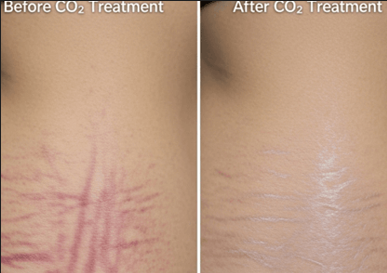
Stretch Mark Removal CO₂ is a fractional ablative CO₂ laser treatment widely offered in Korean dermatology clinics to reduce stretch marks (striae), whether red (striae rubrae) or white (striae albae). By delivering fractional beams into the dermis, the laser stimulates collagen and elastin remodeling, helping to smooth depressed lines, improve texture, and blend stretch marks with surrounding skin.
Compared to topical creams or microneedling, CO₂ fractional laser penetrates deeper, providing superior results for stubborn stretch marks on the abdomen, thighs, hips, breasts, or arms. Korean clinics often combine this treatment with regenerative boosters (exosomes, PRP, PN) for faster healing and enhanced results.
It belongs to the Skin Concerns: Stretch Marks, Scarring, Laxity, Texture family (Stretch Mark CO₂, Scar Therapy CO₂, Resurfacing Plus CO₂, INFINI RF, Microneedling + Exosomes):
- Stretch Mark CO₂: Best for red/white stretch marks.
- Scar Therapy CO₂: Best for acne/surgical scar remodeling.
- Resurfacing Plus CO₂: Best for wrinkles + scars + overall skin renewal.
- INFINI RF: Best for tightening loose skin with stretch marks.
- Microneedling + Exosomes: Best for mild marks + skin repair.
Purpose & Benefits
- Stretch Mark Reduction: Improves both red and white stretch marks.
- Collagen Remodeling: Stimulates new collagen and elastin in damaged dermis.
- Texture Improvement: Smooths rough or depressed lines.
- Skin Tightening: Firms surrounding loose skin.
- Blended Appearance: Helps stretch marks blend with natural skin tone.
- Long-Lasting Results: Visible improvement with progressive sessions.
Ideal Candidates
Stretch Mark Removal CO₂ in Korea is recommended for:
- Women with postpartum stretch marks (abdomen, breasts, thighs).
- Individuals with stretch marks from weight changes or puberty.
- Patients with long-standing white marks resistant to creams.
- Men and women wanting smoother, firmer skin in affected areas.
Comparison with Other Treatments
- Stretch Mark CO₂: Best for moderate to severe marks (red + white).
- Scar Therapy CO₂: Best for acne and surgical scars.
- Resurfacing Plus CO₂: Best for total rejuvenation + scars + wrinkles.
- INFINI RF: Best for tightening skin with mild stretch marks.
- Microneedling + Exosomes: Best for early or mild marks.
Possible Risks & Complications
Although safe in skilled Korean clinics, possible side effects include:
- Redness & Swelling: Common, lasts 5–7 days.
- Scabbing & Peeling: As treated skin renews.
- Temporary Hyperpigmentation (PIH): More common in darker skin, prevented with sunscreen.
- Rare Risks: Prolonged redness, infection, or scarring (extremely rare).
Surgical Techniques Used
Stretch Mark Removal CO₂ uses fractional resurfacing for scar-like lesions:
- Laser Device: Advanced fractional CO₂ systems (eCO₂, UltraPulse).
- Deep Microbeams: Penetrate dermis to trigger collagen induction.
- Controlled Ablation: Breaks down damaged stretch mark tissue.
- Treatment Zones: Abdomen, hips, thighs, breasts, buttocks, arms.
- Protocol: 3–5 sessions spaced 6–8 weeks apart; yearly maintenance optional.
Recovery & Aftercare
- Immediately: Redness, swelling, mild pinpoint bleeding.
- 5–7 Days: Crusting and peeling of treated zones.
- 2–4 Weeks: Visible texture improvement and fading of marks.
- 3–6 Months: Ongoing collagen remodeling improves stretch mark appearance.
Aftercare Tips:
- Apply SPF 50+ daily to treated areas if exposed.
- Use gentle moisturizers and repair creams.
- Avoid hot baths, saunas, and friction on treated areas.
- Do not pick or scratch healing skin.
- Consider combination care (exosomes, PRP) for faster recovery.
Results & Longevity
- Immediate: Skin feels firmer post-healing.
- Short-Term (1–2 Months): Red marks fade, white marks soften.
- Medium-Term (3–6 Months): Stretch marks blend better with surrounding skin.
- Long-Term: Results last permanently, though multiple sessions are required for best outcomes.
Treatment Process in Korea
- Consultation & Skin Analysis – Doctor examines stretch mark type (red vs. white).
- Preparation – Cleansing + numbing cream.
- Laser Session – Fractional CO₂ applied over stretch mark zones.
- Optional Add-Ons – PRP, exosomes, or PN boosters for regeneration.
- Post-Care – Cooling mask, soothing ointments, barrier serums.
- Follow-Up – Multi-session program ensures progressive fading.
Why Korea is a Top Destination
- Specialized in treating stretch marks on different skin tones.
- Dermatologists use FDA/KFDA-approved CO₂ devices.
- Combination therapy (CO₂ + RF + regenerative boosters).
- Affordable pricing compared to Western aesthetics clinics.
- Seoul clinics are globally recognized for body-skin repair programs.
Cost Range (Detailed Breakdown)
Pricing for Stretch Mark Removal CO₂ in Korea depends on body area and severity:
- Small Area (per zone): USD 300 – 600 per session
- Medium Area (abdomen or thighs): USD 600 – 1,200 per session
- 3–5 Session Package: USD 1,500 – 3,500
- CO₂ + PRP/Exosome/PN Boosters: USD 700 – 1,300 per session
- Premium Stretch Mark Package (CO₂ + INFINI RF + Boosters): USD 3,000 – 5,500
Additional Costs in Korea:
- Consultation: USD 20 – 50
- Add-ons (Exosomes, PN boosters, PRP): USD 200 – 500
💡 Sometimes called the “CO₂ Stretch Mark Eraser”, this treatment helps fade both new red marks and old white marks for smoother skin.
Popular Clinics
- Oracle Dermatology (Seoul): Specialized stretch mark CO₂ + PRP programs.
- Banobagi Dermatology (Seoul): Body contour + CO₂ stretch mark removal.
- Renewme Skin Clinic (Seoul): Known for postpartum stretch mark protocols.
- View Plastic & Dermatology (Seoul): CO₂ + RF combination for stretch marks.
- Chaum Anti-Aging Center (Seoul): Premium regenerative stretch mark treatments.


