
Treatment Overview
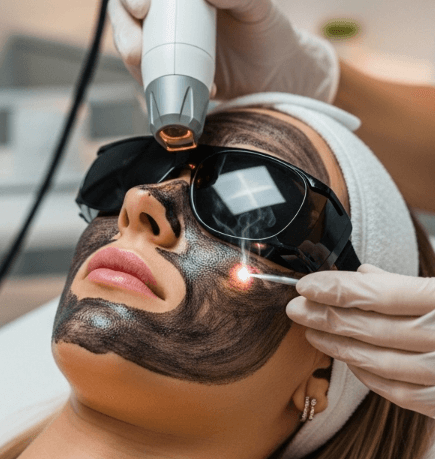
The Carbon Laser Peel (also known as the Hollywood Peel or China Doll Facial) is a non-invasive Q-Switched Nd:YAG laser procedure that uses a thin layer of liquid carbon applied to the skin before laser treatment. The carbon particles absorb oil, impurities, and pigment, which are then destroyed by the laser’s energy.
In Korea, the Carbon Laser Peel is primarily used for skin brightening, acne control, pore tightening, and mild pigmentation, but in some cases, it may also be applied to lighten superficial pigmented birthmarks or reduce the appearance of café-au-lait spots and minor epidermal pigmentation. However, for deep or congenital birthmarks, stronger lasers such as Q-Switched Nd:YAG, Alexandrite, or Ruby lasers are typically preferred.
It belongs to the Birthmark & Pigmentation Treatment family (Carbon Laser Peel, Q-Switched Nd:YAG, Alexandrite, Ruby, Pico Lasers):
- Carbon Laser Peel: Best for surface pigmentation + brightening + acne-related marks.
- Q-Switched Nd:YAG: Best for melasma, dermal pigment, and Ota nevus.
- Q-Switched Alexandrite: Best for congenital and café-au-lait spots.
- Q-Switched Ruby: Best for resistant pigment lesions.
- Pico Lasers: Best for stubborn pigment and combination therapy.
Purpose & Benefits
- Mild Birthmark Fading: Helps lighten certain superficial pigmented lesions.
- Pigment Reduction: Breaks down melanin clusters for brighter tone.
- Acne & Oil Control: Carbon absorbs impurities, reducing breakouts.
- Pore Minimization: Tightens enlarged pores for smoother texture.
- Skin Rejuvenation: Stimulates collagen, improving elasticity and fine lines.
- Safe & Gentle: Minimal downtime and discomfort.
Ideal Candidates
Carbon Laser Peel in Korea is recommended for:
- Patients with superficial birthmarks or minor epidermal pigmentation.
- Adults with dull, oily, or acne-prone skin who also want pigment control.
- Individuals seeking a gentle, no-downtime laser option.
- Men and women comparing treatments:
- Carbon Peel: Best for mild pigment + acne + pores.
- Nd:YAG: Best for deeper dermal pigment + melasma.
- Alexandrite: Best for congenital birthmarks + café-au-lait spots.
- Ruby: Best for resistant pigment lesions.
- Pico Lasers: Best for stubborn pigmentation + scars.
Possible Risks & Complications
Carbon Laser Peel is safe, but mild side effects may include:
- Redness or Warmth: Temporary, fades within hours.
- Mild Flaking or Dryness: Short-lived as skin renews.
- Rare Risks: Temporary pigmentation changes if not performed by experienced dermatologists.
Surgical Techniques Used
Carbon Laser Peel uses a Q-Switched Nd:YAG laser with a carbon mask:
- Carbon Lotion Application: Applied to absorb oil, pigment, and impurities.
- Laser Activation: Q-Switched Nd:YAG laser vaporizes carbon particles, destroying trapped pigment and stimulating collagen.
- Protocol: 3–6 sessions spaced 2–4 weeks apart; maintenance every 3–6 months.
Recovery & Aftercare
- Immediately: Brighter, fresher-looking skin.
- 1–2 Days: Mild dryness or flaking may occur.
- 1–2 Weeks: Progressive pigment lightening and skin improvement.
Aftercare Tips:
- Apply hydrating serums and barrier creams.
- Use SPF 50+ sunscreen daily.
- Avoid harsh exfoliants, acids, or retinoids for 3–5 days.
- Limit sun exposure during treatment cycles.
Results & Longevity
- After First Session: Instant glow and smoother skin.
- Short-Term (2–3 Sessions): Noticeable brightening and minor pigment reduction.
- Medium-Term (3–6 Sessions): Lightening of superficial pigmented lesions + better texture.
- Long-Term: Maintenance needed for sustained results; not a permanent solution for deep birthmarks.
Treatment Process in Korea
- Consultation & Skin Analysis – Doctor evaluates whether the birthmark is suitable for Carbon Peel.
- Preparation – Cleansing, application of carbon lotion.
- Laser Session – Nd:YAG laser pulses vaporize carbon particles, targeting pigment.
- Post-Care: Cooling mask or hydrating serum applied.
- Follow-Up: Multi-session plan for cumulative pigment reduction.
Why Korea is a Top Destination
- Korea is a global leader in Carbon Laser Peel treatments with refined protocols.
- Dermatologists combine Carbon Peel with Nd:YAG, Pico, or Alexandrite lasers for better birthmark results.
- Affordable compared to Western treatments.
- Popular in Seoul as part of “glass skin” laser programs.
- Many clinics pair Carbon Peel with skin boosters, exosomes, or Aqua Peel for synergy.
Cost Range (Detailed Breakdown)
Pricing for Carbon Laser Peel in Korea:
- Single Session (full face): USD 100 – 200
- 3–6 Session Package: USD 300 – 800
- Premium Package (Carbon Peel + Nd:YAG/Pico/Boosters): USD 800 – 2,000
Additional Costs in Korea:
- Consultation: USD 20 – 50
- Add-ons (Exosomes, PN boosters, Vitamin drips): USD 100 – 400
💡 The Carbon Laser Peel is often called “the glass skin peel” in Korea, ideal for brightening and surface pigment, but for deeper or congenital birthmarks, dermatologists usually recommend Nd:YAG, Alexandrite, Ruby, or Pico systems.
Popular Clinics
- Banobagi Dermatology (Seoul): Carbon Peel + Nd:YAG for birthmark fading + glow.
- Oracle Dermatology (Seoul): Carbon Peel programs for acne + pigmentation.
- Renewme Skin Clinic (Seoul): Carbon Peel with Pico for PIH and mild lesions.
- View Plastic & Dermatology (Seoul): Carbon Peel + booster therapies.
- Chaum Anti-Aging Center (Seoul): Premium Carbon Peel with regenerative add-ons.


