
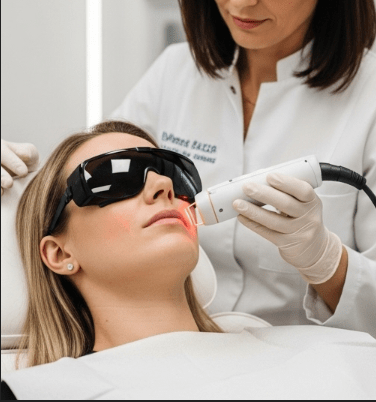
Treatment Overview
The Q-Switched Nd:YAG Laser is considered one of the gold-standard devices for birthmark and pigmentation correction. Operating at 1064 nm (deep penetration) and 532 nm (superficial pigment), it delivers ultra-short, high-intensity pulses that selectively fragment melanin and pigment particles into tiny fragments, which the body gradually clears.
In Korea, the Q-Switched Nd:YAG Laser is a primary treatment option for pigmented birthmarks such as Ota nevus, café-au-lait spots, congenital nevi, and dermal pigmented lesions. It is also used for freckles, age spots, melasma, and tattoos, making it highly versatile. Korean dermatologists often use it in low-fluence laser toning protocols for safe pigment reduction in Asian skin prone to PIH (post-inflammatory hyperpigmentation).
It belongs to the Birthmark & Pigmentation Treatment family (Q-Switched Nd:YAG, Alexandrite, Ruby, Pico Lasers, CO₂ Fractional, IPL):
- Q-Switched Nd:YAG (1064/532 nm): Best for dermal pigment + Ota nevus + congenital marks.
- Alexandrite (755 nm): Best for congenital pigmented lesions (café-au-lait).
- Ruby (694 nm): Best for resistant pigmented lesions.
- Pico Lasers (PicoCare, PicoPlus, PicoSure): Best for stubborn pigment + scars.
- CO₂ Fractional: Best for superficial pigmented lesions + textural irregularities.
- IPL: Best for redness + superficial vascular-pigment issues.
Purpose & Benefits
- Birthmark Removal: Treats Ota nevus, café-au-lait, and congenital pigmented lesions.
- Pigment Clearance: Removes freckles, age spots, and sun-induced pigmentation.
- Multi-Layer Pigment Targeting: 1064 nm for dermal pigment; 532 nm for superficial pigment.
- Safe for Asian Skin: Minimizes PIH with controlled protocols.
- Scar & Texture Benefits: Stimulates collagen for improved skin smoothness.
- Tattoo Removal: Effective for dark inks (black, blue, green).
Ideal Candidates
Q-Switched Nd:YAG Laser in Korea is recommended for:
- Children and adults with pigmented congenital birthmarks.
- Patients with Ota nevus, café-au-lait spots, or dermal pigmentation.
- Individuals with freckles, melasma, or post-inflammatory pigmentation.
- Men and women comparing treatments:
- Q-Switched Nd:YAG: Best for congenital dermal pigmentation.
- Alexandrite: Best for congenital café-au-lait spots.
- Ruby: Best for resistant pigment lesions.
- Pico Lasers: Best for stubborn pigmentation + scars.
- CO₂ Fractional: Best for surface lesions + texture correction.
- IPL: Best for redness + mild pigmentation.
Possible Risks & Complications
The Q-Switched Nd:YAG is safe and FDA/KFDA-approved, but mild side effects may include:
- Redness & Swelling: Temporary, subsides in hours to days.
- Temporary Darkening: Pigment may darken before fading.
- Dryness or Flaking: As pigment clears.
- Rare Risks: PIH, hypopigmentation, or scarring (rare in expert Korean clinics).
Surgical Techniques Used
Q-Switched Nd:YAG Laser uses selective photothermolysis with nanosecond pulses:
- 1064 nm Wavelength: Penetrates deep dermis for Ota nevus, congenital nevi, and tattoos.
- 532 nm Wavelength: Targets superficial freckles, sunspots, and café-au-lait.
- Low-Fluence Toning Mode: Safe gradual pigment reduction.
- Protocol:
- Birthmarks: 3–10 sessions spaced 3–4 weeks apart.
- Pigmented lesions: 2–5 sessions depending on depth.
- Maintenance: Every 6–12 months for melasma or recurring pigment.
Recovery & Aftercare
- Immediately: Mild redness, tingling, or warmth.
- 2–5 Days: Temporary crusting or darkening.
- 1–2 Weeks: Visible pigment fading.
Aftercare Tips:
- Apply SPF 50+ daily.
- Use hydrating and barrier-strengthening creams.
- Avoid picking at crusts or scabs.
- Avoid strong acids, scrubs, and retinoids for 5–7 days.
Results & Longevity
- After First Session: Initial lightening and brighter tone.
- Short-Term (2–4 Sessions): Noticeable fading of birthmarks or spots.
- Medium-Term (5–8 Sessions): Significant improvement in congenital pigment.
- Long-Term: Many results are permanent; maintenance may be needed for melasma or recurring lesions.
Treatment Process in Korea
- Consultation & Skin Analysis – Doctor evaluates pigment depth and lesion type.
- Preparation – Cleansing, numbing cream (optional), protective eyewear.
- Nd:YAG Session – Pulses delivered at 532 nm and/or 1064 nm.
- Post-Care: Cooling mask, hydration serum, or soothing ointment.
- Follow-Up: Multi-session plan for complete clearance.
Why Korea is a Top Destination
- Korea is a leader in laser toning and pigmentation correction.
- Dermatologists specialize in safe treatment for Asian skin prone to PIH.
- Clinics use FDA/KFDA-approved Nd:YAG devices with customized protocols.
- More affordable than Western pigmentation and birthmark removal.
- Seoul is internationally known for birthmark and melasma correction programs.
Cost Range (Detailed Breakdown)
Pricing for Q-Switched Nd:YAG Laser in Korea:
- Single Session (small area): USD 150 – 300
- Medium to Large Birthmark (per session): USD 300 – 600
- 3–8 Session Package: USD 1,000 – 3,000
Additional Costs in Korea:
- Consultation: USD 20 – 50
- Add-ons (Exosomes, PN boosters, whitening drips): USD 100 – 400
💡 The Q-Switched Nd:YAG is often called “the melasma & birthmark control laser” in Korea, thanks to its dual ability to treat congenital dermal pigmentation and acquired pigmented lesions.
Popular Clinics
- Banobagi Dermatology (Seoul): Nd:YAG for Ota nevus + congenital lesions.
- Oracle Dermatology (Seoul): Specialized Nd:YAG toning for birthmarks.
- Renewme Skin Clinic (Seoul): Nd:YAG with boosters for stubborn pigment.
- View Plastic & Dermatology (Seoul): Nd:YAG programs for congenital nevi.
- Chaum Anti-Aging Center (Seoul): Premium Nd:YAG with regenerative add-ons.


