
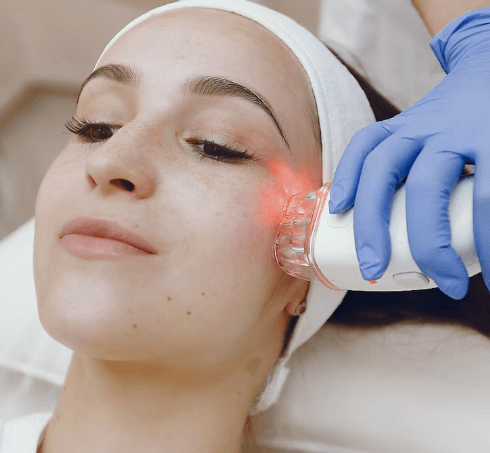
Treatment Overview
V-Beam Prima is the latest generation Pulsed Dye Laser (PDL) system, widely used in Korean dermatology clinics for vascular birthmarks and mixed pigmented-vascular lesions. With its 595 nm and 1064 nm dual wavelengths, it effectively targets oxyhemoglobin in blood vessels, making it especially effective for port-wine stains, hemangiomas, rosacea-related redness, and vascular-pigment combined birthmarks.
Compared to older PDL devices, V-Beam Prima offers greater depth penetration, larger spot sizes, and faster treatment times, which means better outcomes for thicker or more extensive vascular birthmarks.
Purpose & Benefits
- Vascular Birthmark Clearance: Particularly effective for port-wine stains, hemangiomas, and capillary malformations.
- Dual Wavelengths: 595 nm for superficial vessels, 1064 nm for deeper or thicker lesions.
- Safe for Asian Skin: Dynamic cooling device (DCD) minimizes PIH risk.
- Redness Reduction: Calms vascular-related pigmentation and discoloration.
- Combination Friendly: Can be combined with pigment lasers for mixed lesions.
Ideal Candidates
V-Beam Prima in Korea is recommended for:
- Patients with vascular birthmarks (port-wine stains, strawberry hemangiomas, vascular malformations).
- Children and adults with congenital vascular lesions.
- Patients with mixed pigmented-vascular marks (e.g., reddish-brown congenital nevi).
- Individuals looking for a safe, effective, and pediatric-friendly vascular laser.
Possible Risks & Complications
V-Beam Prima is considered safe under Korean dermatology protocols, but side effects may include:
- Redness & Warmth: Common, resolves in hours to a few days.
- Purpura (Bruising): Temporary, typically 5–10 days.
- Swelling or Tenderness: Mild, fades within days.
- Rare Risks: PIH rebound, blistering, or scarring (minimized with Korean low-fluence protocols).
Surgical Techniques Used
- 595 nm Wavelength: Targets superficial vascular lesions.
- 1064 nm Wavelength: Penetrates deeper for thick or nodular vascular birthmarks.
- Dynamic Cooling Device (DCD): Protects surrounding skin during treatment.
- Multi-Pass Approach: Layered passes for larger or more stubborn vascular lesions.
Protocol: Typically 4–8 sessions, spaced 4–6 weeks apart. Pediatric cases may require more treatments.
Recovery & Aftercare
Immediately: Redness, warmth, and possible purplish bruising.
3–7 Days: Purpura gradually fades; skin begins to lighten.
1–2 Weeks: Birthmark appears lighter and less vascular.
Aftercare Tips:
- Daily SPF 50+ sunscreen to prevent PIH.
- Use soothing creams to reduce irritation.
- Avoid scratching or peeling the treated area.
- Avoid hot baths, intense workouts, or saunas for 2–3 days.
Results & Longevity
- After 1 Session: Birthmark redness begins to reduce.
- After 3–4 Sessions: Noticeable fading of vascular birthmarks.
- After 6–8 Sessions: Significant clearance and long-lasting improvement.
- Long-Term: Many vascular birthmarks are permanently reduced, though maintenance may be required for some cases.
Treatment Process in Korea
Consultation & Skin Analysis
- Dermatologist assesses if birthmark is vascular, pigmented, or mixed.
- V-Beam Prima selected for vascular-dominant lesions.
Preparation
- Gentle cleansing, protective eyewear.
- Optional numbing cream (often not required in children).
V-Beam Prima Session
- Step 1: Laser applied with cooling device.
- Step 2: Multiple passes for larger or stubborn lesions.
- Step 3: Cooling or calming cream applied after treatment.
- Duration: 15–30 minutes depending on lesion size.
Post-Treatment Care
- Sunscreen and hydrating ointments applied.
- Patient resumes daily life with mild restrictions.
Follow-Up
- 4–8 sessions usually required.
- May be combined with Pico, Alexandrite, or CO₂ lasers for mixed lesions.
Unique Korean Advantages
- Advanced Devices: Korea adopts the latest V-Beam Prima systems.
- Pediatric Expertise: Many clinics specialize in child-friendly vascular protocols.
- Combination Therapy: Often integrated with pigment lasers for mixed birthmarks.
- Cost-Effective Multi-Sessions: Korean bundles are more affordable than in Western countries.
Cost Range (Estimated)
- Small Vascular Lesion (per session): USD 200 – 350
- Medium to Large Lesion (per session): USD 350 – 600
- 4–8 Session Package: USD 1,200 – 3,000
Additional Costs:
- Consultation: USD 20 – 50
- Add-ons (Whitening drips, Vitamin C serums, PRP, exosomes): USD 100 – 400
Example Korean Packages:
- Basic V-Beam Prima Birthmark Program (3 sessions): USD 600–900
- Advanced Program (V-Beam + Whitening/Boosters): USD 1,200–1,800
- Premium Program (V-Beam + Pigment Lasers + Regenerative Add-ons): USD 2,000–3,200
Popular Clinics in Seoul
- Oracle Dermatology: V-Beam Prima for port-wine stains and vascular lesions.
- Banobagi Dermatology: V-Beam + Pico for mixed pigmented-vascular marks.
- Renewme Skin Clinic: Pediatric-friendly V-Beam programs.
- View Plastic & Dermatology: V-Beam + CO₂ for vascular + textured lesions.
- Chaum Anti-Aging Center: Premium vascular programs with regenerative boosters.


