
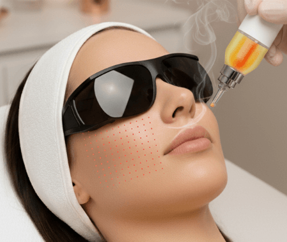
Treatment Overview
Ablative CO₂ Fractional Laser Resurfacing is one of the most powerful acne scar treatments performed in Korean dermatology clinics, designed to target deep atrophic scars, uneven skin texture, and enlarged pores.
This procedure uses a carbon dioxide (CO₂) fractional laser to deliver precise, high-energy beams into the skin. The laser vaporizes micro-columns of scarred tissue (ablative action) while leaving surrounding skin intact. This stimulates collagen production, elastin remodeling, and new skin regeneration, leading to smoother, healthier skin.
In Korea, this treatment is often part of multi-step scar programs, paired with subcision, PRP, PDRN, or exosome boosters to accelerate healing and minimize pigmentation risks.
Purpose & Benefits
- Scar Remodeling: Reduces depth of rolling, boxcar, and mixed atrophic scars.
- Skin Resurfacing: Smoothens rough skin and refines large pores.
- Collagen Induction: Stimulates fibroblasts for long-term scar correction.
- Pigmentation Improvement: Helps fade post-acne pigmentation and discoloration.
- Skin Tightening: Improves elasticity and firmness.
- High Efficacy: Delivers stronger results compared to non-ablative lasers.
Ideal Candidates
Ablative CO₂ Fractional Laser Resurfacing in Korea is recommended for:
- Patients with moderate to severe acne scars (rolling, boxcar, or icepick when combined with subcision).
- Individuals with enlarged pores and uneven texture.
- Those who want dramatic improvement in skin smoothness and firmness.
- Patients able to commit to downtime (5–7 days).
- Individuals who previously tried gentler treatments with limited results.
Possible Risks & Complications
This is an intensive procedure, and temporary side effects may include:
- Redness & Swelling (5–7 days).
- Crusting & Peeling during recovery.
- Risk of PIH (Post-Inflammatory Hyperpigmentation), particularly in Asian skin (minimized with Korean aftercare protocols).
- Infection Risk if aftercare is not followed properly.
- Longer Downtime compared to non-ablative lasers.
Surgical Techniques Used
- Fractional CO₂ Laser: Creates microscopic thermal zones of ablation in scarred skin.
- Customized Depth & Density: Energy adjusted according to scar type and skin thickness.
- Combination Therapy: In Korea, often combined with subcision, microneedling RF, PRP, PDRN, or exosome boosters for faster recovery and better outcomes.
Protocol: Typically 2–3 sessions, spaced 2–3 months apart.
Recovery & Aftercare
Immediately: Skin is red, warm, and swollen (similar to a strong sunburn).
3–7 Days: Crusting and peeling occur as damaged tissue sheds.
1–2 Weeks: New skin forms; redness gradually subsides.
1–6 Months: Progressive collagen remodeling improves scars and skin quality.
Aftercare Tips:
- Avoid makeup for at least 5–7 days.
- Keep skin moisturized with barrier-support creams.
- Avoid sun exposure; apply SPF 50+ sunscreen daily.
- Use only dermatologist-recommended gentle skincare during healing.
- Avoid saunas, hot baths, or strenuous exercise during recovery week.
Results & Longevity
- After 1 Session: Noticeable improvement in scar depth and skin texture.
- After 2–3 Sessions: Significant remodeling with smoother, firmer skin.
- After 6 Months: Collagen continues to rebuild, further improving results.
- Longevity: Results last years, though maintenance sessions may be recommended.
Treatment Process in Korea
Consultation & Skin Analysis
Dermatologist evaluates scar types, skin tone, and sensitivity to determine laser settings.
Preparation
Topical numbing cream and/or local anesthesia applied; protective eyewear provided.
Laser Resurfacing Session
- Step 1: Fractional CO₂ laser applied across scarred areas at customized depth and density.
- Step 2: Cooling mask or regenerative booster (PDRN, exosomes, PRP) applied immediately after to aid healing.
- Step 3: Post-treatment soothing therapy provided.
Duration: 30–60 minutes.
Why Korea is a Top Destination
- Advanced CO₂ Systems: Korean dermatology clinics use next-gen fractional CO₂ devices with adjustable precision.
- Safe Protocols for Asian Skin: Minimize risk of pigmentation.
- Integrated Scar Programs: Often combined with subcision, RF microneedling, or regenerative injections.
- Scar-Safe Healing Philosophy: Focus on regeneration rather than aggressive resurfacing alone.
- Affordable Premium Care: More cost-effective compared to Western clinics offering the same level of technology.
Cost Range (Estimated)
- Single Ablative CO₂ Fractional Session: USD 400 – 700
- Laser + Soothing/LED Therapy: USD 500 – 900
- Comprehensive Scar Program (CO₂ + Subcision/Boosters/Exosomes): USD 1,200 – 2,500 per session
Example Korean Packages:
- Standard Program (2 sessions): USD 800 – 1,400
- Advanced Program (3 sessions with regenerative boosters): USD 1,800 – 2,800
- Premium Program (3 sessions with exosomes/Rejuran + subcision): USD 3,000 – 4,500
Popular Clinics in Seoul
- Oracle Dermatology: Advanced fractional CO₂ scar resurfacing programs.
- Banobagi Dermatology: CO₂ laser combined with subcision for deep scars.
- Renewme Skin Clinic: Fractional CO₂ with PRP and PDRN add-ons.
- View Dermatology: Multi-step scar care packages including CO₂ resurfacing.
- Chaum Anti-Aging Center: Premium regenerative CO₂ laser resurfacing programs.


