
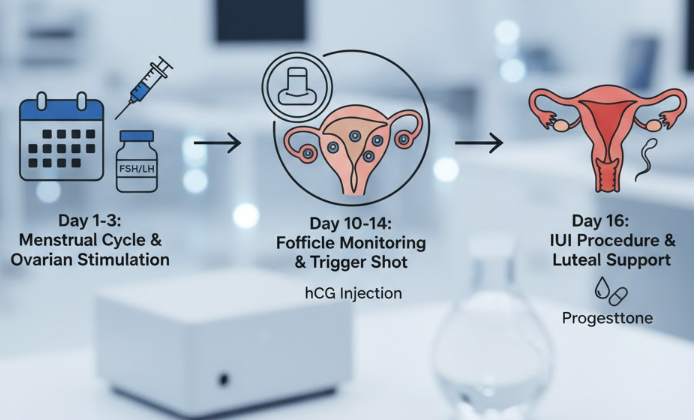
Treatment Overview
Intrauterine insemination (IUI) is a minimally invasive fertility procedure that involves placing processed, highly motile sperm directly into the uterine cavity around ovulation. In Korea, advanced IUI protocols combine precision medicine, innovative sperm selection technologies, and real-time hormonal and ultrasound monitoring to optimize fertilization chances.
Unlike conventional IUI, advanced Korean protocols integrate microfluidic sperm sorting, endometrial receptivity testing, and AI-based ovulation prediction to achieve higher pregnancy success rates with lower risks. Korean fertility specialists are globally recognized for their evidence-based, technologically advanced reproductive care and meticulous patient management.
Purpose & Benefits
The main purpose of advanced IUI is to enhance natural fertilization by ensuring that the best-quality sperm reach the egg at the optimal time.
Key benefits include:
- Improved fertilization rates in mild infertility cases.
- Minimally invasive and cost-effective compared to IVF.
- Reduced treatment time and faster recovery.
- Ability to repeat cycles safely for cumulative success.
- Enhanced sperm quality through advanced selection and washing.
- Precise timing supported by hormone tracking and imaging systems.
Ideal Candidates
Advanced IUI is suitable for individuals or couples facing mild reproductive challenges such as:
- Unexplained infertility after standard evaluation.
- Mild male-factor infertility with slightly reduced motility or count.
- Cervical factor infertility caused by poor mucus or sperm penetration issues.
- Mild endometriosis with open fallopian tubes.
- Couples or individuals using donor sperm.
- Women under 38–40 years with normal ovarian function.
For patients with severe male infertility, blocked fallopian tubes, or significant uterine abnormalities, IVF or ICSI may be a better option.
Possible Risks & Complications
While advanced IUI is generally safe, potential risks include:
- Mild cramping or spotting after the procedure.
- Infection (rare due to sterile techniques).
- Ovarian hyperstimulation in medicated cycles.
- Multiple pregnancies (when ovulation-stimulating drugs are used).
- Emotional stress related to cycle outcomes.
Korean clinics minimize these risks through precise medication control and close ultrasound and hormone monitoring throughout the cycle.
Techniques and Technology Used
Although IUI is not a surgical procedure, it requires high technical precision. Korean fertility centers employ some of the world’s most advanced technologies and laboratory techniques, such as:
- Microfluidic Sperm Sorting: A microchannel device that selects sperm with the best motility and DNA integrity.
- Density Gradient Centrifugation: Removes debris and immotile sperm to improve sample quality.
- MACS (Magnetic-Activated Cell Sorting): Used for eliminating apoptotic sperm in certain cases.
- Ultrasound-Guided Catheter Insertion: Ensures accurate placement of sperm in the uterus.
- Endometrial Receptivity Analysis (ERA): Determines the ideal implantation window for improved results.
- Personalized Ovulation Triggers: Use of hormonal monitoring and predictive AI systems to time insemination precisely.
These innovations have made Korea a leading destination for successful, minimally invasive fertility treatment.
Recovery & Aftercare
Recovery from IUI is simple and requires minimal downtime.
After the procedure:
- Patients typically rest for 10–20 minutes in the clinic.
- Normal activities can resume the same day, though heavy exercise or intercourse is usually avoided for 24–48 hours.
- Progesterone or hormonal support may be prescribed to strengthen the uterine lining.
- A pregnancy test is performed about two weeks later.
- Emotional support, nutritional guidance, and stress management are often part of the aftercare programs in Korean fertility centers.
Results & Longevity
Success rates for advanced IUI depend on age, ovarian function, and sperm quality.
- Per-cycle pregnancy rates range between 10–20% for women under 35.
- Cumulative pregnancy rates improve over 3–6 cycles.
- Once pregnancy occurs, outcomes are similar to those of natural conception.
- If conception doesn’t occur after several cycles, doctors typically recommend transitioning to IVF or ICSI.
Korean fertility programs focus on continuous data analysis, ensuring that each subsequent cycle benefits from lessons learned in prior ones.
Treatment Process in Korea
Korean fertility centers are known for a patient-centered, data-driven approach. The process generally includes:
1. Pre-Treatment Evaluation
Comprehensive tests such as hormone panels, ultrasound scans, genetic screening, and semen analysis.
2. Cycle Preparation & Ovarian Stimulation
Either a natural or mildly stimulated cycle is chosen. Monitoring is done via serial ultrasound and hormone tests to ensure precise follicular development.
3. Ovulation Trigger
An hCG or GnRH agonist trigger is administered once follicles reach optimal size, with insemination timed ~36 hours later.
4. Sperm Preparation
Advanced washing and selection techniques like microfluidic sorting or density gradients are used to concentrate motile sperm.
5. Insemination Procedure
A soft, flexible catheter delivers the sperm sample into the uterus under ultrasound guidance.
6. Post-Procedure Care
Rest, hormonal support, and close follow-up until pregnancy results are confirmed.
Why Korea is a Leading Destination for IUI
Korea has become a global hub for fertility care due to its combination of advanced technology, research innovation, and patient-centered protocols.
- Rapid integration of AI, precision medicine, and lab automation in fertility treatments.
- High medical standards with globally accredited centers and English-speaking fertility experts.
- Short waiting periods and cost-effective packages for international patients.
- Supportive medical tourism infrastructure and customized treatment programs.
Cost Range in Korea
The cost of IUI in Korea varies depending on complexity and technology used:
- Standard IUI: USD 500 – 1,000 per cycle.
- Advanced IUI with adjuncts: USD 1,500 – 3,000 + per cycle.
- Packages for multiple cycles are often available at discounted rates.
Additional charges may apply for diagnostic tests, medications, genetic screening, or special sperm preparation methods.
Popular Clinics for IUI in Korea
- CHA Fertility Center (Seoul) – A leader in advanced reproductive medicine and ART innovation.
- Asan Medical Center – Reproductive Medicine Department – Renowned for high-quality care and research-based fertility solutions.
- MizMedi Hospital (Seoul) – Offers complete women’s health and fertility services under one roof.
- Hamchoon Women’s Clinic – Known for advanced laboratory techniques and genetic diagnostics.
- Best of Me Fertility Clinic (Gangnam) – Specializes in tailored IUI and IVF programs for both domestic and international patients.


