
Treatment Overview
Assisted Sperm Banking in Korea is a highly specialized fertility preservation service designed to collect, process, and store sperm for future reproductive use. It combines advanced laboratory techniques, cryobiology, and fertility science to safeguard male fertility potential. This service is vital for men facing medical treatments that may affect fertility, couples undergoing assisted reproduction, and individuals planning for future parenthood.
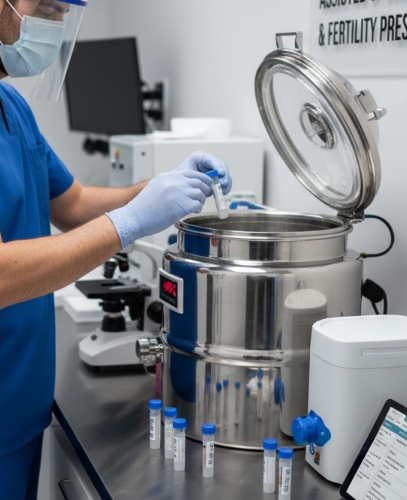
In assisted sperm banking, sperm samples are carefully collected and then processed to isolate the healthiest, most motile sperm before freezing. Advanced cryopreservation technologies—particularly vitrification and controlled-rate freezing—are used to maintain the structural and genetic integrity of sperm cells. The frozen samples are stored at ultra-low temperatures (−196°C) in cryogenic tanks equipped with continuous monitoring and redundant backup systems.
Korean fertility centers are world leaders in the precision, safety, and reliability of sperm cryopreservation. With state-of-the-art andrology laboratories, biobank-grade storage facilities, and expert embryologists, assisted sperm banking in Korea is performed to the highest global standards.
Purpose & Benefits
The primary goal of assisted sperm banking is to preserve male fertility by securing viable sperm for future use in assisted reproductive technologies such as IVF (In Vitro Fertilization), ICSI (Intracytoplasmic Sperm Injection), or IUI (Intrauterine Insemination). It is an important safeguard for individuals whose fertility might be compromised due to age, medical treatments, or other factors.
Key Benefits Include:
- Fertility Preservation Before Medical Treatment: Men undergoing chemotherapy, radiation therapy, or surgery can preserve sperm before procedures that may impair reproductive function.
- Reproductive Planning Flexibility: Couples can plan pregnancies at a later time, without time constraints.
- Safety for Donor Programs: Donor sperm is routinely banked to ensure safe use in regulated fertility programs.
- Backup for IVF or ICSI Cycles: Stored sperm provides security if a fresh sample cannot be collected on the day of egg retrieval.
- Reduced Emotional and Physical Pressure: Patients facing illness or infertility can focus on treatment knowing their sperm is preserved safely.
- Long-Term Viability: Cryopreserved sperm can remain viable for decades when properly maintained.
For many men, assisted sperm banking represents an invaluable option for protecting reproductive potential and family planning autonomy.
Ideal Candidates
Assisted sperm banking is suitable for a broad range of individuals and situations, including:
- Men undergoing cancer treatment or surgeries affecting reproductive organs.
- Individuals with progressive conditions that may impact fertility (e.g., autoimmune or hormonal disorders).
- Couples using assisted reproductive technologies requiring multiple sperm collections.
- Men with irregular sperm counts or low motility who wish to preserve good samples for later use.
- Military personnel or workers in high-risk environments.
- Donor sperm providers or individuals seeking to contribute to fertility programs.
- Couples delaying parenthood for career or personal reasons.
Korean clinics typically offer counseling to determine the best timing and procedure for sperm banking based on each patient’s medical background and fertility goals.
Laboratory & Clinical Process
The process of assisted sperm banking in Korea follows internationally standardized steps and is executed by certified andrologists and embryologists under sterile, tightly controlled conditions.
1. Pre-Procedure Evaluation
Patients undergo a consultation and semen analysis to assess sperm count, motility, and morphology. Medical and lifestyle factors are reviewed to optimize sample quality.
2. Sperm Collection
Sperm is usually collected through masturbation in a private, hygienic environment. In cases where natural ejaculation is not possible, testicular sperm extraction (TESE) or microsurgical sperm aspiration (MESA) may be used.
3. Sperm Processing
The sample is washed and processed using techniques like density gradient centrifugation or swim-up selection to isolate the most motile and morphologically normal sperm.
4. Cryoprotectant Application
Specialized cryoprotectant solutions are added to shield sperm from damage during freezing. These solutions prevent ice crystal formation and maintain membrane integrity.
5. Controlled Freezing (Vitrification or Slow Freezing)
The sperm is gradually cooled or vitrified in a matter of seconds to ultra-low temperatures, minimizing thermal stress.
6. Secure Cryostorage
Samples are stored in cryogenic tanks with continuous temperature monitoring, backup nitrogen supply, and automated alarm systems. Each sample is digitally labeled and cataloged under strict confidentiality and chain-of-custody protocols.
7. Thawing & Quality Testing
Before use, samples are thawed in a controlled environment. Sperm motility, viability, and DNA integrity are evaluated to confirm quality for reproductive use.
These steps ensure safety, consistency, and excellent post-thaw outcomes across Korean fertility centers.
Results & Longevity
Modern sperm cryopreservation techniques allow 90–95% of sperm cells to remain viable after thawing. Fertilization and pregnancy rates using frozen sperm are comparable to those achieved with fresh sperm, especially when used in IVF or ICSI procedures.
Stored sperm can remain viable for 10 to 20 years or longer if properly maintained in liquid nitrogen. Korean cryobanks perform regular safety audits, temperature calibration, and equipment maintenance to ensure stable, long-term preservation.
Possible Risks & Considerations
While assisted sperm banking is extremely safe, patients should be aware of a few minimal risks and limitations:
- Slight reduction in motility or viability after thawing.
- Limited success in cases of very low sperm count or severe morphology abnormalities.
- Cost of annual storage and maintenance.
- Emotional factors related to fertility preservation decisions.
Korean fertility clinics address these considerations with personalized care, counseling, and transparent communication about success rates and storage terms.
Aftercare & Patient Support
Following sperm banking, patients receive a detailed report of the analysis and freezing results. Regular consultations and optional repeat collections may be advised to maintain sufficient reserves. Clinics often provide:
- Fertility counseling for future planning.
- Lifestyle recommendations to enhance sperm quality.
- Secure documentation and renewal reminders for ongoing storage.
Leading Clinics in Korea
Korea’s fertility and reproductive medicine sector is known globally for its expertise and advanced technology. Leading institutions that specialize in assisted sperm banking and male fertility services include:
- CHA Fertility Center (Seoul and Bundang) – Renowned for comprehensive fertility programs, male infertility solutions, and long-term cryostorage systems.
- Hamchoon Women’s Clinic (Seoul) – Offers advanced andrology services and fertility preservation programs integrated with genetic testing.
- MizMedi Women’s Hospital (Seoul) – Provides full-spectrum reproductive care, including male fertility preservation and cryogenic biobanking.
- Seoul National University Hospital – Reproductive Medicine Department – A leading academic center with advanced laboratory infrastructure for sperm and embryo freezing.
- Gachon University Gil Medical Center (Incheon) – Known for clinical precision and multidisciplinary fertility care, including sperm cryopreservation.


