
Treatment Overview
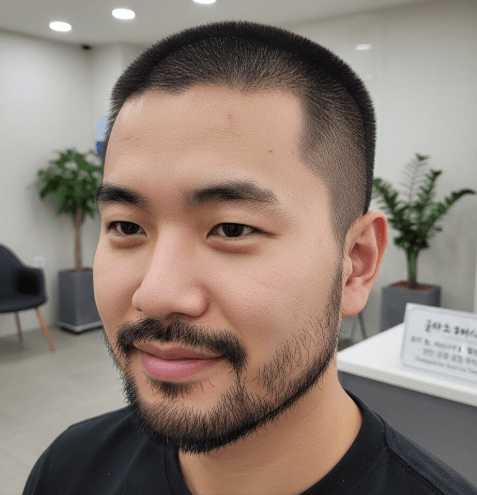
The Ultra-Short Hairstyle Compatible Beard Transplant is a specialized version of beard restoration designed for patients who maintain short hairstyles or shaved looks.
Using advanced FUE (Follicular Unit Extraction) or DHI (Direct Hair Implantation) with micro-punch tools (0.6–0.8 mm), Korean surgeons extract donor grafts from the scalp in a way that leaves no visible scarring, even with a buzz-cut or fade haircut.
The follicles are then precisely implanted into the beard region to create dense, natural coverage while keeping the donor area undetectable — ideal for men who want a neat, modern look without hiding their hairline or donor zone.
Purpose & Benefits
The purpose of this technique is to allow patients to grow a natural, full beard while maintaining an ultra-short hairstyle, ensuring aesthetic harmony and invisible donor extraction marks.
Key benefits include:
- No visible scarring even with buzzed or shaved donor areas
- Natural beard density and smooth jawline coverage
- Minimal downtime and fast healing
- Suitable for all beard styles (light stubble to full beard)
- Ideal for men who prefer modern, clean-cut looks
Ideal Candidates
This procedure is ideal for:
- Men who maintain short hairstyles or fade haircuts
- Individuals seeking a beard transplant with undetectable donor areas
- Those with patchy beard growth or sparse facial hair
- Men wanting full jawline coverage without long recovery
- Patients with good donor density on the sides or back of the head
Possible Risks & Complications
This beard transplant method is extremely safe when performed by experienced Korean surgeons.
Temporary side effects may include:
- Mild swelling or redness in the donor or recipient area
- Slight tenderness for 1–2 days
- Tiny scabs that heal naturally within a week
Korean clinics reduce these effects with PRP therapy, laser-assisted healing, and cooling therapy immediately post-procedure.
Techniques & Technology Used
Korea’s Ultra-Short Compatible Beard Transplant uses cutting-edge tools and advanced aesthetic design techniques to ensure both donor invisibility and natural beard density.
Key technologies include:
- Micromotor FUE Extraction (0.6–0.8 mm) for near-invisible donor marks
- Choi Implanter Pens (DHI) for precise follicle direction and depth control
- 3D Facial Design Software for balanced beard density mapping
- PRP (Platelet-Rich Plasma) Therapy for enhanced graft healing and growth
- Low-Level Laser Therapy (LLLT) for scalp and beard rejuvenation
This advanced combination ensures natural hair direction, no visible scars, and a smooth, even beard texture.
Treatment Process in Korea
Step 1 – Consultation & Design:
The surgeon performs a 3D digital facial scan to design the beard outline and assess donor zones suitable for buzz-cut coverage.
Step 2 – Donor Hair Extraction:
Using micro FUE punches, hair follicles are gently extracted from the back or sides of the scalp under local anesthesia — leaving no visible linear marks.
Step 3 – Implantation:
Each graft is implanted into the beard area using DHI implanter pens for precise control of direction, angle, and density.
Step 4 – Regenerative Therapy:
PRP or growth-factor serum is applied to strengthen graft survival and accelerate recovery.
The procedure typically lasts 4–6 hours, depending on graft quantity (1,500–3,000 grafts for full coverage).
Recovery & After-Care
Recovery is quick and compatible with daily routines. Most patients resume work or normal activities within 1–2 days.
After-care guidelines:
- Avoid washing or touching the beard area for 48 hours
- Use a mild cleanser after 3 days
- Avoid shaving or trimming for 2 weeks
- Keep both donor and beard areas clean and moisturized
- Avoid heat, sweating, and direct sunlight for 7 days
By 5–7 days, redness fades completely, and donor extraction marks are invisible even with a buzzed head.
Results & Longevity
New beard growth starts around 2–3 months, with full results visible by 9–12 months.
Because transplanted follicles are permanent and resistant to hair loss, the results are lifelong.
Hair grows naturally, allowing for trimming, styling, or shaping just like a regular beard.
Korean clinics achieve high success rates with natural direction, density, and texture matching.
Why Korea Is a Top Destination
Korea leads the world in aesthetic micro-surgical precision and scar-minimized hair restoration, making it the go-to destination for buzz-cut-compatible procedures.
Why patients choose Korea:
- World-class surgeons skilled in micro-FUE and DHI
- High graft survival and invisible donor healing
- Natural, masculine beard designs
- Advanced regenerative after-care (PRP, laser, stem-cell)
- Affordable, luxury-level treatment for international clients
Cost Range
The cost of Ultra-Short Hairstyle Compatible Beard Transplant in Korea typically ranges from USD 3,000 – 6,000, depending on:
- Number of grafts required
- Surgeon expertise and clinic reputation
- Inclusion of PRP or regenerative therapy
Popular Clinics in Korea
- ID Hospital – Specialists in buzz-cut compatible FUE and natural beard design
- Banobagi Plastic Surgery Clinic – Experts in invisible-donor beard and sideburn restoration
- Forhair Korea – Known for micro-FUE and DHI beard transplants with no visible scars
- Moohan Clinic – Focuses on short-hair-friendly and natural facial hair restoration


