
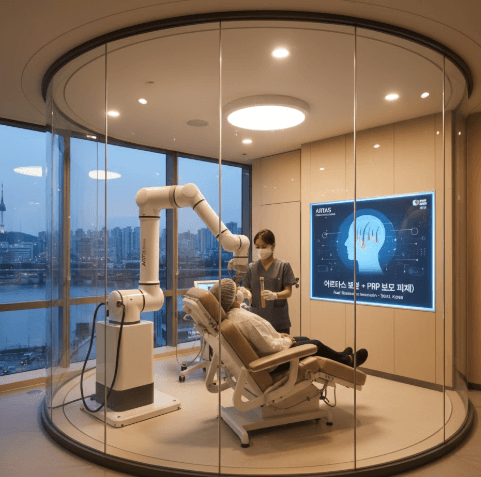
Treatment Overview
The ARTAS Robotic + PRP Adjunct Package combines two of the most advanced technologies in modern hair restoration — robotic follicular extraction and natural growth stimulation.
The ARTAS robotic system provides unmatched precision in harvesting and implanting hair follicles, while PRP (Platelet-Rich Plasma) therapy uses the patient’s own blood plasma, rich in growth factors, to promote faster healing and stronger hair regrowth.
In Korea, this powerful combination is offered as a premium package for patients seeking faster recovery, enhanced results, and long-term follicle vitality.
Purpose & Benefits
The purpose of this treatment package is to maximize graft survival, accelerate recovery, and enhance hair density after robotic transplantation.
Key benefits include:
- Increased graft survival rate and stronger follicle growth.
- Faster healing of both donor and recipient sites.
- Thicker, healthier, and more vibrant hair post-surgery.
- Reduced inflammation and improved scalp circulation.
- Long-term strengthening of existing hair follicles.
- Perfect synergy of advanced robotics and regenerative medicine.
Ideal Candidates
You may be an excellent candidate for the ARTAS + PRP package if you:
- Are undergoing an ARTAS robotic hair transplant.
- Want improved healing and faster recovery time.
- Have weak or thinning hair and want to strengthen existing follicles.
- Prefer a natural, non-synthetic boost to support regrowth.
- Are looking for maximum density and long-lasting results.
- Want a high-quality, all-in-one hair restoration experience in Korea.
Possible Risks & Complications
This combination is extremely safe since PRP is derived from your own blood, but minor side effects can include:
- Mild swelling or redness after PRP injections.
- Temporary scalp tenderness.
- Minor bruising at the injection site.
- Rare risk of infection if after-care is not followed.
- Slight discomfort during blood draw or injection (local anesthetic minimizes this).
Techniques & Technology Used
- ARTAS Robotic FUE: Uses AI and a robotic arm to identify and harvest individual follicular units with high precision, avoiding human error.
- PRP (Platelet-Rich Plasma) Therapy: A small blood sample is processed in a centrifuge to extract plasma enriched with growth factors, which is then injected into the scalp.
- Combined Approach: PRP is applied immediately after transplantation to improve graft anchoring, healing, and blood supply.
- Enhanced Graft Survival: PRP helps transplanted follicles integrate faster and grow stronger.
- Optional Maintenance: Additional PRP sessions every few months can further boost long-term results.
Treatment Process in Korea
- Consultation: Assessment of hair loss pattern, donor area, and suitability for the combined ARTAS + PRP treatment.
- Preparation: Local anesthesia applied; ARTAS robot maps and prepares donor extraction zones.
- Robotic Extraction: ARTAS system harvests follicles using digital mapping and AI precision.
- Implantation: Surgeon and team implant follicles into the thinning areas according to natural density and angle.
- PRP Therapy: After implantation, PRP is injected across donor and recipient areas to stimulate healing and support new growth.
- After-Care: Cooling therapy, gentle washing instructions, and medications are provided.
- Follow-Up: Additional PRP booster sessions may be recommended 2–3 months after surgery for optimal results.
Recovery & After-Care
- Mild swelling or tightness for 2–3 days post-procedure.
- Avoid washing or touching scalp for 48 hours.
- Gentle shampooing can begin after day 3 as instructed.
- Avoid strenuous activities, alcohol, or direct sunlight for a week.
- PRP reduces typical post-surgery inflammation and promotes faster healing.
- Noticeable improvements in growth and scalp health appear within 3–6 months.
Results & Longevity
- Early regrowth visible at 3–4 months after treatment.
- Full density and thickness achieved by 9–12 months.
- PRP significantly enhances follicle vitality, leading to thicker and healthier hair.
- Permanent results from transplanted hair combined with improved growth of existing follicles.
- Optional PRP maintenance every 6–12 months helps sustain long-term results.
Why Korea Is a Top Destination
- Korea leads in integrating robotics and regenerative medicine for hair restoration.
- Highly trained surgeons with experience in ARTAS and PRP combination therapy.
- World-class clinics equipped with AI technology and advanced centrifuge systems.
- Comprehensive packages for international patients, including translation and accommodation.
- Affordable costs compared to Western clinics with superior aesthetic results.
- Proven track record of success for both male and female hair restoration patients.
Cost Range
The ARTAS Robotic + PRP Adjunct Package in Korea typically includes both robotic transplantation and PRP sessions:
- Standard ARTAS + PRP package: ₩8,000,000 – ₩10,000,000 (≈ USD 6,400 – 8,000)
- High-density ARTAS + multiple PRP sessions: ₩10,000,000 – ₩13,000,000 (≈ USD 8,000 – 10,800)
- VIP ARTAS + PRP luxury package (accommodation & extended after-care): ₩13,000,000 – ₩16,000,000 (≈ USD 10,800 – 13,200)
Packages for overseas clients include consultation, anesthesia, procedure, PRP session(s), medications, translator, and follow-up support.
Popular Clinics in Korea
- Dream Hairline Clinic (Seoul): Expert in robotic FUE combined with PRP regenerative therapy.
- Moaman Hair Transplant Clinic (Seoul): Offers ARTAS + PRP combo packages for improved recovery and density.
- Seojin Plastic Surgery Clinic (Gangnam): Provides luxury ARTAS packages with PRP and long-term follow-up care.


