
Treatment Overview
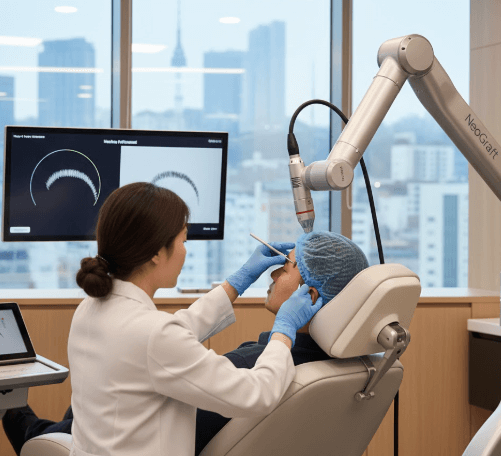
The NeoGraft Mega-Session Robotic Hair Transplant is designed for patients who require extensive hair restoration across multiple zones such as the hairline, crown, and mid-scalp. This state-of-the-art procedure uses the NeoGraft semi-automated FUE (Follicular Unit Extraction) system, which employs pneumatic suction to gently extract and implant large volumes of hair follicles with minimal trauma.
In Korea, clinics offer Mega-Session packages that focus on high-density coverage in a single sitting, blending advanced technology with exceptional surgical skill to produce natural, long-lasting results.
Purpose & Benefits
The purpose of the Mega-Session NeoGraft procedure is to restore extensive hair loss areas efficiently and naturally, using thousands of grafts in one procedure.
Key benefits include:
- Capability to transplant 3,000 to 5,000 + grafts in one session.
- No linear scar — ideal for short hairstyles.
- Shorter treatment time compared to manual FUE methods.
- Greater density and coverage achievable within a single visit.
- Fast recovery with minimal pain or discomfort.
- Excellent option for overseas patients wanting a comprehensive, one-time restoration.
Ideal Candidates
You may be an ideal candidate for the NeoGraft Mega-Session if you:
- Have moderate to severe hair loss and want maximum coverage.
- Possess a healthy, dense donor area at the back or sides of the scalp.
- Prefer a scar-free, minimally invasive procedure.
- Are in good health and can tolerate a longer procedure duration.
- Want a dramatic yet natural transformation in one visit.
- Are traveling to Korea for world-class medical tourism and hair restoration.
Possible Risks & Complications
While NeoGraft is a highly refined procedure, large-area transplants carry some risks:
- Temporary swelling or redness in donor and recipient areas.
- Mild pain or tightness in the first few days.
- Fatigue from long procedure times (usually 6–10 hours).
- “Shock loss” of some transplanted hairs during early recovery.
- Minor uneven density if donor hair is overused.
- Rare infection if post-care is ignored.
Techniques & Technology Used
- NeoGraft Robotic FUE System: Utilizes pneumatic pressure to gently harvest and implant follicles without cutting or stitches.
- High-Capacity Automation: Allows extraction and implantation of thousands of grafts efficiently.
- Dense Packing Design: Strategic placement for maximum coverage and natural flow.
- PRP Therapy Enhancement: Often included to improve healing and graft survival.
- Laser After-Care or LED Therapy: Accelerates healing and stimulates growth.
- Non-Shaven Options: For patients wanting a discreet approach.
Treatment Process in Korea
- Consultation & Planning: Comprehensive scalp analysis and design of target zones with 3D imaging and graft mapping.
- Preparation: Local anesthesia administered; donor area is trimmed and cleaned.
- Extraction: NeoGraft robotic handpiece harvests thousands of follicular units with precision and minimal trauma.
- Implantation: Harvested follicles are implanted at specific angles and density patterns for a natural look.
- Post-Procedure Care: Cooling therapy and medications are provided for comfort and healing.
- Recovery Period: Patients usually stay in Korea for 3–5 days for follow-up and after-care supervision.
Recovery & After-Care
- Mild soreness and tightness for 2–3 days.
- Avoid touching or washing the scalp for 48–72 hours.
- Gentle washing starts after day 3 using clinic-approved products.
- Avoid heavy exercise, alcohol, and direct sunlight for a week.
- Initial shedding occurs within 2–4 weeks — normal for transplanted hairs.
- New growth visible by 3–4 months, with full results at 9–12 months.
- Long-term maintenance through PRP or medications is recommended.
Results & Longevity
- Early growth appears within 3–6 months.
- Full density and coverage achieved by 9–12 months.
- Transplanted hair is permanent and grows naturally.
- Results remain long-lasting with proper care and scalp health maintenance.
- Korean surgeons focus on balanced density and natural aesthetics for the most lifelike results.
Why Korea Is a Top Destination
- Korea is a global leader in robotic FUE technology and large-graft hair transplants.
- Expert surgeons specialize in Mega-Sessions for international patients.
- Clinics offer multilingual support, VIP packages, and luxury medical tourism services.
- Costs are lower than in Western countries while maintaining superior results.
- Comprehensive after-care and follow-up make the entire journey stress-free and effective.
Cost Range
The cost of a NeoGraft Mega-Session Robotic Hair Transplant in Korea depends on graft count and service level:
- Large Session (3,000–4,000 grafts): ₩8,000,000 – ₩10,000,000 (≈ USD 6,400 – 8,000)
- Mega Session (4,000–5,000 + grafts): ₩10,000,000 – ₩13,000,000 (≈ USD 8,000 – 10,800)
- VIP Mega Session (Full coverage + PRP + accommodation): ₩13,000,000 – ₩16,000,000 (≈ USD 10,800 – 13,200)
All packages typically include consultation, anesthesia, procedure, medications, translator service, and follow-up care.
Popular Clinics in Korea
- Dream Hairline Clinic (Seoul): Specializes in NeoGraft Mega-Sessions with high graft counts and natural results.
- Moaman Hair Transplant Clinic (Seoul): Offers large-area NeoGraft restoration and international patient packages.
- Woomchan Hair Transplant Clinic (Gangnam): Renowned for advanced robotic FUE and high-density restoration for medical tourists.


