
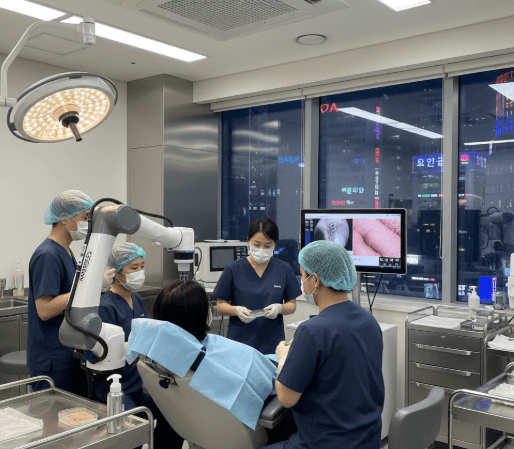
Treatment Overview
The Large-Graft NeoGraft Hair Transplant is an advanced robotic-assisted hair restoration technique designed to move a high number of grafts in one session. Using the NeoGraft system — a semi-automated Follicular Unit Extraction (FUE) technology — Korean surgeons can perform large-scale hair transplants with precision, consistency, and minimal trauma.
This approach is ideal for patients seeking full coverage of the scalp, high-density results, and faster recovery compared to traditional manual hair transplant methods.
Purpose & Benefits
The purpose of a large-graft NeoGraft procedure is to restore thick, natural-looking hair to areas of significant hair loss while minimizing visible scarring and downtime.
Key benefits include:
- Capable of transplanting thousands of grafts in a single session.
- No linear scar or stitches — suitable for short hairstyles.
- Automated pneumatic suction for gentle follicle extraction and higher graft survival.
- Fast recovery and minimal discomfort.
- Natural results due to precise graft handling and placement.
- Korea’s top clinics offer advanced technology, experienced surgeons, and seamless service for international patients.
Ideal Candidates
You may be an ideal candidate for the Large-Graft NeoGraft Hair Transplant if you:
- Have moderate to severe hair loss and desire full restoration.
- Have a healthy donor area with sufficient hair for large graft sessions.
- Are looking for a minimally invasive, no-scalpel, and no-stitch procedure.
- Want a faster recovery and less visible post-surgery marks.
- Are ready to travel to Korea for high-quality, affordable medical care.
- Have realistic expectations and can commit to post-operative care.
Possible Risks & Complications
Even though the NeoGraft system reduces many traditional risks, some complications can still occur:
- Temporary redness, swelling, or soreness in donor and recipient areas.
- Shedding of transplanted hair within the first few weeks (“shock loss”).
- Minor scarring or uneven density if not properly planned.
- Infection or inflammation if after-care instructions are not followed.
- Fatigue due to longer procedure time for large graft counts.
- Over-harvesting if donor areas are pushed beyond their safe limits.
Techniques & Technology Used
- FUE-Based Robotic Extraction: NeoGraft automates the extraction of individual follicular units using pneumatic suction for minimal damage.
- High Graft Volume Efficiency: Allows large numbers of grafts to be harvested and implanted in one sitting.
- Precision Implantation: Each follicle is implanted at the correct angle, depth, and density for a natural pattern.
- Adjunct Therapies: Many Korean clinics combine NeoGraft with PRP (Platelet-Rich Plasma) or LED healing treatments to promote graft survival.
- Non-Shaven Options: Available for patients who prefer not to shave the entire donor area.
Treatment Process in Korea
- Pre-Consultation: Online photo submission or video consultation to assess suitability and plan graft count.
- Arrival & Evaluation: In-clinic consultation, scalp analysis, and design of the new hairline and coverage area.
- Preparation: Local anesthesia is applied; donor area trimmed and cleaned.
- Extraction: The NeoGraft device gently removes follicular units using pneumatic pressure.
- Implantation: Grafts are sorted and carefully implanted into thinning areas for dense, natural results.
- Post-Treatment Care: Medication and after-care guidance provided; patients usually stay in Korea for 3–5 days for monitoring.
- Follow-Up: Online or video follow-ups ensure smooth recovery and ongoing growth assessment.
Recovery & After-Care
- Mild redness or tightness may occur for the first 2–3 days.
- Avoid touching or scratching the treated area.
- Gentle shampooing can begin after day 4 as advised by your surgeon.
- Avoid direct sunlight, sweating, and swimming for two weeks.
- Transplanted hair may shed temporarily within the first month.
- Noticeable new hair growth appears between 3–6 months.
- Full, natural density is typically achieved within 9–12 months.
Results & Longevity
- Initial Growth: Around 3–4 months post-procedure.
- Full Density: Typically visible after 9–12 months.
- Permanent Results: Transplanted follicles are resistant to balding and last for years.
- Maintenance: Additional treatments or medications may be recommended to preserve surrounding hair.
- Aesthetic Outcome: Korean surgeons are known for creating natural-looking, well-distributed density, even in large graft sessions.
Why Korea Is a Top Destination
- Korea is globally recognized for cutting-edge robotic hair transplant systems and expert surgeons.
- Clinics specialize in large-scale FUE and robotic extraction, offering smooth procedures for international clients.
- High patient satisfaction rates and transparent package pricing.
- Comprehensive medical tourism services including translation, transportation, and accommodation support.
- Competitive cost compared to Western countries, with equal or superior quality results.
- Experienced teams familiar with diverse hair types and aesthetic goals.
Cost Range
The cost of a Large-Graft NeoGraft Hair Transplant (Robotic Extraction) in Korea depends on graft volume and clinic reputation:
- Moderate sessions (2,000–3,000 grafts): ₩5,000,000 – ₩7,000,000 (≈ USD 4,100 – 5,800)
- Large sessions (3,000–4,000 grafts): ₩7,000,000 – ₩9,000,000 (≈ USD 5,800 – 7,500)
- Mega sessions (4,000+ grafts): ₩9,000,000 – ₩12,000,000 (≈ USD 7,500 – 10,000)
Packages often include consultation, anesthesia, medications, follow-up visits, and partial accommodation support for overseas patients.
Popular Clinics in Korea
- Dream Hairline Clinic (Seoul): Known for advanced FUE and robotic hair transplant systems.
- Moaman Hair Transplant Clinic (Seoul): Offers large-graft NeoGraft and PRP combination procedures.
- Woomchan Hair Transplant Clinic (Gangnam): Specializes in high-volume, natural-looking FUE procedures for international clients.


