
Treatment Overview
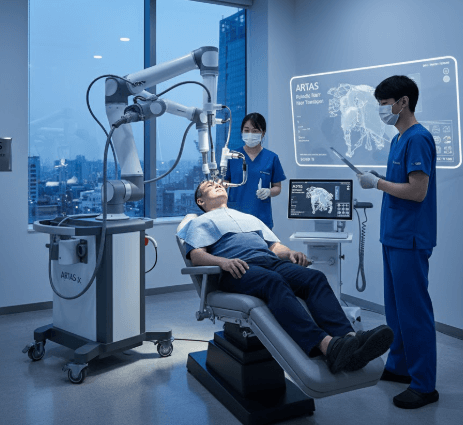
The ARTAS Robotic Hair Transplant is a cutting-edge, AI-assisted procedure that has revolutionized hair restoration. This advanced robotic system performs the delicate steps of Follicular Unit Extraction (FUE) with unmatched accuracy. It identifies, extracts, and implants healthy hair follicles with precision while minimizing damage and downtime.
In Korea, the Standard Package for ARTAS Robotic Hair Transplant typically includes a pre-treatment consultation, robotic harvesting of donor follicles, expert implantation by a trained surgical team, post-operative care, and follow-up appointments.
Purpose & Benefits
The purpose of this treatment is to restore natural hair density and improve confidence for individuals experiencing hair loss or thinning.
Key benefits include:
- Minimally invasive procedure with no linear scar.
- Robotic precision ensures uniform graft extraction and placement.
- Reduced risk of human error and faster recovery.
- Natural-looking hairline design tailored to your facial structure.
- Enhanced accuracy, consistency, and efficiency compared to manual FUE.
- Safe and comfortable treatment ideal for international patients visiting Korea.
Ideal Candidates
You may be a good candidate for the ARTAS Robotic Hair Transplant if you:
- Have pattern baldness or thinning hair with a healthy donor area.
- Desire a natural result without visible scarring.
- Are in good health and able to follow after-care instructions.
- Want an advanced, technology-based solution for permanent hair restoration.
- Prefer traveling to Korea for high-quality yet affordable medical treatment.
Possible Risks & Complications
While this is one of the safest modern hair transplant options, a few minor risks can occur:
- Temporary redness or swelling of the scalp.
- Slight bleeding or discomfort in donor and recipient areas.
- Shedding of transplanted hair (normal “shock loss”).
- Mild scarring or uneven density if after-care isn’t followed.
- Additional travel time for follow-up if you are an overseas patient.
Techniques & Technology Used
- The ARTAS system uses advanced imaging and artificial intelligence to select and harvest optimal follicular units.
- The robotic arm extracts follicles individually (FUE) without the need for scalp incisions.
- The system calculates the exact angle, direction, and depth for precise graft placement.
- Korean clinics often enhance results with PRP (Platelet-Rich Plasma) or laser scalp therapy to stimulate healing and growth.
Treatment Process in Korea
- Consultation: You submit photos or visit the clinic for an initial assessment and customized hairline design.
- Preparation: The scalp is trimmed and cleansed; local anesthesia is applied.
- Robotic Extraction: The ARTAS robot harvests healthy hair follicles from the donor area with AI precision.
- Graft Implantation: The surgeon and team implant the grafts into the thinning or bald areas.
- Post-Treatment Care: Medications, scalp cleansing, and follow-up instructions are provided.
- Recovery: Patients usually remain in Korea for several days to allow for initial healing and monitoring.
Recovery & After-Care
- Expect mild swelling and tightness for 1–3 days.
- Avoid touching or washing the scalp for the first few days.
- Gentle washing starts around day 4–5 following clinic instructions.
- Avoid strenuous activity, direct sunlight, and alcohol for at least a week.
- New hair begins growing after 3–4 months, with full results visible by 9–12 months.
- Maintain scalp hygiene and follow your clinic’s recommended care routine.
Results & Longevity
- Early hair growth begins around 3–6 months after the procedure.
- Full, natural-looking results are usually visible after 12 months.
- The transplanted hair is permanent since it’s taken from genetically stable donor zones.
- Long-term results depend on hair care, general health, and managing future hair loss.
Why Korea Is a Top Destination
Korea is one of the world’s leading destinations for robotic hair transplants due to its advanced technology, experienced specialists, and excellent patient care. Clinics in Seoul offer:
- Expert surgeons trained in robotic FUE procedures.
- Competitive prices compared to Western countries.
- Multilingual staff and complete medical tourism support.
- High graft survival rates and natural aesthetic results.
- Safe, comfortable facilities equipped with the latest ARTAS technology.
Cost Range
The cost of the ARTAS Robotic Hair Transplant (Standard Package) in Korea varies depending on graft count and clinic reputation:
- Hairline restoration: ₩5,000,000 – ₩7,000,000 (≈ USD 4,100 – 5,800)
- Frontal and crown coverage: ₩7,000,000 – ₩10,000,000 (≈ USD 5,800 – 8,300)
- Full coverage or high graft sessions: ₩10,000,000 – ₩13,000,000 (≈ USD 8,300 – 10,800)
Most international packages also include consultation, anesthesia, post-care medications, and basic accommodation assistance.
Popular Clinics in Korea
- Dream Hairline Clinic (Seoul): Specializes in ARTAS robotic transplants and non-shaven procedures.
- Seojin Plastic Surgery Clinic (Gangnam): Offers large-scale FUE and PRP combination treatments.
- Moaman Hair Transplant Clinic: Recognized for high success rates and expertise with robotic FUE.


