
Treatment Overview
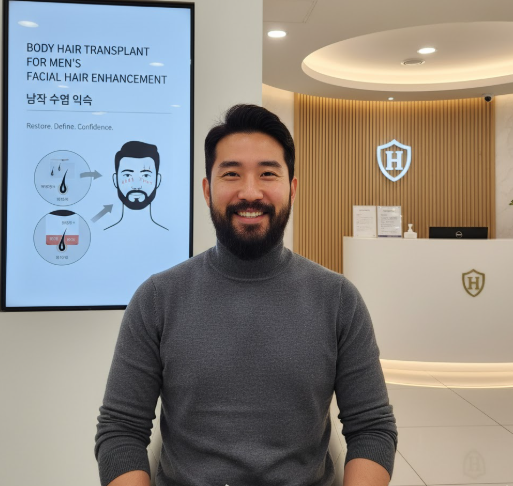
The Body Hair Transplant for Men’s Facial Hair Enhancement is a specialized micro-FUE procedure that uses body donor hair—such as chest, beard-to-beard redistribution, leg, arm, and torso hair—to enhance or reconstruct facial hair regions including the beard, mustache, sideburns, jawline, and cheeks.
This method is ideal for men who want stronger, fuller, and more defined facial hair growth, especially when natural beard density is low or traditional scalp donor hair does not match facial texture properly.
Korean surgeons are globally known for their precision in facial hair design, natural angulation, and density control.
Purpose & Benefits
This procedure focuses on creating masculine facial features with natural, textured growth.
Key benefits include:
- Creates fuller beard, mustache, and jawline density.
- Ideal for patchy or uneven beard growth.
- Chest and beard grafts match facial hair thickness and strength.
- Leg/arm grafts can be used for softer blending in cheek or sideburn zones.
- Permanent hair growth that can be shaved, trimmed, or styled.
- Great for cosmetic enhancement or reconstructing hair after injury/trauma.
Ideal Candidates
You may be a strong candidate if you:
- Have naturally sparse or patchy beard growth.
- Want a fuller beard, goatee, mustache, or defined jawline.
- Have limited scalp donor hair and need body donors instead.
- Prefer coarse, thick grafts for masculine hair patterns.
- Suffered facial hair loss due to scarring, burns, or prior surgery.
- Want long-term, permanent facial hair enhancement.
Possible Risks & Complications
Body hair to facial transplant is safe but may include:
- Mild redness or small scabs on recipient facial areas.
- Slight discomfort while shaving for a few days.
- Temporary swelling in beard/mustache zones.
- Rare ingrown hairs in chest or leg donor sites.
- Slight texture variation depending on donor area.
Techniques & Technology Used
- Micro-FUE Extraction: Ultra-fine 0.6–0.9 mm punches for minimal donor marks.
- Texture-Matched Donor Selection:
- Chest/beard → thick, coarse grafts for strong beard definition
- Arms/legs → softer grafts for cheek blending
- Angle-Controlled Implantation: Mimics natural beard direction and pattern.
- Density Layering: High density at the jawline/chin, softer blending at cheek zones.
- Facial Hair Blueprint Design: Personalized beard shape and symmetry planning.
- Optional PRP Therapy: Improves early growth and graft survival.
Treatment Process in Korea
- Consultation & Facial Design: Surgeon maps out beard shape, density zones, and angles.
- Body Donor Selection: Chest, beard, leg, or arm hair chosen for best match.
- Micro-FUE Extraction: Fine grafts harvested with minimal trauma.
- Graft Sorting: Categorized by thickness, curl, and placement suitability.
- Implantation Phase:
- Coarse grafts → jawline, goatee, chin, mustache
- Fine grafts → cheeks, sideburns, upper face
- After-Care Explanation: Tailored instructions for facial skin and donor areas.
Recovery & After-Care
- Redness reduces within 2–4 days.
- Tiny facial scabs fall off in 3–5 days.
- Avoid shaving for 7–10 days.
- Donor sites (chest/arms/legs) heal in 2–5 days.
- Normal shedding of transplanted hairs: 2–6 weeks.
- Early growth: 3–4 months.
- Full beard/mustache result: 8–12 months.
Results & Longevity
- Strong, masculine beard density.
- Permanent facial hair that grows naturally and can be styled freely.
- High coverage for patchy or uneven beard patterns.
- Natural texture blending using body donor grafts.
- Ideal for men wanting a sharper, fuller facial aesthetic.
Why Korea Is a Top Destination
- Korea leads in precision beard and facial hair restoration.
- Surgeons excel in fine angulation control for realistic facial hair direction.
- Clinics offer natural, masculine facial hair designs tailored to each patient.
- Ultra-fine donor extraction ensures minimal scarring on the body.
- Affordable compared to Western beard transplant clinics.
- Highly popular among international men seeking stronger beard aesthetics.
Cost Range
Pricing varies based on graft count and donor area selection:
- Small enhancement (200–400 grafts): ₩1,800,000 – ₩3,000,000
- Medium beard/cheek shaping (400–800 grafts): ₩3,000,000 – ₩5,500,000
- Full beard reconstruction (800–1,800+ grafts): ₩5,500,000 – ₩9,000,000
Includes consultation, extraction, implantation, anesthesia, medication, and follow-up.


