
Treatment Overview
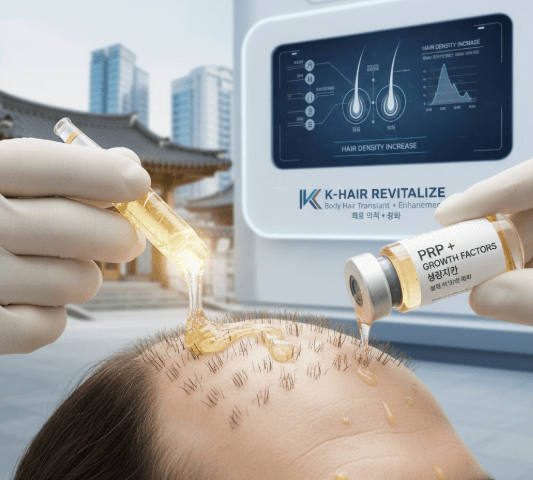
The Body Hair Transplant + PRP / Growth Factor Adjunct is an advanced restoration approach that combines body donor grafts with regenerative treatments such as PRP (Platelet-Rich Plasma) or Growth Factor therapy.
This dual-method boosts graft survival, accelerates healing, and enhances overall density for patients needing additional donor sources from the beard, chest, arms, legs, abdomen, or torso.
Korean clinics are pioneers in pairing BHT with regenerative treatments to achieve the highest possible success and natural appearance.
Purpose & Benefits
This combined treatment is designed to improve both graft performance and healing quality.
Key benefits include:
- Increases graft survival rate after body hair transplantation.
- Accelerates recovery of both donor and recipient areas.
- Strengthens transplanted follicles for improved long-term growth.
- Enhances density and fullness, especially in large BHT cases.
- Reduces inflammation and shock loss after the procedure.
- Improves hair thickness and growth speed during the early months.
Ideal Candidates
You may be a suitable candidate if you:
- Have limited scalp donor hair and require body grafts for restoration.
- Want improved results with enhanced graft survival.
- Need better density or growth speed after previous procedures.
- Are undergoing large-session BHT and want regenerative support.
- Prefer the most advanced, medically supported approach to BHT.
- Experience slow growth or poor graft retention from earlier transplants.
Possible Risks & Complications
This combined procedure is safe, but temporary effects may include:
- Mild swelling or redness after PRP injections.
- Light sensitivity at donor areas (normal for BHT).
- Slight bruising at PRP injection points.
- Temporary dryness or tightness on the scalp.
- Rare allergic reactions to growth factors (extremely uncommon).
Techniques & Technology Used
- Micro-FUE Body Hair Extraction: Fine punches (0.6–1.0 mm) harvest beard, chest, leg, or arm hair.
- PRP Therapy: Platelets from the patient’s own blood injected to stimulate growth and healing.
- Growth Factor Boosters: Bio-active serums enhance follicle viability.
- Dual-Zone Integration:
- Beard grafts → density areas (crown, mid-scalp)
- Body grafts → blend zones
- Scalp grafts → frontal and hairline regions
- Implantation at Low Trauma: Ensures follicles and surrounding tissues respond well to PRP.
Treatment Process in Korea
- Consultation & Donor Assessment — Analysis of beard, scalp, and body donor areas.
- Blood Draw for PRP — Blood processed to isolate growth-rich plasma.
- Micro-Shave or No-Shave Prep (Optional) — Depending on patient preference.
- Body Hair Extraction — FUE taken from beard, chest, legs, or arms.
- Graft Sorting & Hydration — PRP-infused solution used to store grafts.
- Scalp Implantation — Follicles placed in zones requiring density or rebuilding.
- PRP / Growth Factor Injection — Applied over grafted regions to optimize survival.
- After-Care Program — Healing serums, growth tonics, and follow-up monitoring.
Recovery & After-Care
- PRP reduces redness and speeds healing within 1–3 days.
- Body donor zones heal in 2–5 days depending on the area.
- Scalp scabbing typically resolves within 3–7 days.
- Avoid strenuous activity for one week.
- Transplanted grafts shed in 2–6 weeks (normal shedding phase).
- New growth appears around 3–4 months.
- Enhanced fullness observed at 6 months.
- Final results visible at 10–14 months with improved density.
Results & Longevity
- Improved density thanks to PRP-supported growth cycles.
- Enhanced graft survival and stronger follicle health.
- Soft, natural blending with multi-donor integration.
- Long-lasting results due to combined regenerative therapy.
- Excellent option for large BHT or repair cases.
Why Korea Is a Top Destination
- Korea excels in BHT + regenerative medicine combination therapy.
- Surgeons use PRP not only during implantation but in graft storage for added vitality.
- Clinics offer world-class micro-FUE tools and growth-boosting protocols.
- Experience with large BHT sessions and multi-donor blending.
- Affordable compared to Western regenerative hair treatment packages.
- Trusted by international patients seeking faster, stronger results.
Cost Range
Costs for Body Hair Transplant + PRP / Growth Factor Adjunct in Korea vary by graft count and PRP sessions:
- Small BHT + PRP (300–700 grafts): ₩3,000,000 – ₩5,500,000
- Medium BHT + PRP (700–1,500 grafts): ₩5,500,000 – ₩8,500,000
- Large BHT + PRP/GF (1,500–3,000+ grafts): ₩8,500,000 – ₩14,000,000
Includes consultation, extraction, implantation, regenerative therapy, anesthesia, medication, and follow-ups.
Popular Clinics in Korea
- Dream Hairline Clinic (Seoul): Known for PRP-supported high-yield BHT sessions.
- Moaman Hair Transplant Clinic (Seoul): Experts in growth-factor enhanced restoration.
- Woomchan Hair Transplant Clinic (Gangnam): Skilled in large-scale BHT with regenerative additions.


