
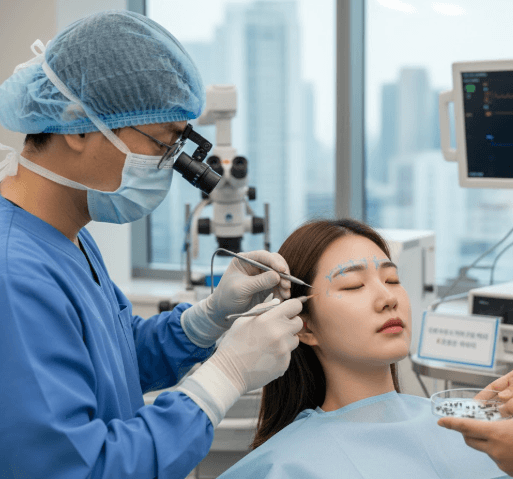
Treatment Overview
The Body Hair to Eyebrow Transplant is a specialized procedure where fine hairs from the body—typically the legs, arms, torso edge, or nape—are used as donor grafts to restore or enhance eyebrow density.
This method is ideal for patients who lack suitable donor hair in the scalp or who need ultra-fine hair that closely matches natural brow texture. Korean clinics are highly experienced in using body hair for eyebrow reconstruction thanks to their advanced micro-FUE precision and refinement techniques.
Purpose & Benefits
This procedure is designed to provide natural, soft-textured eyebrow restoration using fine body hair.
Key benefits include:
- Provides ultra-fine grafts suitable for soft, natural eyebrow texture.
- Ideal for patients with limited scalp donor hair.
- Creates precise, delicate brow lines with natural flow.
- Great for filling sparse areas, arches, tails, or full brows.
- Beneficial for reconstructing brows after trauma, over-plucking, or medical thinning.
- Produces permanent, natural-looking results.
Ideal Candidates
You may be an excellent candidate if you:
- Have very little scalp donor hair available for eyebrow transplantation.
- Need ultra-fine, soft-textured hairs that match native brows.
- Have sparse, thin, patchy, or over-plucked eyebrows.
- Require brow reconstruction after scarring, thyroid-related loss, or aging.
- Want subtle, natural restoration instead of bold, thick results.
- Are seeking a permanent alternative to microblading and cosmetic makeup.
Possible Risks & Complications
Although safe and minimally invasive, the procedure may involve:
- Mild redness and small scabs for 2–4 days.
- Slight mismatch in texture if thicker body hairs are used.
- Temporary shedding of transplanted hairs.
- Potential ingrown hairs in donor sites (rare).
- Body hair may grow slower on the eyebrows initially.
Techniques & Technology Used
- Micro-FUE Extraction: Ultra-fine punches (0.6 mm) used to harvest delicate body hairs.
- Fine Graft Selection: Only soft, thin body hairs are chosen for natural brow texture.
- Angle & Direction Control: Critical for ensuring realistic eyebrow alignment.
- Feathered Implantation: Creates soft density for subtle, natural results.
- Precision Brow Mapping: Customized design based on ideal eyebrow symmetry and facial proportions.
- Optional PRP Therapy: Boosts healing and early graft growth.
Treatment Process in Korea
- Consultation & Eyebrow Design — Surgeon assesses donor suitability and designs a natural brow shape.
- Donor Preparation — Fine body hair zones (legs, arms, torso edge, or nape) are trimmed and sterilized.
- Micro-FUE Extraction — Soft single-hair follicles gently removed using tiny punches.
- Fine-Graft Sorting — Grafts sorted by thickness, length, and curl for optimal placement.
- Brow Implantation — Precision placement following natural brow direction and density.
- After-Care Guidance — Includes ointments, mild cleansing, and follow-up evaluations.
Recovery & After-Care
- Redness and tiny scabs fade within 2–4 days.
- Keep brows dry for 48 hours.
- Avoid makeup or heavy skincare around brows for 1 week.
- Transplanted hairs shed after 2–6 weeks.
- New growth begins at 2–3 months.
- Full eyebrow results develop by 6–10 months.
- Brows can be shaped or lightly trimmed as they grow.
Results & Longevity
- Soft, natural eyebrow restoration using ultra-fine body hair.
- Permanent follicle growth once transplanted hairs settle.
- Ideal for patients needing subtle, realistic texture.
- Natural blending with your existing eyebrows.
- Long-lasting improvement without reliance on makeup.
Why Korea Is a Top Destination
- Korea leads in fine-detail micro-FUE for eyebrow restoration.
- Surgeons specialize in choosing the right body hairs for perfect brow texture.
- High-precision implantation techniques ensure natural shape and alignment.
- K-beauty aesthetics prioritize soft, harmonious eyebrow designs.
- Clinics have extensive experience with subtle, artistic eyebrow reconstruction.
- Affordable, world-class treatment for international patients.
Cost Range
Costs depend on brow density needs and donor complexity:
- Light-density fill: ₩1,800,000 – ₩3,000,000
- Moderate-density restoration: ₩3,000,000 – ₩4,500,000
- Full eyebrow reconstruction using body grafts: ₩4,500,000 – ₩6,000,000
Includes consultation, micro-FUE extraction, implantation, anesthesia, medication, and follow-up care.
Popular Clinics in Korea
- Dream Hairline Clinic (Seoul): Experts in natural eyebrow reconstruction using fine donor hairs.
- Moaman Hair Transplant Clinic (Seoul): Known for ultra-soft micro-FUE body-to-brow restoration.
- Woomchan Hair Transplant Clinic (Gangnam): Specialist in fine-graft eyebrow design for global clients.


