
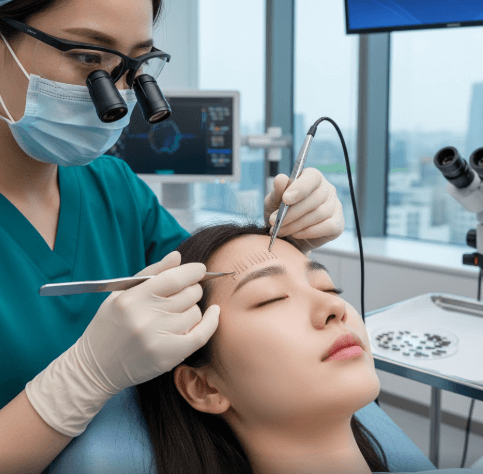
Treatment Overview
The Ultra-Fine Implant Eyebrow Transplant is a highly advanced eyebrow restoration technique that uses super-fine, micro-sized follicular grafts to create the softest, most natural eyebrow texture possible.
This method uses ultra-miniaturized single-hair grafts (often 0.5–0.6 mm in size), making it ideal for patients who want extremely natural results, seamless blending, and a soft, feathered eyebrow look.
Korean clinics are globally recognized for mastering this ultra-precision technique, offering some of the most natural eyebrow reconstruction outcomes in the world.
Purpose & Benefits
This technique focuses on achieving hyper-realistic, fine-textured eyebrows.
Key benefits include:
- Super-fine grafts mimic natural eyebrow hair perfectly.
- Exceptionally soft, natural eyebrow texture and direction.
- No bulkiness or visible grafting — ideal for close-up realism.
- Perfect for women seeking soft, delicate brows or men seeking natural subtleity.
- Minimal healing due to ultra-small punches and incisions.
- Permanent, long-lasting results with real hair growth.
Ideal Candidates
You may be an ideal candidate if you:
- Want the most natural-looking eyebrow restoration possible.
- Prefer soft, feathered, K-beauty eyebrow softness.
- Have thin, patchy, or uneven brows and want ultra-fine detailing.
- Had previous eyebrow work (microblading/tattoo) and want a natural finish.
- Desire a subtle but refined improvement rather than thick or heavy brows.
- Want an eyebrow transplant with minimal visible signs of surgery.
Possible Risks & Complications
Although the technique is extremely gentle, minor temporary issues may include:
- Mild redness for 1–2 days.
- Tiny scabs for 2–3 days.
- Slight sensitivity in the donor area.
- Temporary shedding of transplanted hairs.
- Rare slight misdirection of hairs (easily managed with trimming).
Techniques & Technology Used
- Ultra-Fine Micro FUE: Uses ultra-small extraction tools (0.5–0.6 mm) for delicate follicles.
- Feather-Layer Implantation: Placement technique that mimics natural ‘feathered’ eyebrow growth.
- Ultra-Shallow Angle Control: Ensures eyebrow hairs grow at natural 10–15° angles.
- Soft Single-Hair Graft Selection: Only the thinnest, most natural hairs are chosen.
- 3D Eyebrow Mapping: Designed to create layered depth without heaviness.
- Optional PRP Therapy: Enhances early healing and growth.
Treatment Process in Korea
- Detailed Consultation & Mapping: Surgeon evaluates your brow shape and plans ultra-fine density zones.
- Donor Area Preparation: Ultra-soft hairs are selected from behind the ear or scalp sides.
- Ultra-Fine FUE Extraction: Micro tools extract delicate single-hair follicles.
- Micro-Incision Creation: Tiny, ultra-fine channels made along natural brow angles.
- Super-Fine Implantation: Each graft placed to create soft, natural, feathered texture.
- Post-Care Routine: Gentle antiseptic care and healing serum applied.
Recovery & After-Care
- Very mild redness typically fades within 24–48 hours.
- Minimal scabbing that resolves in 2–3 days.
- No makeup for 1 week to protect fine grafts.
- Keep brows dry for 48 hours.
- Transplanted hairs shed after 2–4 weeks (normal).
- New growth begins at 2–3 months.
- Full, ultra-natural results appear at 6–9 months.
Results & Longevity
- Hyper-natural-looking eyebrows with ultra-soft texture.
- Permanent, life-long growth pattern once grafts settle.
- Perfect feathered look with no harsh lines or detectable grafts.
- Smooth blending with existing eyebrow hairs.
- High-definition results ideal for both natural and cosmetic brow styles.
Why Korea Is a Top Destination
- Korea leads in super-fine graft technology and ultra-miniaturized FUE techniques.
- Eyebrow surgeons specialize in soft, detailed eyebrow artistry.
- Clinics provide exceptional precision and natural density mapping.
- Results follow K-beauty aesthetic standards — delicate, soft, youthful brows.
- Competitive pricing with world-class quality and advanced micro-tools.
- Highly experienced with international patients seeking ultra-natural outcomes.
Cost Range
The cost of an Ultra-Fine Implant Eyebrow Transplant in Korea varies by density and complexity:
- Light-density ultra-fine shaping: ₩2,500,000 – ₩3,500,000 (≈ USD 2,000 – 2,800)
- Full ultra-fine eyebrow reconstruction: ₩3,500,000 – ₩5,500,000 (≈ USD 2,800 – 4,400)
- High-density super-fine premium package: ₩5,500,000 – ₩7,500,000 (≈ USD 4,400 – 6,000)
Includes consultation, transplant, anesthesia, medication, and follow-up.
Popular Clinics in Korea
- Dream Hairline Clinic (Seoul): Experts in ultra-fine graft eyebrow design.
- Moaman Hair Transplant Clinic (Seoul): Known for soft, feathered eyebrow restoration.
- Woomchan Hair Transplant Clinic (Gangnam): Specializes in super-fine detail eyebrow reconstruction for international clients.


