
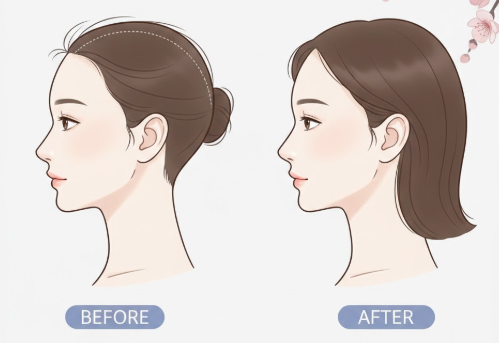
Treatment Overview
High-Forehead Reduction Surgery, also known as Forehead Height Correction, is a cosmetic procedure that reduces the vertical height of the forehead to create more balanced facial proportions. A high forehead can make the face look longer, older, or disproportionate. This procedure lowers the hairline or shortens the forehead area, helping patients achieve a more harmonious, youthful, and aesthetically pleasing appearance.
Forehead Height Correction can be achieved through scalp advancement, bone-soft tissue adjustments, or a combination of hairline lowering and hair grafting. The goal is to reduce forehead length while creating a natural-looking and symmetrical upper facial structure. This procedure is especially popular among individuals whose high forehead is genetic rather than age-related, and among people who desire a more proportional and photogenic face.
Purpose & Benefits
Purpose
High-Forehead Reduction Surgery aims to:
- Correct genetically large or elongated foreheads
- Improve facial balance according to the golden facial ratios
- Lower the hairline to enhance harmony in facial thirds
- Reduce signs of aging by creating a more youthful upper face
- Increase self-confidence and comfort with hairstyles
Benefits
Patients experience multiple aesthetic and emotional benefits from forehead height correction:
- More Balanced Facial Proportions: The face appears more symmetrical and naturally shaped.
- Immediate Forehead Reduction: Scalp advancement provides visible results right after surgery.
- More Hairstyle Options: Patients can confidently wear ponytails, middle parts, or updos.
- Youthful Appearance: A reduced forehead helps restore youthful facial harmony.
- Natural Hairline: When combined with trichophytic incisions or grafting, the hairline looks soft and realistic.
- Permanent Results: Once healed, the new hairline and forehead height remain stable.
Ideal Candidates
High-Forehead Reduction Surgery is ideal for:
- Individuals with a naturally high hairline
- People with long or disproportionate forehead height
- Women or men who want a more balanced upper face
- Patients with good scalp laxity (for scalp advancement methods)
- Individuals with minimal or no active hair loss
- Patients who prefer a permanent solution instead of temporary concealing hairstyles
This procedure is especially beneficial for those whose high forehead creates an older or harsh appearance or whose facial balance is affected by upper facial length.
Possible Risks & Complications
Although forehead height correction is considered safe with modern surgical methods, some risks can occur:
- Temporary forehead numbness
- Mild swelling or bruising
- Visible scar if trichophytic method is not used
- Temporary shedding of hair near the incision
- Limited scalp movement in patients with low scalp laxity
- Infection (rare when performed in advanced clinics)
- Slight asymmetry during healing
These risks are usually minimized when performed by experienced surgeons, especially those specializing in facial harmony and hairline procedures.
Techniques & Technology Used
Scalp Advancement (Hairline Lowering)
This is the most common technique. The surgeon creates an incision along the hairline and advances the scalp forward to lower the hairline by 1–3 centimeters or more, depending on scalp elasticity.
Trichophytic Incision Technique
A refined incision where hair grows through the scar, making it almost invisible. This ensures the hairline appears natural and unnoticeable.
Forehead Skin Removal
Excess forehead skin is removed once the scalp is advanced forward, reducing overall forehead height.
Hair Grafting Combination (Optional)
If the patient has a naturally uneven hairline or desires a perfectly shaped hairline, micro hair grafts are added for refinement.
Temple Curve Design
To ensure a natural look, surgeons reshape the temple region, improving the natural flow of hair along the edges.
Treatment Process
1. Detailed Consultation
The surgeon assesses scalp laxity, facial proportions, and patient goals. Advanced imaging tools help simulate expected outcomes.
2. Hairline Design
A customized hairline is drawn while considering:
- Facial symmetry
- Gender-specific aesthetics
- Natural hair growth direction
- Individual preference
3. Anesthesia
Local anesthesia with sedation is typically used for comfort and safety.
4. Incision and Scalp Mobilization
The scalp is lifted and carefully loosened to allow smooth advancement. The surgeon brings the hairline down and removes excess skin.
5. Closure and Refinement
Trichophytic suturing is used to promote hair growth through the incision. If needed, hair grafts are added to refine shape and density.
6. Postoperative Monitoring
Patients rest in the clinic briefly before heading home or their accommodation. Follow-ups are scheduled to ensure proper healing.
Recovery & After-Care
Recovery Timeline
- Days 1–3: Mild swelling, tightness, and slight discomfort
- 1 Week: Stitches removed; swelling reduces significantly
- 2–4 Weeks: Minor numbness or temporary hair shedding
- 2–3 Months: Hair begins to grow through the incision line
- 6–12 Months: Final natural results become fully visible
After-Care Tips
- Avoid heavy exercise for two weeks
- Keep incision clean and dry
- Apply scar ointments as recommended
- Sleep with your head elevated for the first few nights
- Avoid smoking or alcohol until fully healed
- Protect the forehead from strong sun exposure
Results & Longevity
High-Forehead Reduction Surgery provides long-lasting and natural results. Patients enjoy:
- A more balanced facial structure
- A visibly smaller, more youthful-looking forehead
- Improved face-to-hairline harmony
- Better overall aesthetic appearance
Once complete healing occurs, the results are permanent. The hairline blends naturally and continues to grow normally.
Why This Surgery Is Popular
Forehead Height Correction has gained popularity because:
- It instantly enhances facial balance
- It creates a more youthful and elegant upper face
- It is customizable for both men and women
- It provides a permanent solution to forehead concerns
- Modern techniques produce extremely natural and subtle results
This surgery is especially popular among those in beauty, media, modeling, and professional fields where appearance plays a key role.
Cost Range
The cost of High-Forehead Reduction Surgery varies depending on:
- Technique used
- Amount of lowering needed
- Whether grafting is added
- Clinic reputation
- Surgeon experience
Typical price range:
USD 3,500 – 7,500
Popular Clinics
Some well-known clinics for forehead height correction include:
- GNG Hospital
- DA Plastic Surgery
- ID Hospital
- Banobagi Plastic Surgery
- VIEW Clinic
These clinics are known for expertise in facial proportion surgery and hairline design.


