
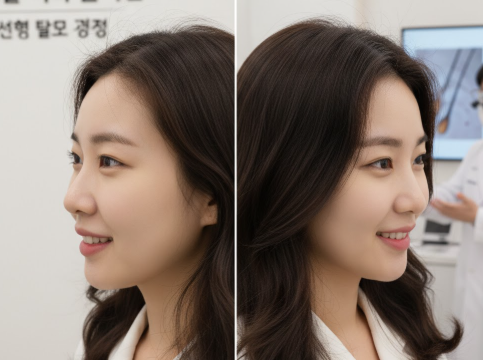
Treatment Overview
Female pattern thinning (also called Female Pattern Hair Loss – FPHL) often affects the hairline, causing diffuse thinning, receding sides, and loss of density at the frontal region. Hairline correction for female pattern thinning focuses on restoring fullness, improving symmetry, and rebuilding a natural feminine shape through advanced hair restoration techniques.
In Korea, clinics specialize in high-density implantation, ultra-fine grafting, and regenerative treatments—allowing patients to achieve a softer, youthful hairline that blends perfectly with existing hair.
Purpose & Benefits
✔ Restore a fuller, natural-looking female hairline
Rebuilds the density of the frontal zone and temples affected by thinning.
✔ Improve facial framing
A fuller hairline enhances facial proportion and rejuvenates appearance.
✔ Correct diffuse miniaturization
Techniques like Micro-FUE and regenerative therapy target weakened follicles.
✔ Boost confidence
Many women feel more confident with a thicker, more defined hairline.
✔ Long-lasting results
Transplanted hairs are permanent and resistant to hormonal thinning.
Ideal Candidates
You may be a good candidate if:
- You have thinning or diffused hair loss at the frontal hairline.
- You have miniaturization rather than complete bald patches.
- You experience widening of the part or temple thinning.
- You want a more feminine hairline shape (rounder / curved).
- You have realistic expectations regarding density restoration.
May not be suitable for:
- Severe diffuse thinning all over the scalp (requires medical therapy first).
- Uncontrolled hormonal imbalance.
- Very low donor density.
Possible Risks & Complications
Potential risks include:
- Slight shock loss (temporary shedding near transplant area)
- Follicle survival variation (density may require multiple sessions)
- Swelling, redness, or scabbing
- Donor site sensitivity (mostly with FUE)
- Need for ongoing medical therapy to maintain native hair
Korean clinics typically minimize risks by using microscopic graft inspection, gentle harvesting, and minimally invasive implantation tools.
Techniques & Technology Used
Micro-FUE for Female Pattern Thinning
Ultra-fine punches (0.6–0.8mm) extract grafts without shaving large areas.
No-Shave / Partial-Shave FUE
Especially popular among women—only a tiny hidden patch is trimmed.
Dense-Packing Hairline Method
Precise angle and direction control creates natural female softness.
Regenerative Add-Ons
- PRP (Platelet-Rich Plasma)
- Exosomes / Stem-Cell Growth Factors
Helps strengthen thinning surrounding hairs.
Microscopic Graft Sorting
Ensures single-hair grafts for the front and multi-hair grafts behind for natural layering.
Treatment Process in Korea
1. Consultation & Digital Hairline Mapping
Clinics use AI imaging and 3D scalp analysis to measure thinning patterns.
2. Donor Hair Assessment
Back-of-scalp donor density is evaluated using high-resolution magnification.
3. Personalized Hairline Design
Special feminine patterns such as S-curve, rounded, or soft contour are considered.
4. Local Anesthesia & Graft Harvesting
Performed using micro-punch tools for minimal discomfort.
5. Implantation
Surgeons place grafts at precise angles to mimic natural female growth direction.
6. Regenerative Booster Treatments
Often included to stabilize miniaturizing native hairs.
7. After-care & Follow-up
Special shampoos, LED therapy, and scalp tonics may be recommended.
Recovery & After-Care
Typical recovery timeline:
- 3–5 days: Mild swelling/scabbing.
- 7–10 days: Scabs fall naturally.
- 1–3 months: Transplanted hairs shed (normal).
- 4–6 months: Visible new growth.
- 9–12 months: Fuller, blended density.
Korean clinics provide detailed after-care kits, cooling masks, and anti-inflammatory scalp serums to maintain comfort.
Results & Longevity
What to expect:
- Natural, soft density increase.
- Improved frame around the forehead and temples.
- Rejuvenated, youthful appearance.
Longevity:
Transplanted hairs last permanently. Native thinning hairs may still require medical therapy such as:
- Minoxidil
- Low-level laser therapy
- Growth-factor injections
Why Korea Is a Top Destination
Key advantages:
- Specialized female hairline surgeons
- Ultra-fine grafting tech unique to Korean clinics
- High-density results with natural feminine aesthetics
- No-shave techniques ideal for female patients
- Clinics experienced in diffuse thinning cases
- Comprehensive packages for international patients
K-Beauty hairline artistry is recognized globally for producing exceptionally natural, camera-ready results.
Cost Range in Korea
| Procedure | Approx. Cost (USD) |
|---|---|
| Micro-FUE Hairline Correction | $2,000 – $5,500 |
| No-Shave FUE (Female) | $2,500 – $6,000 |
| Growth-Factor / Stem-Cell Add-ons | $150 – $600 |
| PRP Therapy | $100 – $300 per session |
Prices vary depending on graft count, surgeon expertise, and clinic location.
Popular Clinics in Korea for Female Hairline Thinning Correction
- Wonjin Aesthetic Hospital
- Jayjun Hair Restoration Center
- DA Plastic Surgery Clinic – Hairline Unit
- MOE Hair Transplant Clinic
- Banobagi Hairline Center
- BK Plastic Surgery Hair Clinic
- ID Hospital Hair Restoration Team


