
Treatment Overview
Male Hairline with PRP (Platelet-Rich Plasma) and Growth-Factor Enhancements in Korea is a modern hair restoration procedure designed to accelerate hair growth, improve follicle health, and restore a natural hairline. PRP therapy involves using the patient’s own blood plasma, rich in growth factors, to stimulate dormant hair follicles and enhance the survival of transplanted grafts. This treatment is often combined with FUE (Follicular Unit Extraction), FUT (Follicular Unit Transplantation), or robotic-assisted hair transplantation to maximize results.
Purpose & Benefits
The purpose of this procedure is to promote healthier hair growth and support existing or newly transplanted hair follicles. Benefits include:
- Enhanced hair growth and thickness
- Improved follicle survival after hair transplantation
- Faster recovery and healing of the scalp
- Restoration of a natural, youthful hairline
- Non-invasive enhancement option suitable for both early hair loss and post-transplant care
PRP and growth-factor therapies complement traditional hair transplantation, making results more robust and natural-looking.
Ideal Candidates
Male Hairline with PRP / Growth-Factor Enhancements is ideal for:
- Men experiencing thinning hair or early-stage hair loss
- Individuals who have undergone hair transplant surgery and want improved graft survival
- Patients seeking enhanced hair density and scalp health
- Those preferring minimally invasive, natural therapies with low downtime
- Men wanting to strengthen hair follicles and prevent further hair loss
Patients with blood disorders, scalp infections, or certain medical conditions should consult with a Korean clinic prior to treatment.
Possible Risks & Complications
Although PRP therapy is considered safe, potential risks include:
- Mild swelling, redness, or tenderness at injection sites
- Temporary scalp soreness or mild bruising
- Rare infection if hygiene protocols are not strictly followed
- Slight discomfort during injections
Most side effects are mild and resolve within a few days. Selecting an experienced clinic in Korea minimizes risks and ensures high-quality outcomes.
Techniques & Technology Used
Korean clinics use advanced techniques to maximize PRP / growth-factor therapy benefits:
- FUE (Follicular Unit Extraction): For hairline restoration combined with PRP for enhanced follicle health
- FUT (Follicular Unit Transplantation): For larger sessions supported by growth-factor injections
- Robotic-assisted transplantation (ARTAS/NeoGraft): Ensures precise placement and optimal graft survival
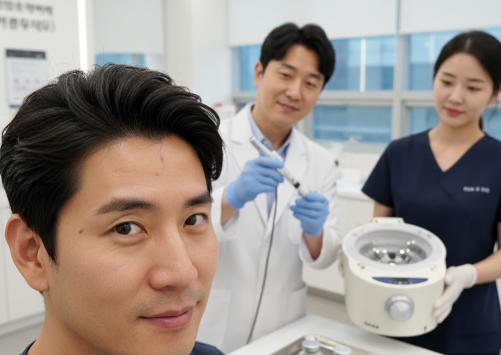
- PRP preparation: Blood is centrifuged to isolate plasma rich in platelets and growth factors
- Targeted scalp injections: Applied to thinning areas and transplanted hairlines to stimulate growth
These methods allow for enhanced, long-lasting hairline results while maintaining a natural appearance.
Treatment Process in Korea
The typical process includes:
- Consultation to assess hair loss, donor hair, and suitability for PRP therapy
- Blood collection and preparation of platelet-rich plasma
- Hair transplantation or scalp assessment for PRP injection
- Targeted PRP / growth-factor injections into the scalp
- Post-treatment care instructions and follow-up visits
Sessions generally take 1–4 hours depending on whether PRP is used as a stand-alone treatment or combined with hair transplantation. Korean clinics ensure comfortable and professional care throughout.
Recovery & After-Care
Recovery is usually straightforward:
- Mild redness or tenderness at injection sites for 1–3 days
- Avoid aggressive washing, saunas, and direct sunlight immediately after treatment
- Follow-up visits to monitor hair growth and scalp health
- Optional repeat sessions every 3–6 months for optimal results
PRP therapy has minimal downtime, allowing patients to continue daily activities almost immediately.
Results & Longevity
Visible hair improvement can be noticed within 2–4 months, with optimal results appearing after 6–12 months. When combined with hair transplantation, PRP enhances graft survival, increases hair density, and improves overall hair quality. The results are long-lasting, particularly with ongoing maintenance and supportive therapies.
Why Korea Is a Top Destination
Korea is a leading destination for PRP and growth-factor hairline enhancements due to:
- Expertise in combining PRP with advanced FUE, FUT, and robotic-assisted hair transplantation
- Highly skilled practitioners experienced in hairline aesthetics
- Clinics catering to international patients with translation and concierge support
- Competitive pricing compared to Western countries
- High success rates with natural, long-lasting results
These factors make Korea ideal for men seeking advanced, minimally invasive hairline rejuvenation treatments.
Cost Range
The cost of Male Hairline with PRP / Growth-Factor Enhancements in Korea typically ranges from $1,500 to $5,000, depending on the number of sessions, combination with hair transplantation, and clinic reputation. Many clinics offer packages for international patients, including post-treatment care.
Popular Clinics in Korea
Top clinics offering Male Hairline with PRP / Growth-Factor Enhancements include:
- ID Hospital, Seoul – Specialists in combining PRP with FUE and robotic hair restoration
- JK Plastic Surgery & Dermatology, Seoul – Offers PRP treatments for enhanced hairline density and growth
- The GONG Hospital, Seoul – Focuses on PRP-supported hair restoration for natural, robust results
- Medi-Peel Clinic, Seoul – Provides comprehensive PRP hairline treatments for local and international patients


