
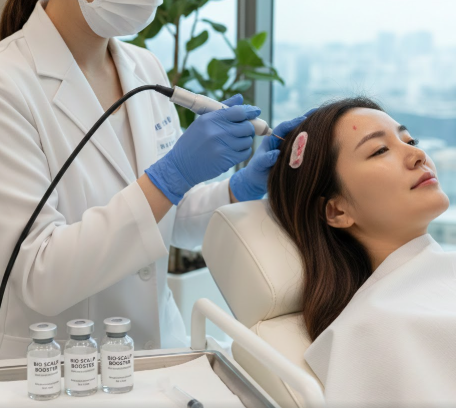
Bio-Scalp Booster Injection is an advanced hair regeneration treatment widely used in Korea to strengthen weak follicles, improve scalp health, and promote thicker, denser hair growth. This technique delivers a powerful blend of bioactive ingredients—such as peptides, vitamins, amino acids, minerals, growth factors, PDRN, and hyaluronic acid—directly into the scalp. Korean dermatology clinics customize the formula based on hair loss patterns, making it one of the most effective non-surgical solutions for early to moderate hair thinning.
In Korea, this treatment is especially popular among medical tourists seeking fast, visible improvement without surgery or long recovery times.
Treatment Overview
The Bio-Scalp Booster Injection works by nourishing hair follicles from the root and improving scalp circulation. Unlike basic mesotherapy, Korean clinics use highly refined clinical-grade bio-solutions that are designed to repair damaged follicles, reduce inflammation, and improve hair density.
A series of micro-injections deliver the formula into the dermal layer where follicles reside. This enhances cell metabolism, accelerates regeneration, and restores a healthy environment for hair growth.
Korean dermatologists often combine Bio-Scalp Booster therapy with PRP, PRF, LLLT, or exosome hair regeneration for superior outcomes.
Purpose & Benefits
- Deeply nourishes and revitalizes weakened hair follicles
- Stimulates hair regeneration and reduces hair shedding
- Increases hair thickness, shine, and density
- Improves scalp circulation and nutrient absorption
- Restores scalp hydration and reduces dryness or flakiness
- Helps combat inflammation and oxidative stress
- Suitable for both men and women
- Non-surgical, minimal discomfort, no downtime
This treatment is ideal for those seeking a natural-strengthening solution before considering hair transplantation.
Ideal Candidates
Bio-Scalp Booster Injection in Korea is suitable for:
- Men and women with early to moderate thinning
- Androgenic alopecia (male and female pattern hair loss)
- Stress-related or hormonal hair loss
- Telogen effluvium
- Individuals with dry, irritated, or unhealthy scalp conditions
- Patients noticing increased shedding
- Those seeking a maintenance therapy to preserve hair thickness
- Post-transplant patients wanting to maintain density
It is also ideal for people who cannot take oral hair loss medications due to side effects.
Possible Risks & Complications
This treatment is very safe when performed by Korean dermatologists. Minor, temporary side effects may include:
- Mild redness or swelling at injection points
- Light pressure sensation in the scalp
- Small pinpoint bruises (rare)
- Slight sensitivity for 12–24 hours
Severe reactions are extremely rare because the ingredients used are medically safe and well-tolerated by most patients.
Techniques & Technology Used
Korea is known for precision-based scalp therapies using advanced tools and customized solutions. Clinics commonly utilize:
- Ultra-fine 31–34G micro-needles for painless injections
- Customized bio-cocktails containing peptides, PDRN, amino acids, minerals, and vitamins
- Korean mesogun injection devices for accurate, even delivery
- Scalp cooling systems for comfort
- High-frequency and laser scalp stimulation for improved absorption
- Hybrid protocols combining PRP, PRF, exosomes, or microneedling
These innovations make Korean Bio-Scalp Booster treatments more effective and comfortable than standard mesotherapy in other countries.
Treatment Process in Korea
- Consultation & Digital Scalp Scan
The dermatologist evaluates hair density, follicle health, and scalp condition using high-resolution cameras. - Customized Booster Formula Selection
Korean clinics tailor the treatment formula based on scalp needs—hydration, regeneration, anti-inflammatory, or growth stimulation. - Scalp Cleansing & Preparation
A gentle cleansing ensures optimal absorption of bioactive ingredients. - Injection Procedure
Using micro-needles or a mesogun, the specialist injects the booster formula across thinning areas. - Optional Combination Therapy
Clinics may add PRP, PRF, LLLT, or growth-factor ampoules for enhanced results. - Post-Treatment Soothing
Cooling therapy or scalp serum is applied to calm the area. - Guidance & Maintenance Plan
The clinic recommends follow-up sessions every 2–4 weeks for best results.
The procedure takes 20–30 minutes and requires no downtime.
Recovery & After-Care
- No major restrictions; normal activities resume immediately
- Avoid washing the scalp for 6–12 hours
- No sauna, swimming, or heavy sweating for 24 hours
- Use gentle, sulfate-free shampoos
- Follow prescribed home-care tonics or serums
- Maintain proper hydration and nutrition
- Schedule booster sessions every 2–4 weeks
Most patients feel mild tenderness for a few hours, which resolves naturally.
Results & Longevity
- Reduction in hair shedding within 2–4 weeks
- Improved scalp hydration and health quickly
- Noticeable thickening and volume in 6–8 weeks
- Visible density improvement in 3–4 months
- Best results after 6–8 sessions
- Maintenance treatment recommended every 1–3 months
Results last longer when combined with PRP/PRF or LLLT therapy.
Why Korea Is a Top Destination
- Highly trained dermatologists specializing in hair regeneration
- Advanced formulas and techniques unavailable in many countries
- Precise delivery methods with minimal discomfort
- Combination protocols for stronger, faster results
- Clinics equipped with world-class diagnostic tools
- Affordable compared to the US, Japan, and Europe
- Excellent care for international patients
Korea’s leadership in cosmetic and regenerative dermatology makes it a global hub for scalp-regeneration treatments.
Cost Range
The Bio-Scalp Booster Injection in Korea typically costs:
₩150,000 – ₩450,000 per session
(USD $110 – $330)
Combination packages such as Booster + PRP or Booster + LLLT can range:
₩400,000 – ₩1,000,000 depending on clinic and formula.
Popular Clinics in Korea
- Gowoonsesang Dermatology Network
- Renewme Dermatology Clinic
- Oracle Dermatology Korea
- Wonjin Dermatology Center
- Mojelim Hair Restoration Clinic
- Dream Hairline Clinic (Gangnam)
- DA Plastic Surgery Hair Center
These clinics are known for delivering consistent, natural-looking improvement with customized scalp booster protocols.


