
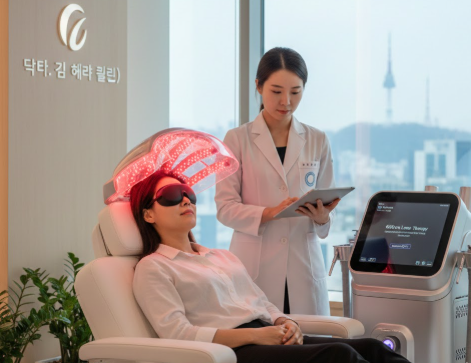
Treatment Overview
The 650 nm Laser Hair Growth Treatment is a non-invasive therapy that uses low-level red laser light at the 650 nm wavelength to stimulate hair follicles, improve scalp circulation, and encourage natural hair growth. This wavelength is clinically recognized for its ability to penetrate the scalp and energize cells at the root of the hair follicle through photobiomodulation.
In Korea, this treatment is widely used in dermatology, trichology, and hair restoration clinics. With advanced laser devices, KFDA-approved technology, and science-backed protocols, Korean clinics provide some of the highest success rates for hair regrowth, especially for early-stage hair loss and thinning.
Purpose & Benefits
The main purpose of 650 nm laser therapy is to rejuvenate weakened hair follicles and slow down hair loss progression. Key benefits include:
- Boosts cellular energy (ATP production) in follicles
- Improves scalp blood circulation
- Strengthens hair roots and prevents premature shedding
- Thickens existing hair shafts
- Increases hair density and overall scalp health
- Helps reduce inflammation on the scalp
- Suitable for both men and women
- Completely painless and non-invasive
- No downtime or side effects
Korean clinics often combine this treatment with scalp injections, growth factors, or mesotherapy for enhanced results.
Ideal Candidates
650 nm Laser Hair Growth Treatment is ideal for:
- Individuals experiencing early-to-moderate hair thinning
- Men and women with androgenetic alopecia (pattern hair loss)
- People with weakened or miniaturized hair follicles
- Patients looking for a non-surgical, low-risk hair regrowth option
- Individuals recovering from hair transplant surgery to support graft survival
- People suffering from inflammation-related hair loss or poor scalp circulation
- Medical tourists seeking safe, proven hair restoration solutions in Korea
It is not typically recommended for individuals with complete baldness or long-term inactive follicles.
Possible Risks & Complications
This treatment is considered extremely safe. However, mild and temporary side effects may include:
- Slight scalp warmth during the procedure
- Minor redness after treatment in sensitive skin
- Rare cases of temporary shedding as new cycles begin
- Not suitable for individuals with photosensitivity disorders
Korean clinics perform a professional scalp diagnosis before treatment to ensure safety.
Techniques & Technology Used
Korea utilizes some of the most advanced laser technologies for hair regrowth. Key devices and techniques include:
- Low-Level Laser Therapy (LLLT) devices at 650 nm wavelength
- Medical-grade helmet-type or panel-type lasers
- KFDA-approved lasers with multiple diode arrays
- Combination therapy with 630–680 nm wavelengths for enhanced penetration
- LLLT machines integrated with scalp cooling and soothing systems
- Digital scalp analysis equipment to track improvement over time
These devices deliver consistent, high-quality energy to the scalp, improving treatment efficiency.
Treatment Process in Korea
The typical treatment journey in Korea is smooth, quick, and highly professional:
- Consultation & Trichoscopy
A scalp specialist examines your hair density, follicle size, and scalp health using high-resolution imaging. - Preparation
The scalp is cleansed, and sebum or buildup may be removed for better laser absorption. - Laser Session
The 650 nm laser device is placed over the scalp for 15–25 minutes. You experience no pain—just gentle warmth. - Optional Enhancements
Some clinics add growth factor serums, mesotherapy, or LED therapy for improved outcomes. - Completion
The patient can immediately return to normal activities. - Follow-Up Plan
Most hair specialists in Korea recommend 8–24 sessions depending on the level of hair loss.
Korean clinics are known for their clean, modern environments and efficient service catered to international patients.
Recovery & After-Care
Since the treatment is non-invasive, recovery is minimal. Recommended after-care includes:
- Avoiding harsh hair products for 24 hours
- Keeping the scalp clean and free of heavy oils
- Staying hydrated to support follicle function
- Following clinic-prescribed topical treatments (if applicable)
- Regular sessions for at least 3 months for visible results
Patients may also be advised to use laser-cap devices at home for maintenance.
Results & Longevity
Results vary, but many patients begin noticing improvements after 4–8 weeks. Typical outcomes include:
- Stronger, thicker hair
- Reduced daily hair shedding
- Increased hair density
- Healthier scalp condition
- Improved follicle activity
Full results generally appear after 3–6 months of continuous treatment.
Longevity depends on consistency; periodic maintenance sessions (once every 2–4 weeks) help sustain long-term results.
Why Korea Is a Top Destination
Korea is one of the world’s most advanced centers for hair restoration and dermatology. Reasons medical tourists choose Korea for 650 nm laser therapy include:
- Highly trained dermatologists & hair specialists
- KFDA-approved, cutting-edge LLLT devices
- Clinics experienced with international patients
- Comprehensive combination treatments for stronger results
- Affordable pricing compared to Western countries
- High hygiene standards and modern medical facilities
- Research-driven treatment protocols
Korea’s hair restoration industry is globally recognized for innovation and safety.
Cost Range
Costs in Korea are competitive and vary by clinic reputation, device type, and treatment package. Average prices include:
- Per session: USD $25 – $60
- 10-session package: USD $200 – $450
- 20-session package: USD $350 – $800
Additional combination treatments (PRP, growth factors, mesotherapy) may increase the overall cost.
Popular Clinics in Korea
Well-known clinics offering 650 nm Laser Hair Growth Treatment include:
- Wonjin Dermatology Clinic
- Banobagi Hair Restoration Center
- Oracle Dermatology
- CNP Dermatology
- ID Hospital Hair Clinic
- ME Clinic Seoul
- Forhair Korea
- Root Hair Clinic Gangnam
These clinics provide English support and customized treatment plans for medical tourists.


