
Treatment Overview
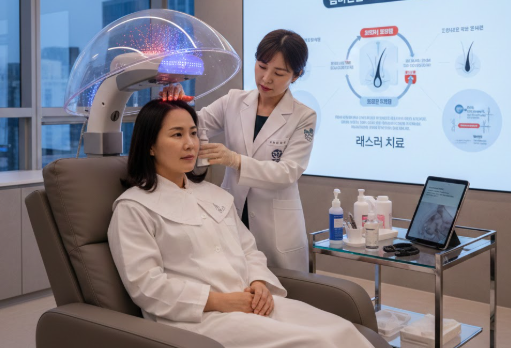
Combination Medical Hair Loss Management with Laser Therapy in Korea integrates low-level laser therapy (LLLT) with multi-therapy approaches including topical minoxidil, DHT blockers, PRP injections, mesotherapy, scalp scaling, and nutritional support. Laser therapy uses specific wavelengths of light to stimulate blood flow, increase follicle activity, and promote hair regrowth.
Korean clinics design personalized combination plans to optimize results, targeting thinning areas with advanced laser technology while complementing other treatments.
Purpose & Benefits
The purpose of integrating laser therapy into combination treatment is to:
- Enhance scalp circulation and oxygen delivery to follicles
- Activate dormant hair follicles for regrowth
- Reduce hair thinning and increase density
- Enhance the efficacy of topical and oral medications
- Promote scalp health by reducing inflammation and improving follicle function
- Provide a non-invasive and pain-free hair restoration solution
Patients in Korea often experience visible improvements in density and thickness within 2–4 months.
Ideal Candidates
Laser-based combination therapy is suitable for:
- Men and women with androgenetic alopecia
- Patients with early to moderate hair thinning in frontal, vertex, or crown regions
- Individuals who have tried monotherapy with limited success
- Post-hair-transplant patients to support graft survival
- Patients seeking non-surgical, low-risk hair restoration
- Individuals committed to regular sessions and combination therapy protocols
Proper patient evaluation ensures maximum effectiveness and safety.
Possible Risks & Complications
Laser therapy is safe and non-invasive, but potential risks include:
- Mild scalp warmth or tingling during treatment
- Temporary shedding as hair cycles adjust
- Minor scalp sensitivity if combined with topical minoxidil
- Ineffectiveness if patient adherence to home care and lifestyle is poor
- Rare irritation from combined therapies such as PRP injections
Korean clinics monitor patients carefully to minimize side effects and optimize outcomes.
Techniques & Technology Used
Korean clinics employ advanced technology to maximize laser therapy results:
- Low-Level Laser Therapy (LLLT): Stimulates follicle activity and scalp circulation
- Topical Minoxidil: Enhances regrowth in conjunction with laser therapy
- DHT Blockers (Finasteride or Dutasteride): Reduces follicle miniaturization
- PRP Therapy: Activates dormant follicles through growth factor injections
- Mesotherapy & Growth Factor Serums: Provides essential nutrients to follicles
- Digital Scalp Imaging & Monitoring: Tracks hair density, growth, and follicle response
- Nutritional Support: Vitamins and amino acids support long-term hair health
The synergy between these therapies produces faster and more consistent hair regrowth.
Treatment Process in Korea
The structured process for laser-based combination therapy includes:
- Initial Consultation: Scalp evaluation, hair density assessment, and medical history review
- Customized Treatment Plan: Laser therapy frequency combined with minoxidil, DHT blockers, PRP, and other therapies
- Clinic Sessions: LLLT performed 2–3 times per week, depending on patient needs
- Home Care Regimen: Daily minoxidil application and oral DHT blockers as prescribed
- Monitoring: Follow-ups every 1–2 months to evaluate results and adjust therapies
- Maintenance Phase: Periodic laser sessions and ongoing combination therapies for sustained growth
This approach ensures consistent hair restoration and follicle activation.
Recovery & After-Care
Recovery is minimal, but proper aftercare ensures optimal results:
- Avoid touching or scratching the scalp after laser sessions
- Apply topical medications as directed
- Follow recommended lifestyle and diet practices to support hair growth
- Attend all follow-up sessions for monitoring progress and additional treatments
- Protect the scalp from harsh sunlight and chemical exposure
Adhering to aftercare instructions ensures maximum effectiveness and long-term results.
Results & Longevity
Clinical results in Korea show:
- 2–3 months: Early follicle stimulation and reduced shedding
- 4–6 months: Noticeable improvement in hair density and thickness
- 6–12 months: Significant regrowth and stabilized hair growth
- Beyond 12 months: Sustained hair density with continued combination therapy
Patients adhering to the full combination therapy program experience higher success rates compared to laser monotherapy alone.
Why Korea Is a Top Destination
Korea is a preferred destination for laser-based combination therapy because:
- Clinics use advanced LLLT devices and technology
- Personalized combination therapy plans maximize regrowth
- Expert dermatologists integrate laser with PRP, DHT blockers, and minoxidil
- High safety standards and structured aftercare protocols
- Multilingual support for international medical tourists
- Holistic approach including lifestyle, nutrition, and scalp health
Korean clinics provide cutting-edge treatments with comprehensive patient support for optimal hair restoration.
Cost Range
Costs vary depending on the combination of therapies and laser sessions:
- LLLT session: USD 50–150 per session
- Monthly combination program (Laser + PRP + minoxidil + DHT blockers): USD 150–450
- 3-month intensive program: USD 600–1,200
- 12-month comprehensive program with maintenance: USD 1,500–2,500
- Home-use laser devices (clinic-guided): USD 100–250
Investing in a structured combination program ensures maximal hair regrowth and long-term maintenance.
Popular Clinics in Korea
Top clinics for laser-based combination therapy include:
- Banobagi Dermatology – Seoul
- Mojelim Hair Clinic – Seoul
- Cheongdam Yonsei Dermatology
- Oracle Dermatology Network
- NIL Hair Medical Center
- Dr. For Hair Scalp Clinics
These clinics provide personalized laser therapy programs, structured monitoring, and expert aftercare to achieve effective hair restoration.


