
Treatment Overview
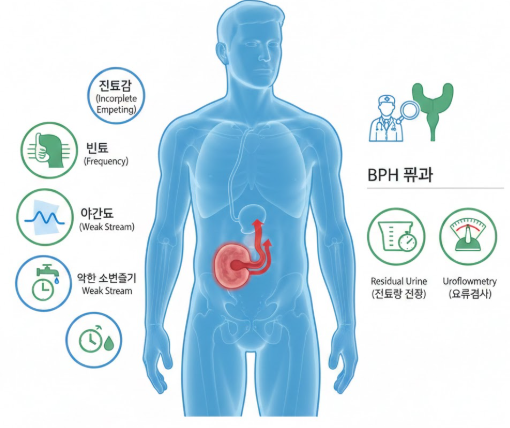
Benign Prostatic Hyperplasia (BPH), or prostate enlargement, is a common condition in men over the age of 50, which can affect urinary function and overall quality of life. Common symptoms include difficulty urinating, weak urine stream, frequent nighttime urination, and urgency.
Korea offers world-class evaluation and diagnostic services for BPH, utilizing advanced technology and experienced urologists to ensure accurate detection and effective management. Evaluating symptoms properly allows for early intervention, preventing complications such as urinary tract infections, bladder stones, or kidney damage.
Purpose & Benefits
The purpose of BPH evaluation is to identify the severity of prostate enlargement, understand its impact on urinary function, and develop an effective treatment plan. Benefits of evaluation in Korea include:
- Accurate assessment of prostate size and urinary function
- Early detection of complications such as bladder obstruction or kidney strain
- Personalized treatment planning based on test results and symptoms
- Minimally invasive and non-invasive diagnostic techniques
- Expert guidance for both local and international patients
Evaluating symptoms and conducting proper testing in Korea ensures patients receive timely and effective care.
Ideal Candidates
Men who should seek evaluation for BPH in Korea include:
- Those over 50 experiencing urinary difficulties
- Patients with frequent nighttime urination (nocturia)
- Men with weak urine flow, difficulty starting or stopping urination
- Individuals experiencing urinary urgency or incontinence
- Patients with recurrent urinary tract infections
- Men seeking a precise diagnosis to plan long-term management
Korean urologists provide thorough evaluations to ensure an accurate diagnosis tailored to each patient’s needs.
Possible Risks & Complications
BPH evaluation is generally safe, with minimal risks. Possible minor complications may include:
- Slight discomfort during urine flow measurement or urodynamic testing
- Mild irritation during transrectal ultrasound or cystoscopy
- Temporary urgency or frequency after certain tests
- Rare allergic reactions to contrast agents used in imaging
Korean hospitals follow strict protocols to minimize risks and ensure patient comfort throughout the evaluation process.
Techniques & Technology Used
Korea uses advanced diagnostic tools to evaluate BPH symptoms and urinary function:
Digital Rectal Examination (DRE)
A simple, non-invasive examination to assess prostate size, texture, and consistency.
Prostate-Specific Antigen (PSA) Test
Blood test to measure PSA levels, helping rule out prostate cancer and evaluate prostate health.
Transrectal Ultrasound (TRUS)
High-resolution imaging to accurately measure prostate volume and detect abnormalities.
Urodynamic Studies
Assess bladder function, urine flow, and pressure to evaluate the impact of BPH on urinary health.
Cystoscopy
A small camera is inserted into the urethra to visualize the bladder and prostate, especially for patients with obstruction or recurrent infections.
CT or MRI Imaging
Advanced imaging is used for complex cases to assess the prostate, bladder, and surrounding structures.
Treatment Process in Korea
The BPH evaluation process in Korea is structured, efficient, and patient-centered:
- Initial Consultation
- Assessment of medical history, symptoms, and physical examination.
- Laboratory Testing
- PSA blood test, urinalysis, and urine culture to identify infections or abnormalities.
- Imaging & Functional Tests
- Ultrasound, TRUS, MRI/CT scans, and urodynamic studies as needed.
- Cystoscopy (if required)
- Visualization of the urethra and bladder to detect obstruction or structural changes.
- Diagnosis & Management Planning
- Urologists analyze all test results and symptoms to recommend medication, minimally invasive procedures, or surgical options if necessary.
- Follow-Up
- Regular monitoring of symptoms and PSA levels, with imaging or tests repeated as needed.
International patients receive support through translation services, appointment coordination, and remote follow-up options.
Recovery & After-Care
Although BPH evaluation itself does not require recovery, follow-up care focuses on symptom management and prevention:
- Lifestyle Adjustments: Reduce caffeine and alcohol, maintain healthy weight, and practice regular urination habits.
- Medication: Alpha-blockers or 5-alpha-reductase inhibitors may be prescribed if early BPH is detected.
- Monitoring: Track urinary patterns and symptoms to report changes promptly.
- Regular Testing: Periodic PSA, imaging, and urodynamic tests to monitor prostate health and disease progression.
Timely evaluation and proper follow-up can prevent severe complications such as urinary retention, bladder stones, or kidney problems.
Results & Longevity
Proper evaluation of BPH symptoms in Korea provides:
- Early detection and management of prostate enlargement
- Effective symptom relief and improved urinary function
- Prevention of complications like bladder or kidney damage
- Personalized long-term care plans for ongoing prostate health
With continuous monitoring and appropriate interventions, patients can maintain quality urinary function for many years.
Why Korea Is a Top Destination
Korea is a preferred destination for BPH evaluation due to:
- Highly skilled urologists with international experience
- Advanced diagnostic technologies including TRUS, MRI, and urodynamic labs
- Streamlined evaluation and treatment planning for domestic and international patients
- Affordable costs compared to the US, Europe, and Japan
- Comprehensive medical tourism support including translators and patient coordinators
Patients worldwide trust Korea for precise diagnosis and expert management of BPH symptoms.
Cost Range
The cost of BPH evaluation in Korea varies depending on the tests required:
- Consultation: USD 50 – 150
- PSA & Blood Tests: USD 50 – 100
- Ultrasound / TRUS: USD 150 – 300
- Urodynamic Studies: USD 200 – 400
- MRI / CT Imaging: USD 250 – 500
- Cystoscopy (if required): USD 300 – 600
International patient packages may include consultation, testing, and interpretation of results for convenience.
Popular Clinics in Korea
Leading hospitals for BPH evaluation and symptom management include:
- Seoul National University Hospital (SNUH)
- Samsung Medical Center, Seoul
- Asan Medical Center, Seoul
- Severance Hospital (Yonsei University)
- St. Mary’s Hospital, Seoul
- Gangnam Urology Specialist Clinics
These hospitals provide advanced diagnostics, accurate evaluation, and comprehensive care for both local and international patients.


