
Treatment Overview
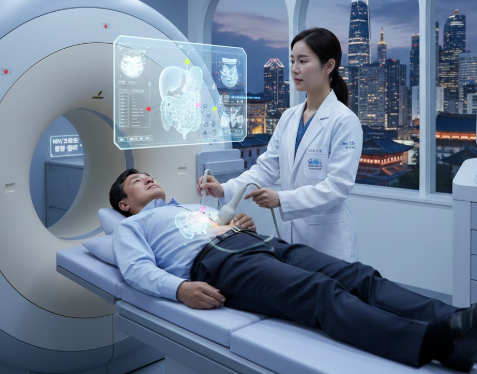
MRI/Ultrasound Fusion Screening is an advanced prostate diagnostic procedure that combines multiparametric MRI (mpMRI) imaging with real-time ultrasound guidance. This technique allows urologists to precisely identify and target suspicious lesions during prostate biopsy, improving detection rates for clinically significant prostate cancer.
In Korea, fusion screening is performed in state-of-the-art hospitals and clinics using high-resolution 3T MRI scanners and sophisticated fusion software. International patients benefit from expert urologists, accurate lesion mapping, and efficient scheduling.
Purpose & Benefits
The purpose of MRI/Ultrasound fusion screening is to:
- Detect clinically significant prostate cancer missed by conventional biopsy
- Improve precision in targeting suspicious lesions
- Reduce unnecessary biopsy cores and overdiagnosis of indolent tumors
Benefits include:
- Higher diagnostic accuracy than systematic biopsy alone
- Minimally invasive and safe procedure
- Shorter procedure time with fewer biopsy cores needed
- Improved treatment planning by mapping tumor location
- Reduced patient discomfort and faster recovery
Ideal Candidates
MRI/Ultrasound fusion screening is recommended for men who:
- Have elevated PSA levels or suspicious PSA trends
- Had a previous negative biopsy but persistent clinical suspicion
- Show suspicious lesions on mpMRI
- Are high-risk patients due to family history or genetic factors
- Require precise tumor localization for biopsy or treatment planning
Korean urologists evaluate each patient’s risk profile and prior imaging to recommend fusion screening.
Possible Risks & Complications
MRI/Ultrasound fusion screening is generally safe. Possible considerations include:
- Mild discomfort or soreness at the biopsy site
- Blood in urine, stool, or semen for a few days
- Temporary urinary difficulties
- Rare infection or hematoma, minimized by strict sterile protocols and antibiotic prophylaxis
- Mild anxiety or claustrophobia during MRI
Techniques & Technology Used
Korea uses advanced technology for MRI/Ultrasound fusion screening:
- 3T multiparametric MRI for high-resolution lesion detection
- Real-time transrectal ultrasound (TRUS) during biopsy
- Fusion software to overlay MRI images onto live ultrasound
- Targeted biopsy of suspicious lesions identified on mpMRI
- Systematic biopsy may be performed concurrently for comprehensive sampling
- Local anesthesia and sedation for patient comfort
These technologies ensure precise targeting and high diagnostic accuracy.
Treatment Process in Korea
- Consultation & Pre-Screening – Review PSA levels, prior biopsy results, and mpMRI images
- Patient Preparation – Antibiotics, anesthesia planning, and imaging review
- Fusion Screening Procedure – MRI images fused with real-time ultrasound for targeted biopsy
- Observation & Recovery – Short monitoring period before discharge
- Pathology & Follow-Up – Results typically available within 3–5 days; English-language reports for international patients
Medical tourism coordinators assist with scheduling, translation, and post-procedure care.
Recovery & After-Care
- Mild discomfort at biopsy site may occur
- Blood in urine or semen may persist for a few days
- Drink plenty of fluids and avoid heavy activity for 24–48 hours
- Take prescribed antibiotics if indicated
- Contact the hospital if fever, severe pain, or urinary difficulty occurs
Results & Interpretation
MRI/Ultrasound fusion screening results provide:
- Accurate detection of clinically significant prostate cancer
- Localization of suspicious lesions for precise treatment planning
- Guidance for active surveillance, surgery, or radiation therapy
- Pathology confirmation through targeted biopsy
These results improve diagnosis and long-term treatment outcomes.
Why Korea Is a Top Destination
- Experienced urologists specialized in fusion-guided prostate biopsy
- Advanced 3T MRI and fusion software for accurate lesion targeting
- Low infection and complication rates due to strict sterile protocols
- Fast scheduling and efficient care for international patients
- English-language support and medical tourism services
- Cost-effective and high-quality compared to Western countries
Cost Range
Typical costs for MRI/Ultrasound fusion screening in Korea:
₩2,000,000 – ₩5,000,000 KRW (~$1,500–$3,900 USD)
Costs vary depending on:
- MRI and fusion software usage
- Hospital grade (private vs. university hospital)
- Number of biopsy cores taken
- Consultation and pathology fees
Popular Clinics in Korea
- Seoul National University Hospital – Fusion Biopsy & Prostate Screening Unit
- Samsung Medical Center – Advanced MRI/Ultrasound Fusion Program
- Asan Medical Center – Urology & Targeted Biopsy Department
- Gangnam Severance Hospital – International Patient Fusion Screening Services
- Korea University Anam Hospital – Fusion Biopsy & Prostate Diagnostics
- JK Urology & Men’s Health Clinics – MRI/Ultrasound Fusion Biopsy Support


