
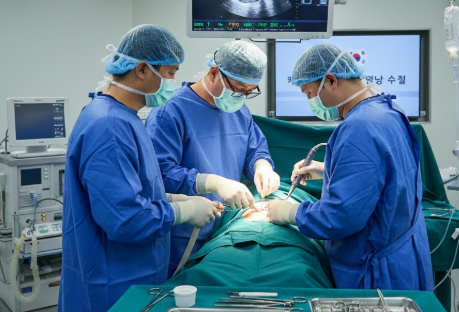
Treatment Overview
Doppler-guided torsion surgery is an advanced urological procedure used to diagnose and treat testicular torsion with high precision. Testicular torsion is a medical emergency in which the spermatic cord twists, cutting off blood supply to the testicle. Without prompt intervention, tissue ischemia can cause irreversible damage within hours. Korea has emerged as a leading hub for this urgent surgery because of its rapid emergency-care infrastructure, highly specialized urologists, and cutting-edge diagnostic tools, particularly Doppler ultrasound technology.
In Korea, Doppler-guided torsion surgery integrates real-time blood flow imaging to confirm the location, severity, and extent of torsion before surgery. By using Doppler vascular assessment, Korean surgeons can distinguish between true torsion, intermittent torsion, and similar conditions such as epididymitis. This ensures accurate decision-making and immediate intervention, improving salvage rates significantly. For international patients, Korean hospitals offer streamlined emergency management protocols, multilingual support teams, and specialized men’s health units equipped for round-the-clock care.
Purpose & Benefits
The primary purpose of Doppler-guided torsion surgery is to restore blood flow to the affected testicle quickly and assess its viability. Doppler imaging provides real-time visualization of arterial and venous circulation, allowing urologists to determine if detorsion alone is sufficient or if further fixation is necessary.
Key benefits include:
- Higher testicular salvage rate through early detection
- Reduced unnecessary surgery by accurately diagnosing true torsion
- Minimally invasive approach with precise technique
- Improved accuracy in assessing blood flow after detorsion
- Faster emergency workflow in Korean hospitals
Early treatment significantly reduces long-term complications such as infertility, hormonal imbalance, and chronic scrotal pain.
Ideal Candidates
Doppler-guided torsion surgery is intended for patients with symptoms of acute scrotal pain or suspected torsion. Ideal candidates include:
- Males with sudden, severe testicular pain
- Patients with nausea, swelling, or a high-riding testicle
- Individuals experiencing intermittent torsion episodes
- Adolescents and young adults
- Newborns with suspected neonatal torsion
- Patients needing urgent viability assessment
- Medical tourists seeking rapid, accurate evaluation
Korea’s emergency-care system is particularly efficient for international patients requiring immediate attention.
Possible Risks & Complications
While generally safe, this surgery carries some potential risks:
- Reduced salvage chances from delayed diagnosis
- Infection or postoperative bleeding
- Recurrent torsion if fixation is inadequate
- Possible fertility reduction if ischemia was prolonged
- Testicular atrophy in severe cases
- Temporary scrotal discomfort or swelling
Korean hospitals maintain extremely high safety standards, minimizing these complications.
Techniques & Technology Used
Korea is globally recognized for using advanced imaging and surgical tools in emergency urology. Techniques include:
- Color Doppler Ultrasound for real-time blood flow assessment
- Spectral Doppler analysis to measure arterial waveforms
- High-resolution scrotal ultrasound to identify the “whirlpool sign”
- Microsurgical tools for precise detorsion and orchiopexy
- Absorbable and non-absorbable sutures for fixation
- Real-time re-evaluation of blood flow post-detorsion
Korea’s latest-generation Doppler machines allow accurate, fast diagnosis—crucial for high salvage outcomes.
Treatment Process in Korea
International patients undergo a systematic treatment pathway:
1. Emergency Diagnostic Assessment
A urologist conducts a physical exam and immediate Doppler ultrasound.
2. Surgical Planning
If torsion is confirmed, emergency surgery is scheduled immediately with full patient coordination support.
3. Detorsion Procedure
A small scrotal incision is made to access and untwist the spermatic cord.
4. Doppler Re-evaluation
Blood flow is rechecked instantly using Doppler imaging.
5. Orchiopexy (Fixation)
Both testicles are surgically fixed to prevent future torsion.
6. Postoperative Monitoring
Patients remain under observation for stability and blood-flow confirmation.
Most surgeries take less than one hour, and many patients are discharged within 1–2 days.
Recovery & After-Care
Recovery from Doppler-guided torsion surgery is usually smooth:
- Minimal postoperative pain
- Return to light activities in 3–5 days
- Avoid strenuous activity or sexual activity for 2–4 weeks
- Follow-up Doppler ultrasound to ensure proper blood flow
- Simple wound care instructions
- Monitoring for swelling or fever
Korean clinics also offer virtual follow-up services for medical tourists after returning home.
Results & Longevity
When treated promptly, the procedure offers:
- Restored blood circulation
- Preserved testicular function
- Protection against future torsion
- High satisfaction due to minimal scarring and fast recovery
Results are long-lasting, and most patients experience full functionality without further issues.
Why Korea Is a Top Destination
Korea is internationally trusted for emergency testicular care due to:
- Advanced Doppler and imaging technology
- 24/7 availability of skilled urologists
- Rapid diagnosis and surgical response
- High global salvage rates
- Cost-effective care compared to Western countries
- English-speaking staff and medical coordinators
- Smooth admission and discharge processes
These strengths make Korea one of the best places for urgent torsion surgery.
Cost Range
General cost estimates:
- Doppler Ultrasound: USD 80–150
- Emergency Surgery: USD 2,500–4,500
- Hospital Stay (1 night): USD 200–400
- Total Estimated Cost: USD 3,000–5,500
Insurance coverage may reduce expenses for international patients.
Popular Clinics in Korea
Top hospitals and clinics include:
- Seoul National University Hospital – Urology Department
- Asan Medical Center
- Samsung Medical Center
- Severance Hospital Men’s Health Clinic
- Wooridul Urology Clinic
- Korea University Hospital – Emergency Urology Division
These centers are known for advanced technology and high surgical success rates.


