
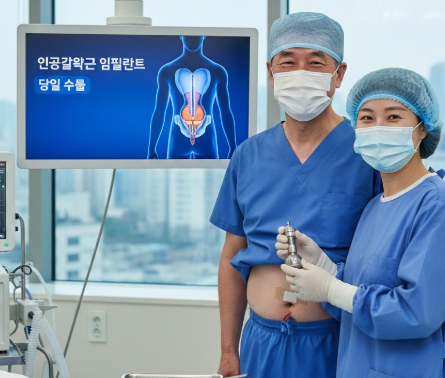
Treatment Overview
Day surgery artificial sphincter implantation is an advanced procedure for treating severe stress urinary incontinence (SUI) in a minimally invasive, same-day surgical setting. Unlike traditional inpatient surgery, patients can undergo the implantation of an artificial urinary sphincter (AUS) and return home the same day. Korea is a global leader in day surgery AUS procedures due to its high-quality hospitals, experienced urologists, and use of advanced minimally invasive techniques.
The procedure involves implanting a mechanical urinary sphincter system that mimics the function of the natural sphincter. Korean surgeons use precision-guided techniques and high-resolution imaging to ensure correct placement, minimizing complications while maintaining high continence success rates. Day surgery AUS implantation combines functional restoration with the convenience of minimal hospital stay.
Purpose & Benefits
The purpose of day surgery AUS implantation is to restore bladder control efficiently while minimizing hospitalization. Patients who suffer from SUI due to prostate surgery, trauma, or sphincter dysfunction can regain independence and quality of life without extended hospitalization.
Key benefits include:
• Same-day discharge for convenience and comfort
• Faster return to daily activities
• Reduced risk of hospital-acquired infections
• Minimally invasive technique with small incisions
• High precision implant placement for long-term continence
• Personalized surgical planning with advanced imaging
• Enhanced patient satisfaction due to efficiency and comfort
Korean hospitals integrate high-tech surgical devices with outpatient care protocols to deliver excellent outcomes for both domestic and international patients.
Ideal Candidates
Day surgery AUS implantation is suitable for patients who require effective urinary sphincter restoration but prefer minimal hospital stay. Ideal candidates include:
• Adults with moderate to severe stress urinary incontinence
• Patients post-prostatectomy or pelvic surgery
• Individuals in good general health with no significant comorbidities
• Patients capable of home-based postoperative care
• Those seeking fast recovery and minimally invasive procedures
• International patients preferring short-term hospitalization
Korean specialists perform thorough evaluations including urodynamic studies, cystoscopy, and imaging to confirm patient suitability for day surgery.
Possible Risks & Complications
Even though day surgery AUS implantation is minimally invasive, patients should be aware of potential risks:
• Infection at the incision or implant site
• Device malfunction or mechanical failure
• Urethral erosion or atrophy from cuff pressure
• Persistent urinary leakage if device is miscalibrated
• Mild pain, swelling, or bruising
• Rare anesthesia-related complications
Korean hospitals employ strict sterile protocols, advanced intraoperative monitoring, and detailed patient education to reduce these risks.
Techniques & Technology Used
Korea’s day surgery AUS procedures utilize modern technology and minimally invasive techniques for precision and efficiency:
• Micro-incision or small incision surgery
• Robotic-assisted or laparoscopic instruments for accurate placement
• Real-time imaging including ultrasound and endoscopic guidance
• Pressure-regulated, biocompatible AUS devices
• Preoperative 3D mapping for customized device positioning
• Minimally invasive entry points to reduce scarring and enhance recovery
These technologies allow for safe, high-quality, and cosmetically favorable outcomes in a day surgery setting.
Treatment Process in Korea
The treatment process for day surgery AUS implantation is streamlined for efficiency, safety, and patient convenience:
- Pre-Arrival Consultation
Patients provide medical history and previous test results for assessment. - Diagnostic Evaluation
On arrival, patients undergo urodynamic testing, cystoscopy, urine tests, and pelvic imaging. - Surgical Planning
Surgeons develop a tailored plan, including incision strategy, device type, and cuff placement. - Surgery
The procedure typically takes 1–2 hours under general or regional anesthesia. Micro-incisions allow for rapid healing and minimal scarring. - Immediate Recovery
Patients are monitored for several hours post-surgery to ensure stable vitals, pain management, and early mobilization. - Discharge
Most patients return home the same day or within 24 hours with detailed instructions for care and device operation. - Follow-Up
Follow-up visits involve device activation, wound assessment, and functional checks. Telemedicine support is often provided for international patients.
Recovery & After-Care
Recovery from day surgery AUS implantation is fast and convenient due to minimally invasive techniques and brief hospitalization.
Patients can expect:
• Mild discomfort or swelling for a few days
• Return to light activities within 1–2 weeks
• Avoidance of heavy lifting or strenuous activities for 4–6 weeks
• Device activation after healing is complete
• Structured follow-up to ensure proper device function
Korean hospitals provide comprehensive after-care including multilingual guidance and telemedicine support for international patients.
Results & Longevity
Day surgery AUS implantation offers excellent continence outcomes, comparable to traditional inpatient surgery. Typical results include:
• Significant reduction or elimination of urinary leakage
• Improved confidence, mobility, and quality of life
• Long-lasting device functionality, usually 7–10+ years
• Minimal scarring and faster recovery than conventional surgery
Korea’s advanced outpatient surgical programs ensure that both efficacy and patient satisfaction are maximized.
Why Korea Is a Top Destination
Korea is a preferred destination for day surgery AUS implantation due to:
• Experienced urologists with expertise in minimally invasive AUS surgery
• Cutting-edge robotic and laparoscopic surgical technologies
• Accredited hospitals with high safety and success standards
• Efficient medical tourism services including translation and travel coordination
• Short waiting times and rapid surgical scheduling
• Competitive pricing compared to Western countries
• Integrated post-op follow-up care and telemedicine options
This combination of expertise, technology, and patient-centered care makes Korea ideal for international medical travelers seeking AUS surgery.
Cost Range
The cost of day surgery AUS implantation in Korea typically ranges from USD 11,000 – 19,000, depending on:
• AUS device model and manufacturer
• Use of robotic or laparoscopic technology
• Hospital type (general or premium center)
• Preoperative diagnostic tests
• Postoperative care and follow-up package
Many hospitals offer comprehensive packages tailored to international patients, combining surgery, diagnostics, and follow-up.
Popular Clinics in Korea
Top hospitals offering day surgery AUS implantation in Korea include:
• Samsung Medical Center
• Asan Medical Center
• Seoul National University Hospital (SNUH)
• Severance Hospital (Yonsei University Health System)
• W Hospital Urology Center
• BnU Urology Clinic
• Chung-Ang University Hospital
• Korea University Anam Hospital
These centers provide advanced minimally invasive surgery, world-class facilities, and dedicated support for overseas patients.


