
Treatment Overview
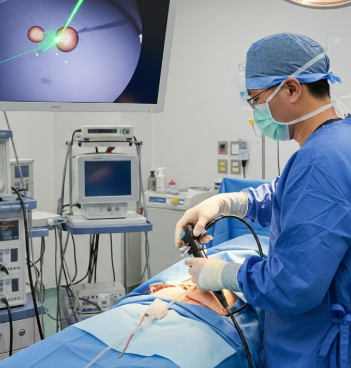
Holmium Laser Stone Fragmentation is one of the most widely used and effective minimally invasive procedures for breaking kidney and ureteral stones. In Korea, this technique is performed using advanced Holmium:YAG laser systems that precisely target and pulverize urinary stones into tiny fragments or dust that can easily pass through the urinary tract.
This method is used during procedures like Ureteroscopy (URS) and Retrograde Intrarenal Surgery (RIRS). Korean hospitals are globally recognized for their high-performance lasers, expert urologists, and cutting-edge digital ureteroscopes that maximize treatment success and patient comfort.
Holmium laser technology is suitable for stones of different sizes, densities, and compositions. Its ability to break both soft and extremely hard stones has made it a gold-standard treatment in leading Korean urology centers.
Purpose & Benefits
The primary purpose of Holmium Laser Stone Fragmentation is to safely break urinary stones into small manageable pieces without performing open surgery. Major benefits include:
- Effective for all stone types, including cystine and calcium oxalate monohydrate
- Minimally invasive approach with no incisions
- High success rate even for complicated stones
- Reduced risk of tissue damage due to precise laser energy
- Quick recovery, making it ideal for medical tourists
- Works with flexible and rigid ureteroscopes
- Suitable for stones in both ureter and kidney
- Less bleeding and post-procedure pain compared to traditional surgical options
Korean specialists also use advanced laser modes such as dusting, fragmentation, popcorning, and Moses technology to optimize results.
Ideal Candidates
Holmium Laser Stone Fragmentation is best suited for:
- Patients with kidney or ureteral stones measuring 5 mm to 3 cm
- Individuals who have failed ESWL (shockwave therapy)
- Patients with stones that cause severe pain, infection, or urinary blockage
- Medical tourists seeking quick, safe, and minimally invasive solutions
- Patients with hard or dense stones resistant to older laser technologies
- Individuals who want to avoid large incisions or lengthy recovery
- Patients requiring precise localization of small stones
This procedure may also be suitable for elderly patients and children depending on individual evaluation.
Possible Risks & Complications
Although Holmium Laser Stone Fragmentation is extremely safe, some possible risks include:
- Mild bleeding or blood in the urine
- Temporary ureteral swelling
- Infection or fever
- Stent-related discomfort if a stent is placed
- Ureteral injury (rare)
- Need for a second session if stones are extremely large
- Temporary pain during fragment passage
Korean hospitals minimize risks through the use of digital scopes, real-time imaging, high-frequency irrigation systems, and meticulous surgical techniques.
Techniques & Technology Used
Korea is known for cutting-edge urological innovations. Holmium Laser Stone Fragmentation typically incorporates:
- High-power Holmium:YAG lasers (30W, 60W, 100W, 120W)
- Dusting Mode – breaks stones into fine powder for natural passage
- Fragmentation Mode – breaks stones into larger pieces for basket retrieval
- Popcorning Technique – vibrates small fragments until they become dust
- Moses Laser Technology – increases efficiency and minimizes retropulsion
- Digital flexible and rigid ureteroscopes for superior visualization
- Ureteral Access Sheaths for smooth instrument entry
- Irrigation pressure control systems to protect kidney health
- Nitinol stone baskets for fragment retrieval
These technologies allow Korean surgeons to achieve exceptionally high stone-free rates.
Treatment Process in Korea
Korea offers a smooth, efficient, and patient-friendly medical experience. Here is the typical process:
1. Initial Consultation & Diagnostics
- CT scan, ultrasound, or X-ray to analyze stone size, density, and location
- Urine and blood tests to screen for infection and kidney function
2. Pre-Procedure Preparation
- Explanation of anesthesia options (general or spinal)
- Antibiotics if infection risk is present
- Instructions regarding fasting before the procedure
3. During the Procedure
- Performed under anesthesia for comfort
- A ureteroscope is inserted through the urethra, bladder, and ureter
- Holmium laser fiber is directed at the stone
- Stone is dusted or fragmented depending on the surgical plan
- Stone baskets may be used to retrieve larger pieces
- A temporary stent may be placed to facilitate healing
Procedure time typically ranges from 30 to 90 minutes depending on stone complexity.
4. Recovery Period
- Same-day discharge or overnight stay depending on the case
- Post-procedure imaging to confirm stone clearance
5. Follow-Up Care
- Stent removal after 1–2 weeks
- Dietary and lifestyle recommendations to prevent recurrence
- Medication support if needed
Recovery & After-Care
The recovery period after Holmium Laser Stone Fragmentation is usually rapid and uncomplicated:
- Most patients resume normal activities within 24–48 hours
- Drink plenty of water to flush out remaining dust
- Expect mild flank discomfort or frequent urination if a stent is present
- Pain medication may be prescribed
- Avoid strenuous activity for one week
- Follow all prescribed antibiotics to prevent infection
Korean hospitals also offer remote consultation and multilingual patient support, which is particularly helpful for international visitors.
Results & Longevity
Holmium Laser Stone Fragmentation delivers long-lasting and effective results:
- High stone-free rate, often above 90% depending on stone size
- Immediate relief from obstruction and pain
- Minimal recurrence when preventive measures are followed
- No visible scarring due to endoscopic technique
- Low complication rate supported by advanced Korean technology
Patients often experience improved urinary comfort and normal kidney function shortly after treatment.
Why Korea Is a Top Destination
Korea is one of the world’s leading destinations for Holmium Laser Stone Fragmentation due to:
- Highly skilled urologists with advanced endoscopic training
- World-class hospitals using the latest laser technologies
- Efficient medical systems with quick appointment scheduling
- Affordable treatment compared to the US, Europe, or Japan
- High success and patient satisfaction rates
- Modern medical tourist support systems (interpreters, coordinators)
- Clean, safe hospital environments with exceptional patient care
Medical tourists trust Korea for both simple and complex urinary stone cases.
Cost Range
The cost of Holmium Laser Stone Fragmentation in Korea generally ranges from:
- USD 2,000 – USD 6,000
(price depends on stone location, size, hospital grade, and anesthesia)
This cost is significantly lower than Western countries while providing superior technology and surgical expertise.
Popular Clinics in Korea
Korea has many renowned hospitals and specialized centers offering Holmium Laser Stone Fragmentation:
- Seoul National University Hospital
- Severance Hospital – Yonsei University
- Asan Medical Center
- Samsung Medical Center
- Korea University Anam Hospital
- Wooridul Hospital
- Seoul Urology Clinic
- CHA Bundang Medical Center
These centers are known for exceptional care, advanced imaging systems, and skilled endoscopic stone surgeons.


