
Treatment Overview
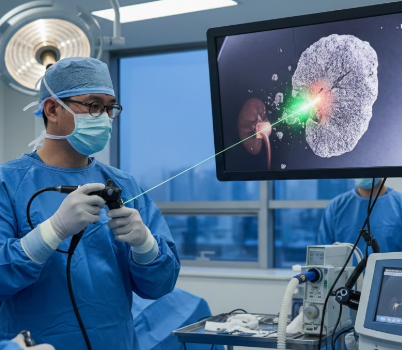
Holmium laser treatment for large kidney stones is one of the most advanced and effective procedures available in modern urology. Korea is a global leader in this technique, offering high-powered Holmium:YAG laser systems capable of treating stones larger than 2 cm, including hard and complex stones that are difficult to remove through standard methods.
This procedure is typically performed using either Retrograde Intrarenal Surgery (RIRS) or Percutaneous Nephrolithotomy (PCNL), depending on the stone’s size, location, and density. Holmium lasers use pulsed energy to precisely fragment stones while minimizing thermal damage to surrounding tissues. As a minimally invasive method, it offers quicker recovery, high stone-free rates, and exceptional safety for both local and international patients.
Purpose & Benefits
The primary purpose of Holmium laser treatment is to safely break down and remove large kidney stones without the need for open surgery. This approach offers several advantages:
- Highly effective for large stones (2–4 cm or more)
- Works on all stone types, including cystine, calcium oxalate monohydrate, and uric acid stones
- Minimally invasive, reducing pain and hospitalization time
- Fast fragmentation with advanced high-frequency dusting technology
- High stone-free rates, even for multiple or complex stones
- Reduced bleeding risk compared to traditional PCNL methods
- Quick return to normal activities, making it ideal for medical tourists
- Low complication rate due to precision laser energy
Korean hospitals are known for using the latest laser modes such as Moses technology, super-pulse dusting, and high-energy fragmentation to maximize treatment success.
Ideal Candidates
Holmium Laser Treatment for large kidney stones is ideal for:
- Patients with stones larger than 2 cm in diameter
- Individuals with multiple stones scattered in different kidney calyces
- Hard stones resistant to shock wave lithotripsy (ESWL)
- Patients who want a minimally invasive treatment option
- Those who previously had failed stone removal procedures
- People looking for a faster recovery with minimal scarring
- Patients with challenging stone shapes like staghorn calculi (partial or complete)
- Medical tourists seeking world-class technology at affordable costs
Patients with abnormal kidney anatomy or severe infection may require special evaluation before proceeding.
Possible Risks & Complications
Holmium laser treatments for large stones are generally safe, but some possible risks include:
- Temporary blood in urine
- Mild kidney or ureteral irritation
- Infection or fever
- Stent discomfort after the procedure
- Rare risk of ureteral stricture (mostly in RIRS cases)
- Kidney bleeding (rare in minimally invasive PCNL)
- Need for a follow-up session if stones are extremely large
Korean hospitals keep risks minimal through experienced urologists, advanced imaging systems, and meticulous intraoperative monitoring.
Techniques & Technology Used
Korea is known for its cutting-edge urology infrastructure. Holmium laser treatment for large kidney stones typically uses:
- High-Power Holmium:YAG Laser Systems (60W, 100W, 120W)
- Flexible Digital Ureteroscopes for RIRS
- Mini-PCNL and Ultra-Mini PCNL Tools for large stones
- Ureteral Access Sheaths to facilitate safe instrument passage
- Stone Dusting, Popcorning, and Fragmentation Modes
- High-frequency pulse lasers for fast stone pulverization
- Digital imaging platforms for 4K intraoperative visualization
- Low-pressure irrigation systems to protect kidney function
- Nitinol stone baskets to retrieve larger fragments
Korean clinics continuously upgrade their laser systems to ensure precision, speed, and higher patient safety.
Treatment Process in Korea
Medical tourists prefer Korea due to its smooth, efficient treatment system. The typical process includes:
1. Diagnostic Evaluation
- CT scan, ultrasound, and X-ray to determine the stone’s size, density, and location
- Urine and blood tests to evaluate kidney function and rule out infection
2. Treatment Planning
Depending on stone characteristics, doctors recommend:
- Holmium Laser RIRS for stones up to 3 cm
- Holmium Laser Mini-PCNL for stones larger than 3–4 cm or staghorn stones
3. Surgical Procedure
- Performed under general or spinal anesthesia
- RIRS: Flexible ureteroscope is passed through the urinary tract
- PCNL: A small puncture is made in the back to access the kidney
- Holmium laser breaks stones into tiny dust or extractable fragments
- A temporary stent may be inserted to support healing
4. Post-Procedure Care
- Recovery monitoring for a few hours or overnight
- Pain control and hydration instructions
- Early mobilization encouraged
5. Follow-Up
- Stent removal after 1–2 weeks
- Ultrasound or CT scan to confirm stone clearance
- Dietary and lifestyle counseling for future prevention
Recovery & After-Care
Recovery after Holmium laser treatment is generally quick and comfortable:
- Light activity can resume within 24–48 hours
- Drink plenty of water to flush out residual fragments
- Temporary urinary frequency or mild discomfort is normal if a stent is placed
- Pain relievers or antibiotics may be prescribed
- Avoid heavy lifting and strenuous exercise for one week
- Most medical tourists can fly home within 3–5 days
Korean clinics also offer multilingual support, telemedicine follow-ups, and personalized recovery plans for international patients.
Results & Longevity
Holmium laser treatment offers excellent long-term outcomes:
- High stone-free rates, even for large and complex stones
- Minimal kidney damage, thanks to precise laser energy
- Low recurrence rates with proper after-care
- No visible scars, especially with RIRS
- Durable long-term results supported by metabolic analysis and lifestyle guidance
Most patients experience immediate relief from pain and obstruction after treatment.
Why Korea Is a Top Destination
Korea is one of the world’s most trusted destinations for advanced kidney stone treatments due to:
- World-class urologists with subspecialty training
- Latest high-power Holmium laser systems
- Specialized stone centers offering comprehensive diagnostics
- Higher success rates compared to many Western countries
- Lower cost despite premium technology
- Multilingual medical coordinators
- Fast scheduling with minimal wait times
- Safe, clean, and comfortable hospital environments
Medical tourists consistently rate Korea as a top choice for reliable, affordable, high-precision stone management.
Cost Range
Holmium Laser Treatment for large kidney stones in Korea typically costs:
- USD 4,000 – USD 9,000
(cost varies depending on stone complexity, technique used, anesthesia, and hospital grade)
Korea offers one of the best price-to-technology ratios globally, making it a preferred destination for affordable high-quality care.
Popular Clinics in Korea
Many top urology centers in Korea specialize in Holmium laser treatments for large kidney stones:
- Seoul National University Hospital
- Asan Medical Center
- Samsung Medical Center
- Severance Hospital – Yonsei University
- Korea University Anam Hospital
- Seoul Urology Clinic
- Wooridul Hospital
- CHA Bundang Medical Center
These clinics are equipped with the newest laser systems and highly skilled stone specialists trusted by international patients.


