
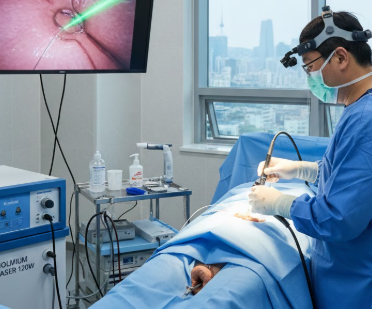
Treatment Overview
Holmium Laser Flexible Ureteroscopy (Flexible URS or RIRS – Retrograde Intrarenal Surgery) is one of the most advanced and minimally invasive treatments for kidney and ureteral stones in Korea. This technique uses a thin, flexible ureteroscope that can bend and navigate deep into the kidney, combined with Holmium:YAG laser technology to fragment stones with extreme precision.
Because the procedure is performed entirely through the natural urinary pathway, no incision is required, making it highly suitable for patients seeking fast recovery and minimal discomfort.
Korea is a global leader in flexible ureteroscopy due to its advanced digital scopes, high-power lasers, and exceptional endourologists. The success rate for stone removal using this technique is among the highest worldwide, making Korea an attractive destination for medical tourists.
Purpose & Benefits
The primary purpose of Holmium Laser Flexible Ureteroscopy is to diagnose and treat kidney or ureteral stones located in areas unreachable by rigid scopes. The holmium laser breaks stones into fine dust or tiny pieces that can pass naturally or be removed with a retrieval basket.
Key benefits include:
- No incision, stitches, or scars
- Effective for stones anywhere in the kidney, even in difficult lower-pole locations
- High stone-free rate (90–98%)
- Suitable for multiple or recurrent stones
- Minimal bleeding and quick recovery
- Works for hard stones resistant to ESWL
- Allows dusting techniques to reduce the need for fragment extraction
- Perfect for patients wanting a comfortable, fast, safe procedure
Korean clinics also offer same-day or next-day discharge, making this ideal for international patients.
Ideal Candidates
You may be an excellent candidate for Holmium Laser Flexible Ureteroscopy in Korea if you:
- Have kidney stones smaller than 2 cm
- Have stones located in hard-to-reach areas of the kidney
- Experience pain, obstruction, or recurrent infections
- Want a minimally invasive, incision-free treatment
- Have stones resistant to shockwave therapy
- Are pregnant or obese (safer alternative to ESWL)
- Have anatomical restrictions making PCNL unsuitable
- Prefer a quick procedure with minimal downtime
This method is widely recommended for medical tourists who want reliable, comfortable stone treatment.
Possible Risks & Complications
Flexible URS is extremely safe, especially in Korea where the procedure is performed using advanced equipment and strict safety standards. However, like any medical procedure, it has potential risks.
Possible complications include:
- Mild bleeding
- Urinary tract infection
- Temporary burning sensation during urination
- Ureteral injury (rare)
- Temporary stent discomfort
- Small fragments remaining that require follow-up
- Rare fever or inflammation
Korean hospitals significantly minimize risks using digital ureteroscopes, high-resolution imaging, and precise laser energy control.
Techniques & Technology Used
Korea is known for its cutting-edge urology equipment and techniques that enhance safety and effectiveness.
Advanced technologies used include:
- Holmium:YAG High-Power Lasers (30W–120W): Efficiently dust or fragment kidney stones.
- Flexible Digital Ureteroscopes: Provide crystal-clear imaging inside the kidney.
- Disposable Ureteroscopes (optional): Reduce infection risks.
- Ureteral Access Sheaths: Allow smooth instrument movement and protect the ureter.
- Stone Dusting Modes: Break stones into ultra-fine particles for easy passage.
- Stone Retrieval Baskets: Remove larger fragments safely.
- Digital Fluoroscopy: Ensures accurate navigation.
- Irrigation Pumps: Maintain clear visibility during surgery.
Thanks to these technologies, Korea achieves some of the world’s highest success rates for flexible ureteroscopy.
Treatment Process in Korea
Korea offers a well-organized and patient-centered treatment journey designed for convenience, safety, and comfort—especially for medical tourists.
1. Initial Consultation & Imaging
Patients undergo CT scan, ultrasound, and sometimes KUB X-ray to locate stones and plan treatment.
2. Pre-Procedure Assessment
Doctors check kidney function, urine culture, blood tests, and anesthesia compatibility.
3. Anesthesia
Flexible URS is typically performed under general or spinal anesthesia for maximum comfort.
4. Flexible Ureteroscopy Procedure
- A flexible ureteroscope is inserted through the urethra into the kidney.
- The holmium laser targets and fragments stones.
- Dusting or fragmentation is chosen based on stone hardness and location.
- Larger fragments may be retrieved using baskets.
5. Stent Placement
A temporary double-J stent is often placed to prevent swelling and ensure smooth urine flow.
6. Discharge
Most patients leave the hospital the same day or the next day.
7. Follow-Up
Stent removal is typically done after 1–2 weeks.
Korean clinics coordinate appointments efficiently for international visitors.
Recovery & After-Care
Recovery after Holmium Laser Flexible URS is generally quick and smooth. Most patients resume daily activities within 24–48 hours.
Important after-care steps:
- Drink plenty of water to help flush out stone dust
- Take prescribed antibiotics and pain medication
- Expect mild discomfort or blood in the urine temporarily
- Avoid strenuous exercise for 1 week
- Attend follow-up for stent removal
- Monitor for high fever or severe pain
Korean hospitals provide multilingual after-care instructions for international patients to follow once they return home.
Results & Longevity
Holmium Laser Flexible Ureteroscopy provides highly reliable and long-lasting results.
Typical outcomes include:
- High stone-free rate in a single session
- Immediate relief from pain or obstruction
- Minimal recurrence with proper lifestyle management
- Improved urinary and kidney function
- Safe and repeatable if needed in the future
Many Korean clinics also offer metabolic evaluations, diet plans, and supplements to help prevent future stone formation.
Why Korea Is a Top Destination
Korea is frequently ranked among the best countries worldwide for kidney stone treatment due to:
- Highly trained endourologists performing large volumes of flexible URS annually
- State-of-the-art digital ureteroscopes and high-power lasers
- Very low complication rates
- Affordable yet premium-quality medical care
- Fast scheduling and efficient system for foreign patients
- English-speaking staff and international patient support services
- Clean, modern hospitals with strict infection control
Medical tourists also appreciate Korea’s convenient airport access, travel support, and transparent pricing.
Cost Range
The cost of Holmium Laser Flexible Ureteroscopy in Korea is very competitive compared to Western countries, offering high value for advanced endoscopic treatment.
Average cost range:
- USD $2,500 – $6,000
The exact price depends on:
- Stone size and number
- Hospital grade (private clinic vs. tertiary hospital)
- Use of disposable vs. reusable scopes
- Need for a stent or additional imaging
The overall cost remains significantly lower than in the U.S., Canada, or Australia.
Popular Clinics in Korea
Many world-class Korean clinics and hospitals specialize in flexible ureteroscopy:
- Seoul National University Hospital (SNUH)
- Asan Medical Center
- Samsung Medical Center
- Severance Hospital (Yonsei University)
- Wooridul Urology Clinic
- Sejong Urology Clinic
- Bumin Hospital Urology Center
- Seoul Urology Clinic (SU Clinic)
These facilities offer international patient coordination, multilingual support, and customized treatment plans.


