
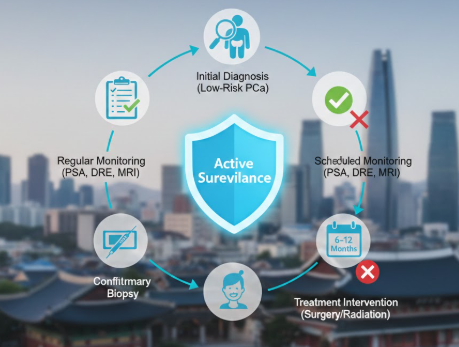
Treatment Overview
Active Surveillance Evaluation is a comprehensive monitoring program for men diagnosed with low-risk or early-stage prostate cancer. Instead of immediate treatment, patients are closely monitored through regular PSA testing, imaging, biopsies, and clinical evaluations to track disease progression while avoiding unnecessary interventions.
In Korea, active surveillance is managed in leading hospitals and urology clinics using advanced diagnostics, personalized care plans, and international patient support.
Purpose & Benefits
The purpose of active surveillance evaluation is to:
- Monitor low-risk prostate cancer safely
- Avoid overtreatment and minimize side effects
- Provide timely intervention if cancer shows signs of progression
Benefits include:
- Minimally invasive management with fewer interventions
- Preservation of quality of life by avoiding unnecessary surgery or radiation
- Early detection of progression through regular monitoring
- Personalized care plans tailored to risk profile
- Integration with advanced diagnostics like mpMRI and targeted biopsy
Ideal Candidates
Active surveillance evaluation is recommended for men who:
- Have low-risk or early-stage prostate cancer (Gleason score ≤6, PSA <10 ng/mL)
- Prefer non-invasive monitoring over immediate treatment
- Are motivated for regular follow-up
- Want to avoid treatment-related side effects such as erectile dysfunction or urinary incontinence
- Are seeking international-standard surveillance programs
Korean urologists carefully assess PSA trends, biopsy results, imaging findings, and patient preferences before enrolling in active surveillance.
Possible Risks & Complications
Active surveillance is generally safe but requires adherence to follow-up:
- Anxiety or stress from ongoing monitoring
- Risk of delayed intervention if cancer progresses
- Rare missed progression between monitoring intervals
- Discomfort or minor complications from periodic biopsies
Techniques & Technology Used
Korean hospitals use advanced tools for active surveillance evaluation:
- Regular PSA and Free PSA testing
- Prostate Health Index (PHI) and 4Kscore for enhanced risk stratification
- Multiparametric MRI (mpMRI) for lesion monitoring
- Targeted biopsy planning if imaging or PSA indicates progression
- Digital Rectal Exam (DRE) for physical assessment
- Genetic risk assessment for high-risk patients
These technologies ensure precise, individualized monitoring.
Treatment Process in Korea
- Initial Consultation & Risk Assessment – Review PSA levels, biopsy, Gleason score, and imaging
- Monitoring Schedule – Regular PSA testing, imaging, and DRE
- Periodic Biopsy or Fusion-Guided Targeted Biopsy – If progression is suspected
- Follow-Up Reviews – Evaluation of trends and adjustment of surveillance plan
- Timely Intervention – Surgery, radiation, or other treatments if disease progresses
Medical tourism coordinators assist international patients with scheduling, translation, and follow-up logistics.
Recovery & After-Care
- No recovery needed for PSA testing, DRE, or imaging
- Resume normal activities immediately
- Minor discomfort after biopsy if performed
- Maintain a record of all test results and imaging reports
- Follow-up intervals typically range from 3–12 months depending on risk
Results & Interpretation
Active surveillance evaluation provides:
- Continuous monitoring of PSA trends and prostate health
- Early detection of disease progression
- Guidance for intervention only when necessary
- Personalized recommendations integrating PSA, PHI, 4Kscore, mpMRI, and biopsy results
This approach balances effective cancer control with quality-of-life preservation.
Why Korea Is a Top Destination
- Experienced urologists specializing in active surveillance programs
- Advanced diagnostic technology including mpMRI, PHI, 4Kscore, and fusion-guided biopsy
- International patient-friendly services with English-language support
- Comprehensive follow-up care tailored for global patients
- Affordable and high-quality care compared to Western countries
Cost Range
Typical costs for active surveillance evaluation in Korea:
₩300,000 – ₩2,000,000 KRW (~$220–$1,500 USD)
Costs vary depending on:
- Frequency of PSA tests, imaging, and biopsies
- Hospital or clinic grade
- Consultation and follow-up coordination fees
Popular Clinics in Korea
- Seoul National University Hospital – Active Surveillance & Prostate Care
- Samsung Medical Center – Advanced Monitoring Program
- Asan Medical Center – Urology & Surveillance Services
- Gangnam Severance Hospital – International Patient Follow-Up
- Korea University Anam Hospital – Prostate Monitoring & Active Surveillance
- JK Urology & Men’s Health Clinics – Personalized Surveillance Programs


