
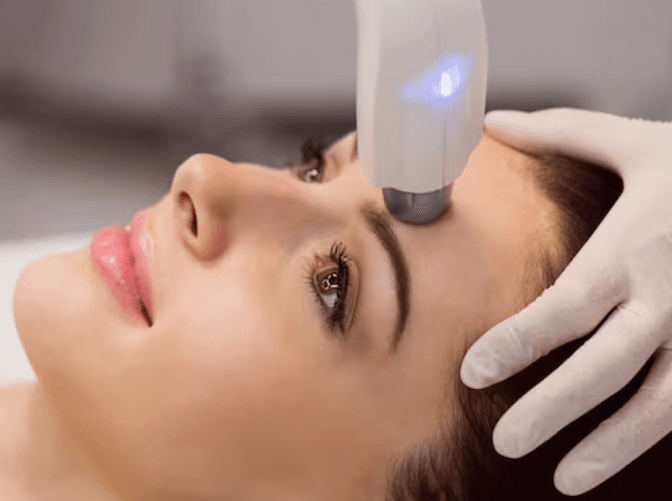
Treatment Overview
Anti-Redness IPL (Intense Pulsed Light) is a non-laser vascular treatment widely performed in Korean dermatology clinics to reduce facial redness, rosacea-related flushing, and post-acne erythema (PIE). IPL uses broad-spectrum light wavelengths that penetrate the skin to selectively target hemoglobin, shrinking dilated capillaries and calming redness while also improving overall tone and texture.
Compared to Vbeam, which is a pulsed-dye laser specialized for redness, Anti-Redness IPL is gentler and more versatile — it can simultaneously address redness, pigmentation, and sun damage in one session. Korean dermatologists often pair IPL with Fraxel, Vbeam, or regenerative boosters (exosomes, PN, PRP) for enhanced, longer-lasting results.
It belongs to the Skin Concerns: Redness, Rosacea, Sensitive Skin, Post-Acne Marks, Photoaging family (Anti-Redness IPL, Acne Redness Vbeam, Redness Fraxel, Pico Toning, Glowing CO₂):
- Anti-Redness IPL: Best for mild to moderate redness + pigmentation.
- Acne Redness Vbeam: Best for inflamed acne redness + PIE.
- Redness Fraxel: Best for tone correction + redness + texture.
- Pico Toning: Best for mild pigmentation + redness with no downtime.
- Glowing CO₂: Best for resurfacing + clarity with downtime.
Purpose & Benefits
- Redness Control: Calms rosacea, flushing, and broken capillaries.
- Post-Acne Healing: Fades PIE (red marks after acne).
- Pigment Correction: Improves freckles, sunspots, and uneven tone.
- Skin Brightening: Creates clearer, more radiant skin.
- Texture Refinement: Shrinks pores and improves mild roughness.
- Gentle & Versatile: Addresses multiple skin concerns at once.
Ideal Candidates
Anti-Redness IPL in Korea is recommended for:
- Adults with mild to moderate facial redness or rosacea.
- Patients with lingering red acne marks (PIE).
- Individuals with blotchy tone, freckles, or sunspots.
- Men and women wanting redness reduction + pigment correction with minimal downtime.
Comparison with Other Treatments
- Anti-Redness IPL: Best for mild redness + pigment correction.
- Acne Redness Vbeam: Best for vascular redness + inflamed acne.
- Redness Fraxel: Best for redness + texture improvement.
- Pico Toning: Best for pigment + mild redness maintenance.
- Glowing CO₂: Best for redness + resurfacing + scars.
Possible Risks & Complications
IPL is safe in Korean clinics, but temporary side effects may include:
- Redness & Swelling: Mild, resolves in 1–2 days.
- Darkening of Spots: Pigment temporarily darkens before peeling.
- Dryness & Flaking: Common during renewal.
- Rare Risks: PIH or burns if done at high settings (rare in expert clinics).
Surgical Techniques Used
Anti-Redness IPL uses intense pulsed light with customizable filters:
- Device: Advanced IPL platforms (Lumenis M22, Stellar M22, etc.).
- Broad Wavelengths: 500–1200 nm for both vascular and pigment targeting.
- Selective Photothermolysis: Breaks down hemoglobin + melanin safely.
- Treatment Zones: Full face, cheeks, nose, chin, neck.
- Protocol: 3–5 sessions spaced 3–5 weeks apart; yearly maintenance optional.
Recovery & Aftercare
- Immediately: Mild redness, warmth, sensitivity.
- 1–2 Days: Redness subsides, pigment may darken.
- 3–7 Days: Spots peel, tone evens, redness fades.
- 2–4 Weeks: Clearer, more even complexion visible.
Aftercare Tips:
- Wear SPF 50+ daily to prevent pigment return.
- Avoid hot baths, saunas, and alcohol for 48 hours.
- Use soothing creams and barrier-repair products.
- Avoid exfoliants, acids, and retinoids until cleared.
- Follow dermatologist’s tailored post-care routine.
Results & Longevity
- Immediate: Calmer, fresher-looking skin post-session.
- Short-Term (1–2 Months): Redness and pigmentation visibly fade.
- Medium-Term (3–6 Months): Continued vascular and pigment clearing.
- Long-Term: Results last 1–2 years; maintenance helps redness-prone patients.
Treatment Process in Korea
- Consultation & Skin Analysis – Doctor evaluates redness, pigment, and vascular condition.
- Preparation – Cleansing + cooling gel applied.
- IPL Session – Pulsed light delivered with customized filter settings.
- Optional Add-Ons – Exosomes, PN, PRP for healing and pigment control.
- Post-Care – Cooling mask, LED calming therapy, sunscreen.
- Follow-Up – Multi-session plan ensures stable redness and pigment reduction.
Why Korea is a Top Destination
- Korea specializes in redness-prone skin (rosacea, PIE, sensitivity).
- Dermatologists use FDA/KFDA-approved IPL systems.
- Clinics offer combination care (IPL + Vbeam + Fraxel + boosters).
- Affordable compared to Western clinics with premium-level care.
- Seoul is a leader in pigmentation and redness-control laser programs.
Cost Range (Detailed Breakdown)
Pricing for Anti-Redness IPL in Korea:
- Single Session (full face): USD 200 – 400
- 3–5 Session Package: USD 600 – 1,500
- IPL + Exosome/PN/PRP Boosters: USD 350 – 800 per session
- Premium Redness Package (IPL + Vbeam + Boosters): USD 1,500 – 3,500
Additional Costs in Korea:
- Consultation: USD 20 – 50
- Add-ons (Exosomes, PN boosters, PRP): USD 150 – 400
💡 Often called the “Korean IPL Tone-Up”, this treatment is popular for patients seeking redness and pigment correction with a radiant finish.
Popular Clinics
- Oracle Dermatology (Seoul): IPL redness + pigment combo care.
- Banobagi Dermatology (Seoul): IPL + Vbeam for rosacea and PIE.
- Renewme Skin Clinic (Seoul): Known for IPL programs for redness-prone skin.
- View Plastic & Dermatology (Seoul): IPL + Fraxel combo for redness + texture.
- Chaum Anti-Aging Center (Seoul): Premium IPL anti-redness with regenerative boosters.


