
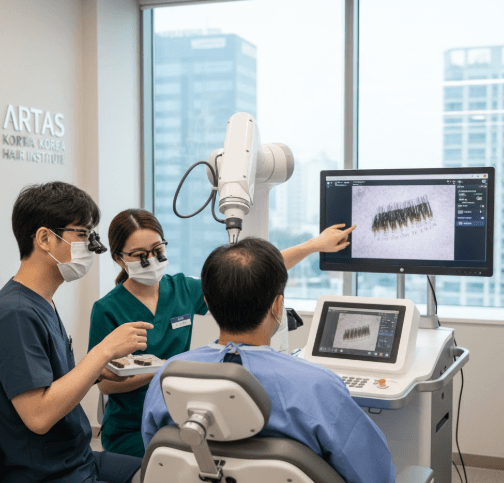
Treatment Overview
The ARTAS “No Shave” Robotic Hair Transplant is an advanced version of robotic FUE (Follicular Unit Extraction) that allows patients to undergo hair restoration without shaving the entire donor area. Using the ARTAS robotic system, surgeons in Korea precisely extract follicular units from within existing hair while keeping the outer appearance nearly unchanged.
This approach is perfect for individuals who want a discreet procedure — ideal for working professionals, celebrities, or anyone who prefers privacy during the recovery period.
Purpose & Benefits
The goal of this treatment is to achieve natural hair restoration with minimal aesthetic disruption during and after surgery.
Key benefits include:
- No visible signs of shaving in donor or recipient areas.
- Quick recovery and minimal downtime.
- Robotic precision ensures uniform extraction and graft quality.
- Natural-looking results with well-designed density and direction.
- Ideal for patients who need to maintain their normal appearance immediately after treatment.
- Korea’s clinics are renowned for combining robotic precision with artistry for seamless outcomes.
Ideal Candidates
You are a great candidate for the “No Shave” ARTAS procedure if you:
- Prefer not to shave your head for professional or personal reasons.
- Have mild to moderate hair loss with sufficient donor density.
- Are looking for natural, discreet results with minimal downtime.
- Have dark or thick hair that helps conceal small donor extractions.
- Are ready to travel to Korea for high-tech, minimally invasive treatment.
Possible Risks & Complications
Although safer and less invasive than traditional methods, potential issues can include:
- Mild redness or swelling in donor and recipient areas.
- Slight shedding of transplanted hairs in the first few weeks.
- Slight difficulty extracting from unshaven donor sites, requiring an experienced surgeon.
- Possible uneven density if donor area is limited.
- Temporary numbness or tightness that subsides with healing.
Techniques & Technology Used
- Robotic FUE Extraction: ARTAS uses AI imaging and robotic arms to harvest individual follicles with precision.
- Selective Donor Harvesting: Only small patches or selected follicles are trimmed, keeping the rest of the hair untouched.
- Microscopic Precision: The system identifies optimal follicles, angle, and depth for graft removal.
- Dense Packing Implantation: Grafts are implanted to match natural growth patterns for a seamless look.
- Adjunct Therapies: Many Korean clinics combine “No Shave” procedures with PRP or laser therapy to enhance graft survival.
Treatment Process in Korea
- Consultation: Online photo or video evaluation followed by an in-person visit for donor-area mapping and design.
- Preparation: Only small donor areas are trimmed strategically; local anesthesia is applied.
- Extraction: ARTAS robot selectively removes follicular units through minimal access points.
- Implantation: The surgeon and team place grafts at precise angles to maintain natural hairline flow.
- Post-Treatment Care: Medication and scalp protection instructions are provided.
- Recovery: Patients can resume daily activities within a few days without visible signs of surgery.
Recovery & After-Care
- Mild swelling or redness for 2–3 days.
- Sleep with head elevated; avoid pressure or scratching.
- Gentle washing allowed after 3–4 days.
- Avoid strenuous exercise, alcohol, and direct sunlight for a week.
- Minimal visibility of donor areas makes recovery discrete and comfortable.
- New hair growth appears within 3–4 months, with full results around 9–12 months.
Results & Longevity
- Early growth becomes noticeable around 3–6 months.
- Final results show fuller density and natural flow within a year.
- Transplanted hair is permanent, as it comes from DHT-resistant donor regions.
- Minimal scarring and natural direction ensure results blend seamlessly with existing hair.
- Maintenance treatments can further enhance thickness and longevity.
Why Korea Is a Top Destination
- Korea leads globally in robotic and no-shave hair transplant technology.
- Surgeons specialize in blending precision robotics with aesthetic design.
- Clinics cater to international patients with translation, airport pickup, and recovery support.
- Competitive pricing paired with world-class outcomes.
- Strong privacy and post-treatment care — ideal for discreet medical tourism.
Cost Range
The cost of an ARTAS “No Shave” Robotic Hair Transplant in Korea varies by graft count and package details:
- Partial hairline restoration: ₩6,000,000 – ₩8,000,000 (≈ USD 4,800 – 6,400)
- Medium-density sessions: ₩8,000,000 – ₩10,000,000 (≈ USD 6,400 – 8,000)
- Full high-density “No Shave” package: ₩10,000,000 – ₩13,000,000 (≈ USD 8,000 – 10,500)
Packages often include consultation, anesthesia, post-care products, and optional lodging for international visitors.
Popular Clinics in Korea
- Dream Hairline Clinic (Seoul): Expert in robotic and no-shave transplants for international clients.
- Moaman Hair Transplant Clinic (Seoul): Specializes in minimally invasive FUE and ARTAS No Shave techniques.
- Seojin Plastic Surgery Clinic (Gangnam): Offers personalized No Shave packages with PRP support for faster recovery.


