
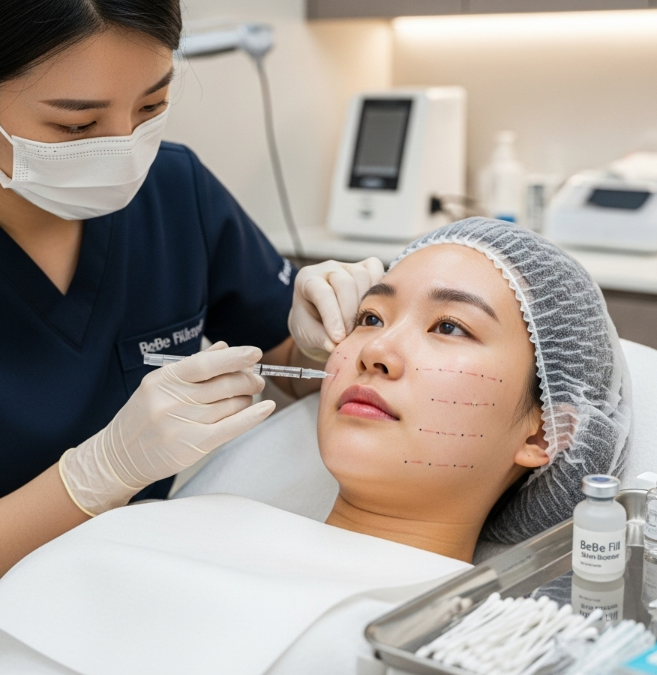
Treatment Overview
BB Laser (also called Laser Toning BB Laser) is a low-fluence Q-switched Nd:YAG laser treatment widely used in Korea for pigmentation disorders, melasma, freckles, and post-inflammatory hyperpigmentation (PIH).
Unlike ablative lasers that peel the skin, BB Laser works gently by sending multiple passes of low-energy light into the dermis. This gradually breaks down melanin clusters, suppresses overactive pigment cells, and stimulates collagen renewal.
In Korea, BB Laser is considered a first-line treatment for hyperpigmentation because it is safe for repeated use, has little downtime, and is effective for Asian skin types that are prone to post-treatment pigmentation.
Purpose & Benefits
- Pigment Reduction: Breaks down melanin for clearer, even-toned skin.
- Melasma Management: Safe, repeated sessions help lighten stubborn melasma.
- Brightening Effect: Improves dull, uneven skin tone.
- Texture Refinement: Smooths skin and reduces pore size.
- Collagen Boost: Thickens dermis, supporting long-term skin health.
- Synergy: Works best when combined with peels, PRP, or skin boosters.
Ideal Candidates
BB Laser in Korea for hyperpigmentation is recommended for:
- Patients with melasma, sun spots, or age spots.
- Individuals with post-inflammatory hyperpigmentation after acne.
- Adults with dull, uneven tone and pigmentation patches.
- Those seeking a gentle pigmentation treatment with minimal downtime.
Comparison with Other Treatments:
- BB Laser: Best for gradual, safe melasma and pigmentation control.
- Laser Toning (Nd:YAG): Stronger settings for stubborn pigmentation.
- Chemical Peels: Good for surface-level pigment exfoliation.
- Vitamin C Infusion: Brightens and protects against oxidative pigmentation.
- Aqua Peel: Best for cleansing and prepping skin before pigment therapies.
Possible Risks & Complications
BB Laser is very safe when performed by skilled Korean dermatologists, but minor side effects may include:
- Mild Redness or Warmth: Fades within hours.
- Temporary Dryness or Flaking: Due to pigment lifting.
- Rare Risks: Over-treatment may cause rebound hyperpigmentation (avoided with Korea’s low-fluence protocols).
Treatment Techniques Used
- Low-Fluence Q-Switched Nd:YAG Laser: Targets melanin in a controlled, gentle manner.
- Multiple Passes: Several layers of treatment per session for deeper effect.
- Session Protocol: Typically 5–10 sessions spaced 2–3 weeks apart.
- Combination Therapy: Often paired with Vitamin C infusion, chemical peels, or Rejuran for stronger outcomes.
Recovery & Aftercare
- Immediately: Mild redness or warmth.
- 1–2 Days: Slight dryness, sometimes faint pigment spots darken before fading.
- 2–4 Weeks: Visible brightening and reduction in pigmentation.
Aftercare Tips:
- Use gentle, hydrating creams.
- Avoid harsh exfoliants (retinol, acids) for 3–5 days.
- Apply SPF 50+ daily to prevent rebound pigmentation.
- Maintain consistent sessions for long-term control of melasma.
Results & Longevity
- Short-Term (2–3 Sessions): Brighter, fresher-looking skin.
- Medium-Term (5–6 Sessions): Noticeable reduction in pigmentation and spots.
- Long-Term (6–12 Months): Results last with maintenance every 3–6 months.
Treatment Process in Korea
- Consultation & Skin Analysis – Doctor identifies pigmentation type (melasma, freckles, PIH).
- Preparation – Cleansing and protective goggles applied.
- BB Laser Session – Low-fluence Nd:YAG laser applied in multiple passes.
- Optional Add-Ons – Vitamin C infusion, Rejuran, or Aqua Peel.
- Post-Care – Cooling mask and hydrating serum.
- Follow-Up – Sessions scheduled every 2–3 weeks for best results.
Why Korea is a Top Destination
- Korean dermatologists are global leaders in melasma management using BB Laser.
- Use of KFDA-approved low-fluence protocols ensures safety for Asian and sensitive skin types.
- Clinics often combine BB Laser with regenerative injectables and peels for optimal results.
- Affordable compared to Western clinics, with package-based pricing.
- Seoul is renowned for multi-step hyperpigmentation care programs.
Cost Range (Detailed Breakdown)
Pricing for BB Laser in Korea for hyperpigmentation:
- Single Session: USD 100 – 200
- 5-Session Package: USD 400 – 800
- BB Laser + Vitamin C Infusion: USD 200 – 400 per session
- Premium Pigmentation Package (BB Laser + Peels + Rejuran/Exosomes): USD 1,200 – 2,000 (5–7 sessions)
Additional Costs in Korea:
- Consultation: USD 15 – 30
- Add-ons (Vitamin C, PRP, Rejuran i, Exosomes): USD 150 – 500
💡 Many patients call BB Laser the “gentle melasma eraser”, because it lightens pigmentation gradually without downtime or irritation.
Popular Clinics in Seoul
- Banobagi Dermatology – BB Laser + melasma protocols.
- Oracle Dermatology – BB Laser + exosome therapy.
- Renewme Skin Clinic – BB Laser + Vitamin C infusion for pigmentation.
- View Plastic & Dermatology – Premium BB Laser + chemical peels.
- Chaum Anti-Aging Center – Luxury pigmentation protocols with BB Laser + boosters.


