
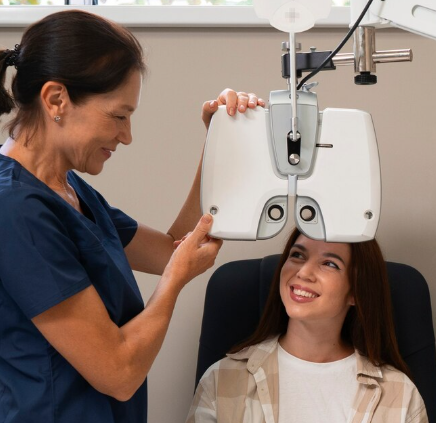
Treatment Overview
Bioptics Vision Correction in Korea is an advanced two-step vision correction technique that combines intraocular lens implantation (such as ICL or refractive lens exchange) with laser corneal reshaping (LASEK or LASIK) to achieve the most precise and comprehensive visual correction possible. It is specifically designed for patients with high myopia, severe astigmatism, or complex refractive errors that cannot be fully corrected by a single procedure.
In the Bioptics approach, the first stage corrects the majority of the refractive error through lens implantation, followed by a customized surface laser procedure (such as LASEK) to fine-tune the vision. Korean ophthalmology centers are global pioneers in AI-guided Bioptics Vision Correction, using wavefront-based excimer lasers, topography mapping, and microsurgical precision to deliver clear, stable, and natural visual results.
The result is high-definition vision across all distances, with reduced glare, minimal recovery time, and lasting stability.
Purpose & Benefits
Purpose
- Correct severe myopia, hyperopia, or astigmatism beyond the limits of standard laser surgery.
- Combine lens-based and corneal-based correction for maximum precision.
- Achieve stable, clear, and permanent vision correction for complex cases.
- Provide a safe alternative for patients with thin corneas or high prescriptions.
Benefits
- Comprehensive Correction: Treats extreme refractive errors with dual precision.
- High Accuracy: AI-guided integration of lens and corneal correction.
- Enhanced Visual Quality: Reduces distortions, halos, and optical aberrations.
- Long-Term Stability: Maintains visual results over decades.
- Safe for Complex Cases: Ideal for patients unsuitable for LASIK or LASEK alone.
- Personalized Outcomes: Tailored correction for each patient’s optical anatomy.
Ideal Candidates
Bioptics Vision Correction in Korea is ideal for:
- Adults aged 18 or older with stable prescriptions for at least one year.
- Individuals with high myopia (over -8.0D) or hyperopia (over +4.0D).
- Patients with thin corneas or irregular curvature preventing full laser correction.
- People with severe astigmatism requiring dual treatment precision.
- Those desiring permanent, clear vision without glasses or contact lenses.
Possible Risks & Complications
Bioptics Vision Correction is a safe, well-established procedure when performed by experienced Korean ophthalmologists. Temporary and mild effects may include:
- Slight dryness or light sensitivity post-surgery.
- Mild halos or glare during the adaptation period.
- Temporary fluctuations in vision during healing.
- Rare infection or inflammation, minimized with advanced sterilization and biologic healing techniques.
Korean clinics reduce risks using AI laser alignment, oxygen-enhanced recovery, and biophotonic tissue regeneration therapy, ensuring precise and safe outcomes.
Techniques & Technology Used
Core Techniques
- Stage 1 – Lens Implantation: Insertion of an ICL (Implantable Collamer Lens) or refractive lens to correct the bulk of the refractive error.
- Stage 2 – Laser Refinement (LASEK): Excimer laser reshaping of the cornea to fine-tune remaining imperfections.
- AI Wavefront Optimization: Corrects higher-order aberrations for maximum visual clarity.
- Topography-Guided Corneal Smoothing: Balances optical zones for perfect focus.
- Oxygen-Enhanced Cooling System: Reduces thermal impact and promotes healing.
- Biophotonic Regeneration Therapy: Stimulates cellular recovery and ensures comfort.
These techniques combine lens precision and corneal refinement to create high-definition, long-lasting vision.
Treatment Process in Korea
Step-by-Step Workflow
- Comprehensive Eye Evaluation: Includes 3D corneal mapping, axial length measurement, and wavefront analysis.
- Stage 1 – Lens Implantation: A biocompatible ICL or lens is inserted to correct major refractive errors.
- Healing Phase: The eyes rest and adapt for 2–4 weeks after lens surgery.
- Stage 2 – LASEK Laser Enhancement: AI-guided surface laser reshaping fine-tunes residual refractive errors.
- Post-Operative Monitoring: Regular digital imaging ensures precise healing and corneal integrity.
The combined procedure is usually completed over 4–6 weeks, providing highly stable and customized results.
Recovery & Aftercare
Aftercare Guidelines
- Use prescribed antibiotic and lubricating eye drops as directed.
- Avoid rubbing or touching the eyes during the recovery period.
- Wear UV-protective sunglasses outdoors.
- Avoid swimming, saunas, or dusty environments for 2 weeks.
- Attend all follow-up appointments to track healing progress.
Recovery Timeline
- 1–3 Days (Post-Lens Surgery): Mild sensitivity; vision starts improving.
- 1–2 Weeks: Stable vision after LASEK enhancement.
- 1–3 Months: Full clarity achieved with complete corneal and lens adaptation.
Results & Longevity
Expected Results
- Sharp, stable, and distortion-free vision.
- Reduced dependency on glasses or contact lenses.
- Improved night vision and contrast sensitivity.
- Enhanced depth perception and visual comfort.
Longevity
Bioptics Vision Correction offers permanent vision correction for most patients.
Korean clinics report success rates above 99%, with stable 20/20 or better vision sustained for over 15–20 years.
With regular eye check-ups, results remain clear and comfortable long-term.
Why Korea Is a Top Destination
- World Leaders in Refractive Innovation: Korea is at the forefront of dual-stage Bioptics systems.
- AI-Guided Integration: Seamless coordination between lens implantation and laser enhancement.
- Microsurgical Excellence: Korean surgeons are renowned for their precision and expertise.
- Regenerative Healing Science: PRF and biophotonic technologies promote rapid recovery.
- Affordable Premium Care: 40–60% more cost-effective than similar procedures abroad.
- International Patient Focus: Multilingual care and advanced vision monitoring systems.
Korea’s combination of AI-guided lens and laser synergy, biologic healing innovation, and ultra-precise optical engineering makes it a world leader in Bioptics Vision Correction.
Unique Korean Methods & Technology
- AI-Integrated Dual-Stage Correction System
- Wavefront & Topography-Guided Ablation
- 3D Corneal and Lens Simulation Mapping
- PRF (Platelet-Rich Fibrin) Ocular Regeneration Therapy
- Biophotonic Laser Healing Technology
- Oxygen-Enhanced Post-Op Recovery
- AI Healing Analytics & Vision Tracking
These advanced technologies ensure biologically safe, precise, and long-lasting visual performance.
Cost Range
| Treatment Package | Price (KRW) | Approx. USD | Inclusions |
|---|---|---|---|
| Standard Bioptics Procedure | ₩4,500,000 – ₩6,000,000 | $3,330 – $4,440 | ICL implantation + surface laser refinement + aftercare |
| Custom AI-Guided Bioptics | ₩6,500,000 – ₩8,000,000 | $4,810 – $5,920 | AI mapping + wavefront-guided enhancement + follow-ups |
| Premium Regenerative Vision Program | ₩8,500,000 – ₩10,000,000 | $6,290 – $7,400 | PRF healing + biophotonic therapy + lifetime vision monitoring |
Popular Clinics
- BGN Eye Clinic (Seoul): Specialists in dual-stage Bioptics with lens and LASEK integration.
- B&VIIT Eye Center (Gangnam): Leaders in AI-guided Bioptics and advanced optical correction.
- Dream Eye Center (Myeongdong): Experts in high myopia and astigmatism correction using Bioptics.
- Olim Eye Clinic (Gangnam): Renowned for regenerative Bioptics and precise refractive enhancement.
- Eyereum Eye Clinic (Apgujeong): Pioneers in AI-calibrated Bioptics with superior visual results.


