
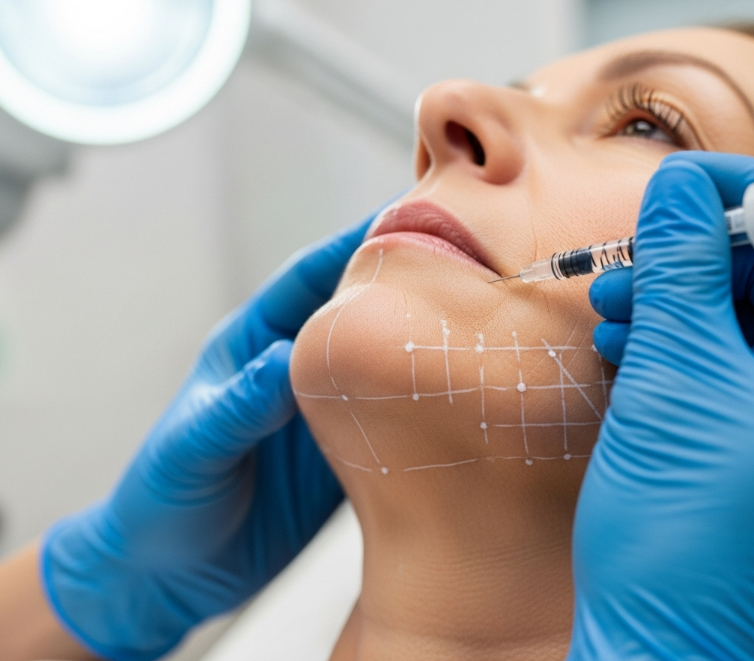
Treatment Overview
Botulinum Toxin Lifting is a Korean dermatology treatment that uses micro-dosed botulinum toxin (Botox, Nabota, or other brands) injected into specific facial muscles to achieve a lifting and tightening effect. Unlike traditional Botox used only for wrinkle relaxation, this lifting technique strategically reduces downward-pulling muscle activity (such as in the jawline or neck), allowing natural upward lift, improved elasticity, and contour definition.
Often referred to as “lifting Botox” or “facial contour Botox” in Korea, this treatment is highly popular for patients seeking a subtle facelift effect without surgery or threads.
It belongs to the Skin Concerns: Sagging Skin family (Air Jet Lifting, Ulthera HIFU, Shurink, Thread Lifting, RF Lifting):
- Botulinum Toxin Lifting: Best for contour definition + lifting effect.
- Air Jet Lifting: Best for non-invasive needle-free lifting.
- Ulthera / Shurink: Best for deep collagen tightening.
- Thread Lifting: Best for instant lifting results.
- RF Lifting: Best for mild sagging and surface tightening.
Purpose & Benefits
- Non-Surgical Lifting: Enhances cheek, jawline, and lower face definition.
- Sagging Reduction: Counteracts downward muscle pull.
- Wrinkle Improvement: Softens fine lines around the eyes, mouth, and forehead.
- Slimmer Jawline: Helps refine facial contour by reducing bulk in lower face.
- Collagen Stimulation: Indirectly improves elasticity through relaxed tension.
- Natural Expression: Maintains mobility while improving lift.
- Synergy with Other Treatments: Often combined with HIFU, Air Jet, or PN boosters.
Ideal Candidates
Botulinum Toxin Lifting in Korea is recommended for:
- Adults in their 20s–50s with early sagging or loss of facial contour.
- Patients with downward-pulling muscles around the jawline, chin, or neck.
- Those who want a subtle lift without surgery or threads.
- Men and women comparing treatments:
- Botulinum Toxin Lifting: Best for muscle-based sagging + contour definition.
- Air Jet Lifting: Best for needle-free tightening.
- Ulthera / Shurink: Best for deep collagen tightening.
- Thread Lifting: Best for instant visible lifting.
Possible Risks & Complications
Botulinum Toxin Lifting is safe, but mild side effects may occur:
- Redness or Swelling: Common, resolves in 24–48 hours.
- Mild Bruising: Temporary at injection points.
- Tenderness: Usually fades within 1–2 days.
- Rare Risks: Asymmetry or over-relaxation (prevented by skilled injection technique).
Surgical Techniques Used
Though non-surgical, this lifting technique requires precision:
- Micro-Dosed Injections: Small units of botulinum toxin injected into specific muscles.
- Targeted Mapping: Focused on platysma (neck bands), jawline, and downward-pulling facial muscles.
- Customized Approach: Injection sites vary depending on sagging severity.
- Combination Therapy: Often layered with HIFU, Air Jet, or PN boosters.
- Multi-Session Protocol: Typically repeated every 4–6 months for sustained results.
Recovery & Aftercare
- Immediately: Mild redness or swelling.
- 1–3 Days: Skin feels tighter as toxin begins to act.
- 2–4 Weeks: Noticeable lifting effect and smoother contours.
- Maintenance: Every 4–6 months for consistent lifting.
Aftercare Tips:
- Avoid lying down for 4 hours after injections.
- Do not massage treated areas for 24 hours.
- Apply SPF 50+ daily.
- Avoid alcohol, saunas, or strenuous exercise for 1–2 days.
Results & Longevity
- Immediate: Subtle tightening effect.
- Short-Term (2–4 Weeks): Improved contour and reduced sagging.
- Medium-Term (2–3 Months): Strongest lifting results visible.
- Long-Term: Effects last 4–6 months, with repeat sessions recommended.
Treatment Process in Korea
- Consultation & Facial Analysis – Doctor evaluates sagging severity and muscle activity.
- Preparation – Cleansing and optional numbing cream.
- Injection Session – Botulinum toxin micro-dosed into specific muscles.
- Optional Add-Ons – HIFU, Air Jet, PN boosters, or threads for synergy.
- Post-Care – Cooling masks or LED therapy if needed.
- Follow-Up – Sessions repeated every 4–6 months for ongoing lift.
Why Korea is a Top Destination
- Korea is a global leader in Botox and lifting techniques.
- Clinics use authentic, KFDA-approved botulinum toxin brands (Nabota, Meditoxin, Botox).
- Dermatologists specialize in micro-dosing for lifting without frozen expressions.
- More affordable than Western clinics with superior precision.
- Seoul is world-famous for non-surgical lifting and facial contouring treatments.
Cost Range (Detailed Breakdown)
Pricing for Botulinum Toxin Lifting in Korea varies by clinic and package:
- Single Session (full face/jawline/neck): USD 250 – 500
- 3-Session Package (recommended): USD 700 – 1,200
- Botulinum Toxin Lifting + HIFU/PN Boosters: USD 600 – 1,200 per session
- Premium Lifting Package (Botulinum Toxin + HIFU + PN/Exosomes): USD 1,800 – 3,200
Additional Costs in Korea:
- Consultation: USD 20 – 40
- Add-ons (PN, PRP, exosomes, threads): USD 200 – 800
💡 Patients often call Botulinum Toxin Lifting the “contour botox” in Korea, since it refines the jawline, tightens sagging areas, and restores youthful definition.
Popular Clinics
- Banobagi Dermatology (Seoul): Offers Botulinum Lifting + HIFU for jawline.
- Oracle Dermatology (Seoul): Specialized in Botox lifting + PN boosters.
- Renewme Skin Clinic (Seoul): Known for Botox lifting for sagging and elasticity.
- View Plastic & Dermatology (Seoul): Combines lifting Botox with thread lifts.
- Chaum Anti-Aging Center (Seoul): Premium lifting Botox + regeneration packages.


