
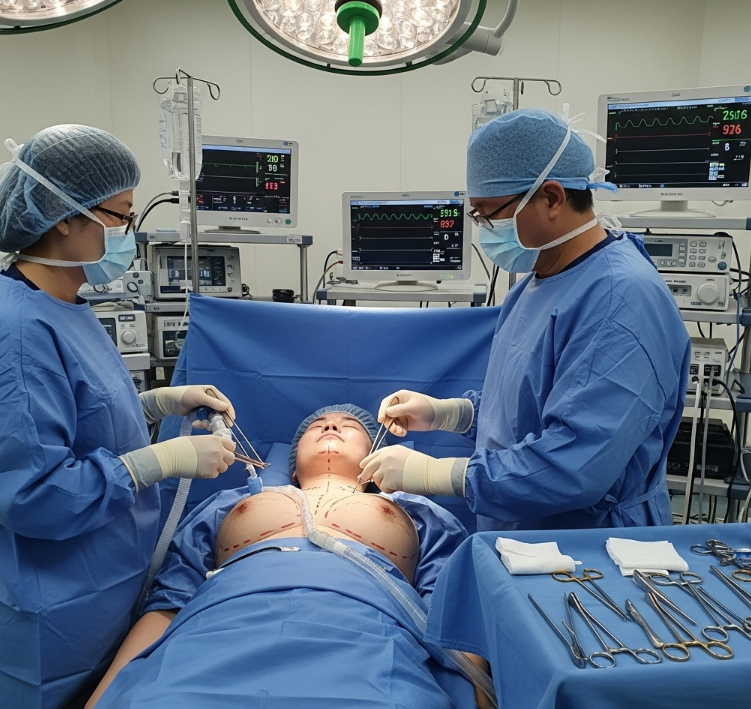
Treatment Overview
Breast Augmentation in Korea is a cosmetic surgical procedure designed to enhance breast size, shape, and symmetry using implants or autologous fat grafting. The procedure aims to improve body proportions, restore breast volume lost due to aging or weight changes, and boost self-confidence.
Korea is globally recognized for its expert surgeons, advanced technology, and natural-looking results, making it one of the top destinations for breast augmentation.
Purpose & Benefits
The main purpose of breast augmentation is to increase breast size and improve shape.
Key benefits include:
- Enhanced breast volume and projection
- Improved symmetry and proportion
- Restored youthful breast contour
- Increased self-confidence and body image
- Wide variety of implant types and sizes for personalized results
- Can be combined with lifts or fat grafting for natural aesthetics
Ideal Candidates
Breast augmentation is ideal for individuals who:
- Desire larger or fuller breasts
- Have asymmetrical or underdeveloped breasts
- Have lost breast volume due to pregnancy, breastfeeding, or weight loss
- Are in good health with realistic expectations
- Wish to improve breast proportion and contour
Possible Risks & Complications
Although Korean clinics maintain high surgical standards, risks include:
- Temporary swelling, bruising, or tenderness
- Infection or bleeding
- Capsular contracture (scar tissue around implants)
- Implant rupture or displacement
- Minor asymmetry
- Rare complications related to anesthesia
Surgical Techniques Used
Korean surgeons utilize advanced techniques for natural results and minimal scarring:
- Submuscular (Under the Muscle) Placement: Provides natural contour and reduces implant visibility.
- Subglandular (Above the Muscle) Placement: Faster recovery, ideal for patients with sufficient breast tissue.
- Dual-Plane Technique: Combines submuscular and subglandular benefits for natural shape and projection.
- Fat Grafting (Hybrid Augmentation): Combines implants with autologous fat to improve softness and correct asymmetry.
- Minimally Invasive Incisions: Inframammary, periareolar, or transaxillary incisions for minimal visible scarring.
Recovery & Aftercare
Recovery is carefully managed to ensure safety and optimal results:
- Light activities can be resumed within 3–5 days.
- Swelling and bruising typically resolve in 2–3 weeks.
- Compression bras are recommended for 4–6 weeks.
- Avoid strenuous chest exercises for at least 4–6 weeks.
- Follow-up visits ensure proper implant position, healing, and symmetry.
Results & Longevity
Results are immediately visible, with final breast shape appearing as swelling subsides in 2–3 months.
- Breast augmentation results are long-lasting, though implants may require replacement after 10–15 years.
- Korean techniques focus on natural contour, minimal scarring, and symmetry for enduring satisfaction.
Treatment Process in Korea
Korea is a leading destination for breast augmentation due to its expertise, technology, and patient-focused care:
- Consultation & Planning: Surgeons assess breast shape, tissue quality, and patient goals using 3D imaging.
- Customized Surgical Plan: Implant type, size, and placement are tailored to body frame and desired outcome.
- Advanced Surgical Techniques: Minimally invasive incisions, precise pocket creation, and meticulous implant placement ensure natural aesthetics.
- Hybrid Options: Many clinics offer combined fat grafting for enhanced softness and contour.
- Post-Operative Care: Structured follow-ups, scar management, and compression garments optimize healing.
- Medical Tourism Support: English-speaking coordinators, accommodation arrangements, and guided recovery services for international patients.
Cost Range
Breast augmentation in Korea is competitively priced with world-class quality:
- Typical Price Range: ₩6,000,000 – ₩12,000,000 KRW
(Approx. $4,500 – $9,000 USD)
Factors Affecting Cost:
- Implant type (silicone, cohesive gel, or anatomical)
- Placement method (submuscular, subglandular, or dual-plane)
- Combination with fat grafting or lift
- Surgeon’s experience and clinic reputation
- Hospital or operating facility fees
Additional Costs:
- Pre-operative tests: ₩150,000 – ₩400,000 KRW ($115 – $300 USD)
- Compression bras and post-op care: ₩150,000 – ₩300,000 KRW ($115 – $230 USD)
- Medications and follow-up visits: ₩200,000 – ₩500,000 KRW ($150 – $380 USD)
Popular Clinics
Some of the most trusted clinics for breast augmentation in Korea include:
- Banobagi Plastic Surgery Clinic – highly experienced in natural-looking augmentations
- JK Plastic Surgery Center – internationally accredited, excellent for medical tourists
- View Plastic Surgery Hospital – combines 3D planning and advanced techniques
- ID Hospital Seoul – specialized in complex breast augmentations and hybrid procedures
- Regen Plastic Surgery – focused on achieving symmetry and natural aesthetics


