
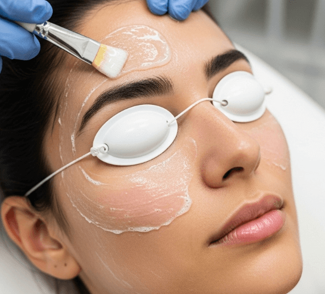
Treatment Overview
Brightening Chemical Peels are a widely used dermatology treatment in Korea for sunspot removal, freckles, dullness, and uneven pigmentation caused by chronic UV exposure.
These peels use carefully formulated acids—such as glycolic acid, salicylic acid, lactic acid, mandelic acid, kojic acid, or trichloroacetic acid (TCA)—to exfoliate damaged skin layers, accelerate cell turnover, and lighten pigmented lesions. In Korea, brightening peels are often customized by combining mild peeling agents with whitening boosters like Vitamin C, arbutin, or tranexamic acid for safer results in Asian skin types prone to PIH.
Purpose & Benefits
- Sunspot Lightening: Gradually fades UV-induced pigmentation.
- Skin Brightening: Restores glow and reduces dullness.
- Even Skin Tone: Improves discoloration and patchy pigmentation.
- Non-Invasive: Quick treatment with little to no downtime.
- Combination-Friendly: Often paired with lasers (Alexandrite, Pico) for deeper pigment clearance.
Ideal Candidates
Brightening Chemical Peels in Korea are recommended for:
- Adults with superficial sunspots (solar lentigines) or UV damage.
- Patients with mild to moderate pigmentation who prefer non-laser options.
- Individuals seeking skin tone improvement and brightness.
- Those looking for affordable and repeatable treatments.
Possible Risks & Complications
Chemical peels are generally safe under Korean dermatology protocols, but possible side effects include:
- Redness or Tingling: Temporary, subsides within hours to 1 day.
- Mild Peeling or Flaking: Common as skin renews.
- Dryness: Requires good moisturization.
- Rare Risks: PIH rebound or scarring if too strong a peel is applied on sensitive skin.
Surgical Techniques Used
- Superficial to Medium Peels: Glycolic, lactic, mandelic, or TCA at adjusted concentrations.
- Brightening Additives: Vitamin C, kojic acid, or tranexamic acid for pigment suppression.
- Customized Peeling: Korean dermatologists tailor peels based on skin type and pigmentation level.
Protocol: Typically 3–6 sessions, spaced 2–4 weeks apart for optimal results.
Recovery & Aftercare
Immediately: Mild redness, tingling, or tightness.
1–3 Days: Possible peeling or flaking.
1 Week: Skin appears smoother and brighter; sunspots gradually lighten.
Aftercare Tips:
- Use SPF 50+ sunscreen daily to prevent new pigmentation.
- Apply gentle, hydrating creams and barrier serums.
- Avoid exfoliants, retinoids, or acids for 5–7 days.
- Do not pick or peel flaking skin.
Results & Longevity
- After 1 Session: Fresher, brighter skin tone.
- After 2–3 Sessions: Noticeable fading of sunspots and improved clarity.
- After 4–6 Sessions: Significant clearance of superficial sunspots.
- Long-Term: Maintenance every 2–3 months may be needed for sun-exposed individuals.
Treatment Process in Korea
Consultation & Skin Analysis
- Dermatologist examines type of pigmentation (sunspot vs melasma vs freckles).
- Peel formula customized for patient’s skin.
Preparation
- Cleansing of the treatment area.
- Application of pre-peel solutions.
Chemical Peel Session
- Step 1: Peeling solution applied evenly across the face or only on pigmented areas.
- Step 2: Peel left on for a few minutes (time controlled by dermatologist).
- Step 3: Neutralizer and soothing mask applied.
- Duration: 15–30 minutes.
Post-Treatment Care
- Cooling mask or hydrating serum applied.
- Sunscreen emphasized before leaving the clinic.
Follow-Up
- 3–6 sessions recommended for best results.
- Often combined with Alexandrite or Pico Lasers for deeper pigmentation.
Unique Korean Advantages
- Customized Peels: Tailored blends (glycolic, mandelic, kojic acid, TXA) for sunspots.
- Asian Skin Safety: Low concentrations in multi-sessions to avoid PIH rebound.
- Affordable Programs: Bundled peel sessions are competitively priced.
- Combination Packages: Clinics often include whitening drips, serums, or mild lasers for stronger results.
Cost Range (Estimated)
- Single Session: USD 80 – 150
- 3–6 Session Package: USD 300 – 700
- Premium Program (Peels + Whitening Drips/Boosters): USD 800 – 1,500
Additional Costs:
- Consultation: USD 20 – 50
- Whitening add-ons (Glutathione, Vitamin C, TXA): USD 100 – 200
- Boosters (PRP, exosomes, Rejuran): USD 200 – 500
Example Korean Packages:
- Basic Brightening Peel (3 sessions): USD 300–400
- Advanced Sunspot Program (Peels + Whitening Drips): USD 600–900
- Premium Package (Peels + Pico or Alexandrite + Boosters): USD 1,200–1,500
Popular Clinics in Seoul
- Oracle Dermatology: Customized chemical peels for sunspots and freckles.
- Banobagi Dermatology: Brightening peels combined with lasers for stubborn pigmentation.
- Renewme Skin Clinic: Whitening-focused peel programs with Vitamin C infusion.
- View Plastic & Dermatology: Peels + Fractional laser for pigment + texture.
- Chaum Anti-Aging Center: Premium sunspot removal with peels + regenerative boosters.


