
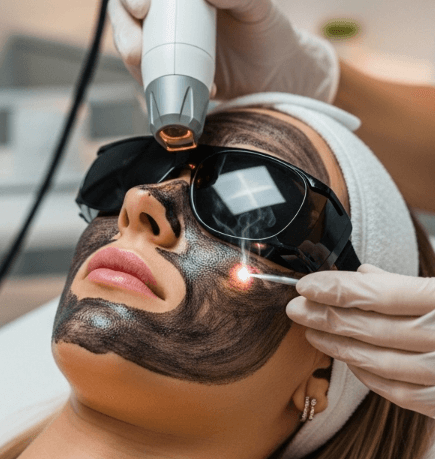
Treatment Overview
The Carbon Laser Peel (often called the “Hollywood Peel” or “China Doll Facial”) is a non-invasive pigmentation and skin rejuvenation treatment that uses a Q-Switched Nd:YAG laser combined with a carbon lotion mask. The carbon particles penetrate deep into the pores, and when activated by the laser, they absorb impurities, excess oil, and pigment, while stimulating collagen production.
In Korea, the Carbon Laser Peel is widely performed for pigmentation, acne, oily skin, large pores, and dull skin. It is especially popular because it delivers gentle yet visible results with no downtime, making it a favorite among both locals and international patients seeking brighter, clearer, and smoother skin.
It belongs to the Pigmentation Treatment family (Carbon Laser Peel, Pico Toning, Laser Toning, IPL, Fractional Lasers):
- Carbon Laser Peel: Best for pigmentation + acne + oily skin + pores.
- Pico Toning: Best for deep pigmentation, freckles, melasma.
- Laser Toning (Q-Switched Nd:YAG): Best for melasma control.
- IPL Photofacial: Best for redness + sun damage.
- Fractional CO₂ / Erbium: Best for deeper resurfacing and scars.
Purpose & Benefits
- Pigmentation Clearance: Reduces freckles, sunspots, and uneven tone.
- Oil & Acne Control: Carbon absorbs oil, impurities, and bacteria, improving acne-prone skin.
- Pore Minimization: Tightens enlarged pores for smoother skin texture.
- Skin Brightening: Restores radiance and reduces dullness.
- Collagen Stimulation: Improves fine lines, elasticity, and firmness.
- Gentle with No Downtime: Quick procedure with immediate glow.
Ideal Candidates
Carbon Laser Peel for pigmentation in Korea is recommended for:
- Adults with pigmentation issues (freckles, sunspots, uneven tone).
- Patients with oily skin, clogged pores, or active acne.
- Individuals with dull skin lacking radiance.
- Men and women comparing treatments:
- Carbon Laser Peel: Best for pigmentation + acne + pores.
- Pico Toning: Best for stubborn pigmentation + scars.
- Laser Toning: Best for melasma.
- IPL: Best for redness + sun damage.
- Fractional CO₂: Best for deeper textural issues.
Possible Risks & Complications
Carbon Laser Peel is safe and well-tolerated, but mild effects may occur:
- Redness or Warmth: Temporary, fades in hours.
- Dryness or Flaking: Short-lived as skin renews.
- Rare Risks: Over-treatment may cause mild irritation or temporary pigmentation changes (rare with expert care).
Surgical Techniques Used
Carbon Laser Peel combines carbon lotion + Q-Switched Nd:YAG laser:
- Carbon Lotion: Applied to the skin, penetrates pores, and binds impurities.
- Q-Switched Nd:YAG (1064 nm): Vaporizes carbon particles, shattering pigment and cleaning pores.
- Protocol: 3–6 sessions spaced 2–4 weeks apart for best results. Maintenance recommended every 3–6 months.
Recovery & Aftercare
- Immediately: Skin looks refreshed, clearer, and smoother.
- 1–2 Days: Slight dryness or flaking may occur.
- 1–2 Weeks: Pigmentation and pores continue to improve.
Aftercare Tips:
- Use hydrating serums and barrier creams.
- Apply SPF 50+ daily to protect against pigmentation recurrence.
- Avoid scrubs, retinoids, and acids for 3–5 days.
- Stay out of direct sun during treatment cycles.
Results & Longevity
- After First Session: Immediate glow and tighter pores.
- Short-Term (2–3 Sessions): Reduction in pigmentation and acne activity.
- Medium-Term (4–6 Sessions): Brighter tone, smoother texture, and reduced oiliness.
- Long-Term: Maintenance treatments every 3–6 months sustain results.
Treatment Process in Korea
- Consultation & Skin Analysis – Doctor evaluates pigmentation, acne, and pores.
- Preparation – Cleansing, application of carbon lotion mask.
- Laser Session – Q-Switched Nd:YAG laser activates and removes carbon particles.
- Post-Care: Cooling gel or soothing mask applied.
- Follow-Up: Multi-session plan for cumulative improvements.
Why Korea is a Top Destination
- Korea offers latest Q-Switched and Pico-based Carbon Peel systems.
- Dermatologists specialize in pigmentation + acne dual treatments.
- Affordable compared to Western pigmentation correction packages.
- Many Seoul clinics market this as a “lunchtime peel” with no downtime.
- Patients often combine Carbon Laser Peel with skin boosters or Aqua Peel for enhanced glow.
Cost Range (Detailed Breakdown)
Pricing for Carbon Laser Peel in Korea:
- Single Session (full face): USD 100 – 200
- 3–5 Session Package: USD 300 – 800
- Premium Package (Carbon Peel + Aqua Peel + Skin Booster): USD 500 – 1,200
Additional Costs in Korea:
- Consultation: USD 20 – 50
- Add-ons (Exosomes, PN boosters, Vitamin cocktails): USD 100 – 400
💡 The Carbon Laser Peel is often called “the glass skin peel” in Korea, as it leaves the skin looking fresh, clear, and radiant after just one session.
Popular Clinics
- Banobagi Dermatology (Seoul): Carbon Peel + Aqua Peel for pigmentation + pores.
- Oracle Dermatology (Seoul): Carbon Peel programs for acne-prone skin.
- Renewme Skin Clinic (Seoul): Carbon Laser Peel with PN boosters for glow.
- View Plastic & Dermatology (Seoul): Combination Carbon Peel + skin rejuvenation packages.
- Chaum Anti-Aging Center (Seoul): Premium Carbon Peel with regenerative care add-ons.


