
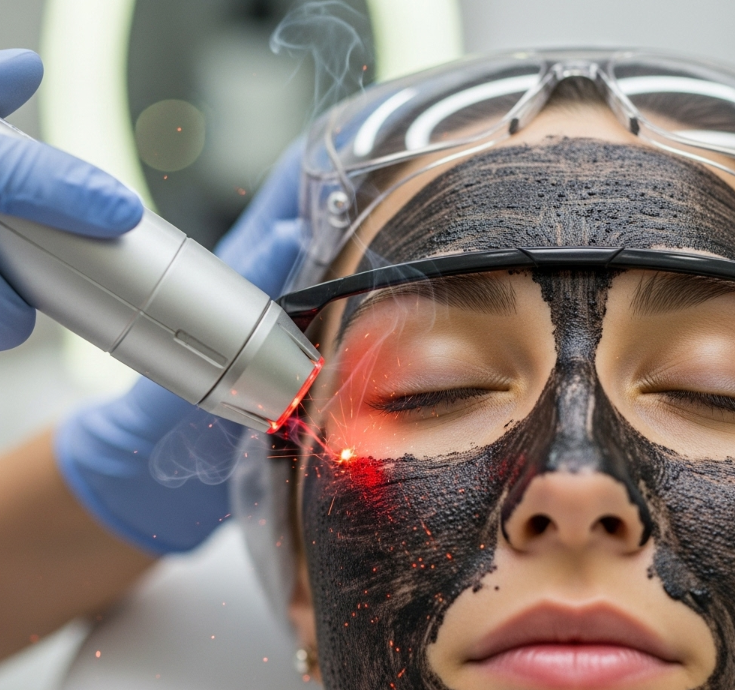
Treatment Overview
The Carbon Laser Peel (also known as the Hollywood Peel or China Doll Facial) is a non-invasive Q-Switched Nd:YAG laser treatment that uses a thin layer of liquid carbon applied to the skin before laser pulses are delivered. The carbon absorbs oil, impurities, and pigment, which are then targeted by the laser to deeply cleanse, exfoliate, and rejuvenate the skin.
In Korea, the Carbon Laser Peel is often included in pigmentation treatment programs to lighten melasma, PIH (post-inflammatory hyperpigmentation), and dull tone, while simultaneously controlling acne and minimizing pores. Although melasma often requires combination therapy (Nd:YAG, Pico, or Gold Toning lasers), the Carbon Laser Peel serves as a gentle adjunct treatment that reduces pigmentation triggers like excess oil, inflammation, and uneven skin renewal.
It belongs to the Pigmentation Treatment family (Carbon Laser Peel, Q-Switched Nd:YAG, Dual Toning, Gold Toning, Pico Lasers, CO₂ Fractional):
- Carbon Laser Peel: Best for melasma support + brightening + acne/oil control.
- Nd:YAG Laser Toning: Best for dermal melasma and PIH.
- Dual Toning: Best for multi-layer melasma.
- Gold Toning: Best for vascular melasma and inflamed pigmentation.
- Pico Lasers: Best for stubborn melasma + scars.
- CO₂ Fractional: Best for textural irregularities with pigment.
Purpose & Benefits
- Melasma Support: Helps lighten superficial pigmentation when combined with other lasers.
- Pigment Reduction: Breaks down melanin clusters for more even tone.
- Oil & Acne Control: Carbon absorbs excess oil and impurities.
- Pore Minimization: Tightens pores for smoother texture.
- Collagen Stimulation: Improves firmness and elasticity.
- Gentle Brightening: Adds glow with minimal downtime.
Ideal Candidates
Carbon Laser Peel in Korea is recommended for:
- Adults with melasma, PIH, or sun-induced pigmentation.
- Patients with dull, oily, or acne-prone skin alongside pigmentation.
- Individuals seeking a gentle treatment to complement other melasma lasers.
- Men and women comparing treatments:
- Carbon Peel: Best for surface pigment + acne + pores.
- Nd:YAG: Best for dermal melasma.
- Dual Toning: Best for multi-layer melasma.
- Gold Toning: Best for vascular-linked pigmentation.
- Pico Lasers: Best for resistant melasma + scarring.
- CO₂ Fractional: Best for texture + pigment.
Possible Risks & Complications
Carbon Laser Peel is safe, but mild effects may include:
- Redness or Warmth: Temporary, resolves in hours.
- Mild Dryness or Flaking: Short-lived as skin renews.
- Rare Risks: PIH or uneven tone if aftercare is ignored.
Surgical Techniques Used
Carbon Laser Peel uses Q-Switched Nd:YAG technology with a carbon mask:
- Carbon Lotion Application: Carbon absorbs impurities, pigment, and oil.
- Laser Activation: Laser pulses vaporize carbon, exfoliating and breaking down melanin.
- Protocol: 3–6 sessions spaced 2–4 weeks apart; often combined with Nd:YAG toning or Pico for melasma.
Recovery & Aftercare
- Immediately: Mild redness, skin feels fresher.
- 1–2 Days: Possible dryness or micro-flaking.
- 1–2 Weeks: Progressive lightening of melasma and improved glow.
Aftercare Tips:
- Use SPF 50+ sunscreen daily to prevent melasma rebound.
- Apply hydrating and soothing creams.
- Avoid harsh scrubs, acids, or retinoids for 3–5 days.
- Limit direct sun exposure during treatment cycles.
Results & Longevity
- After First Session: Brighter tone and smoother skin.
- Short-Term (2–3 Sessions): Noticeable reduction in surface pigmentation.
- Medium-Term (3–6 Sessions): Improved melasma clarity when combined with toning lasers.
- Long-Term: Maintenance sessions every 3–6 months to prevent recurrence.
Treatment Process in Korea
- Consultation & Skin Analysis – Doctor evaluates melasma depth and triggers.
- Preparation – Cleansing, application of carbon lotion.
- Laser Session – Nd:YAG pulses vaporize carbon, exfoliating and targeting melanin.
- Post-Care: Cooling mask, hydration boosters, or whitening serums.
- Follow-Up: Multi-session program for safe melasma management.
Why Korea is a Top Destination
- Korea is a global leader in laser toning and melasma care for Asian skin.
- Dermatologists use combination protocols (Carbon Peel + Nd:YAG/Dual/Gold Toning/Pico) for safe, effective melasma control.
- More affordable than Western pigmentation treatments.
- Clinics often include skin boosters (Rejuran, exosomes, PN) alongside Carbon Peel for improved glow.
- Seoul is world-renowned for “glass skin” melasma treatment programs.
Cost Range (Detailed Breakdown)
Pricing for Carbon Laser Peel in Korea:
- Single Session (full face): USD 100 – 200
- 3–6 Session Package: USD 300 – 800
- Premium Package (Carbon Peel + Toning/Pico + Boosters): USD 800 – 2,000
Additional Costs in Korea:
- Consultation: USD 20 – 50
- Add-ons (Exosomes, Rejuran, PN boosters, Whitening drips): USD 100 – 400
💡 The Carbon Laser Peel is often called “the glass skin peel” in Korea. For melasma, it works best as a supportive therapy, usually paired with Nd:YAG or Dual Toning lasers for deeper pigment control.
Popular Clinics
- Banobagi Dermatology (Seoul): Carbon Peel + Nd:YAG for melasma and pigmentation.
- Oracle Dermatology (Seoul): Carbon Peel for PIH and glow as part of melasma programs.
- Renewme Skin Clinic (Seoul): Carbon Peel + Pico for resistant melasma.
- View Plastic & Dermatology (Seoul): Combination Carbon Peel + Gold Toning for vascular melasma.
- Chaum Anti-Aging Center (Seoul): Premium melasma protocols with Carbon Peel + boosters.


