
Treatment Overview
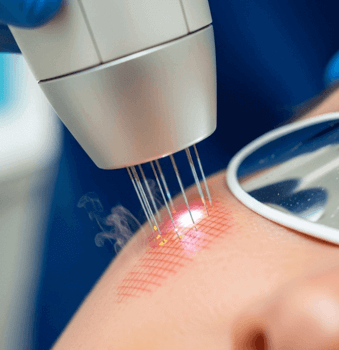
CO₂ Fractional Laser is an advanced resurfacing treatment widely used in Korean dermatology for acne scars, enlarged pores, wrinkles, and skin texture irregularities. It works by delivering microscopic columns of laser energy deep into the skin, vaporizing damaged tissue while leaving surrounding skin intact. This stimulates collagen remodeling, skin tightening, and resurfacing, resulting in smoother, firmer, and more even-toned skin.
Unlike gentle toning lasers, CO₂ Fractional is a more intensive treatment designed for deeper skin concerns such as scarring, severe texture problems, and advanced photoaging.
It belongs to the Skin Concerns: Acne Scars, Enlarged Pores, Wrinkles, Texture family (Laser Toning, Pico Toning, Carbon Laser Peel, Aqua Toning, INFINI RF):
- CO₂ Fractional Laser: Best for scars + deep resurfacing + wrinkle reduction.
- Laser Toning: Best for melasma and pigmentation.
- Pico Toning: Best for pigment + brightening with minimal downtime.
- Carbon Laser Peel: Best for oily skin + pore cleansing.
- INFINI RF: Best for skin tightening and deep dermal remodeling.
Purpose & Benefits
- Scar Improvement: Reduces acne scars, atrophic scars, and surgical marks.
- Wrinkle Reduction: Smooths fine lines and deeper wrinkles.
- Pore Refinement: Shrinks enlarged pores through collagen thickening.
- Texture Resurfacing: Improves rough, uneven skin.
- Collagen Remodeling: Stimulates new collagen and elastin for firmness.
- Skin Tightening: Lifts sagging skin mildly.
- Synergy: Pairs well with exosome boosters, PRP, or PN injections for recovery.
Ideal Candidates
CO₂ Fractional Laser in Korea is recommended for:
- Adults with acne scars, wrinkles, or enlarged pores.
- Patients seeking deep resurfacing rather than mild toning.
- Individuals with photoaged, leathery skin.
- Those who can allow downtime for recovery.
Comparison with other treatments:
- CO₂ Fractional Laser: Best for scars + texture + wrinkles.
- Laser Toning: Best for melasma and pigment only.
- Pico Toning: Best for pigment + gentle rejuvenation.
- Carbon Laser Peel: Best for oil control and pores.
- INFINI RF: Best for tightening + lifting.
Possible Risks & Complications
CO₂ Fractional is safe in Korean dermatology clinics, but stronger than standard toning. Side effects may include:
- Redness and Swelling: Lasts several days.
- Crusting or Flaking: Common during healing phase.
- Hyperpigmentation or Hypopigmentation: Rare, minimized with expert technique.
- Infection: Very rare with proper aftercare.
Surgical Techniques Used
CO₂ Fractional requires precision and expertise:
- Fractional CO₂ Laser Device: Delivers microthermal zones to targeted areas.
- Ablative Micro-Channels: Remove damaged tissue and stimulate healing.
- Targeted Mapping: Focus on scars, pores, and wrinkle-prone zones.
- Adjunctive Therapy: Exosomes, PN, or PRP applied post-laser for enhanced healing.
- Protocol: 2–5 sessions spaced 4–6 weeks apart, with maintenance yearly.
Recovery & Aftercare
- Immediately: Redness, swelling, and pinpoint scabbing.
- 3–7 Days: Skin peels and regenerates, requiring strict hydration.
- 2–4 Weeks: Visible improvement in texture and scars.
- 3–6 Months: Ongoing collagen remodeling for firmer skin.
Aftercare Tips:
- Avoid sun exposure and use SPF 50+ daily.
- Use gentle, hydrating skincare (HA, ceramides).
- Avoid makeup for 3–5 days.
- No exfoliants, acids, or retinoids until fully healed.
- Follow doctor’s post-laser care instructions carefully.
Results & Longevity
- Immediate: Redness, mild tightening after first healing.
- Short-Term (1–2 Months): Noticeable pore shrinking and smoother skin.
- Medium-Term (3–6 Months): Collagen remodeling reduces scars and wrinkles.
- Long-Term: Results can last 1–2 years with maintenance.
Treatment Process in Korea
- Consultation & Skin Analysis – Doctor examines scars, wrinkles, and texture.
- Preparation – Cleansing and numbing cream applied.
- Laser Session – Fractional CO₂ laser applied to target areas.
- Optional Add-Ons – PRP, Exosome boosters, or PN injections for healing.
- Post-Care – Cooling masks, LED therapy, or soothing serums.
- Follow-Up – Multi-session plan for progressive scar and wrinkle improvement.
Why Korea is a Top Destination
- Korea is world-renowned for scar and pore treatments with fractional lasers.
- Clinics use FDA- and KFDA-approved CO₂ fractional devices.
- Dermatologists are highly skilled in layered scar revision protocols.
- Treatments are more affordable than in Western clinics.
- Seoul is known for acne scar packages combining CO₂, RF, and exosome therapy.
Cost Range (Detailed Breakdown)
Pricing for CO₂ Fractional Laser in Korea varies by clinic and package:
- Single Session (full face): USD 300 – 500
- 3–5 Session Package: USD 900 – 2,000
- CO₂ + PRP/Exosome/PN Boosters: USD 500 – 900 per session
- Premium Scar Package (CO₂ + INFINI RF + Exosome + PRP): USD 1,800 – 3,500
Additional Costs in Korea:
- Consultation: USD 10 – 30
- Add-ons (Exosomes, PN boosters, PRP): USD 150 – 500
💡 Patients often call CO₂ Fractional the “scar eraser laser”, as it provides long-term improvement for scars, wrinkles, and texture.
Popular Clinics
- Banobagi Dermatology (Seoul): Specialized in scar + pore treatment with CO₂ fractional.
- Oracle Dermatology (Seoul): Combines CO₂ with PRP or exosomes for advanced recovery.
- Renewme Skin Clinic (Seoul): Offers acne scar packages with CO₂ + RF synergy.
- View Plastic & Dermatology (Seoul): Known for combining CO₂ with lifting lasers.
- Chaum Anti-Aging Center (Seoul): Premium CO₂ protocols with regenerative boosters.


