
Treatment Overview
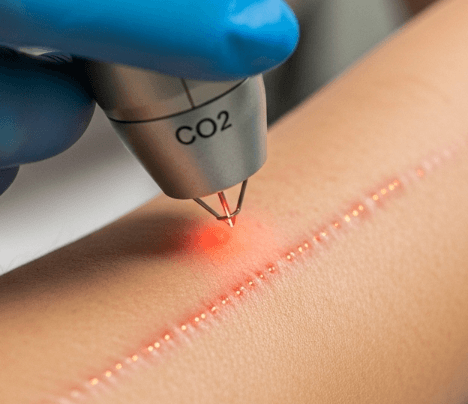
The CO₂ Laser is an ablative laser technology widely used in Korean dermatology for birthmark removal, pigmented lesions, warts, moles, and skin resurfacing. It works by emitting a 10,600 nm wavelength that is absorbed by water in the skin, precisely vaporizing targeted tissue.
For birthmark removal, the CO₂ laser is especially effective in treating raised, textured, or epidermal pigmented birthmarks (such as epidermal nevi or seborrheic keratosis). By removing superficial layers of the lesion, the CO₂ laser helps reduce pigmentation, flatten raised lesions, and stimulate new skin regeneration.
In Korea, CO₂ lasers are often used alongside Alexandrite or Pico/Nd:YAG lasers when both surface and deeper pigmentation need treatment.
Purpose & Benefits
- Birthmark Removal: Especially effective for raised or textured pigmented lesions.
- Surface Pigmentation Clearance: Removes epidermal pigmentation in birthmarks.
- Skin Resurfacing: Smoothens rough or raised birthmark textures.
- Precision: Targets lesions while sparing surrounding tissue.
- Combination Use: Can be paired with other lasers for deep pigmented birthmarks.
Ideal Candidates
CO₂ Laser in Korea is recommended for:
- Patients with raised, thickened, or textured pigmented birthmarks.
- Individuals with epidermal birthmarks (e.g., seborrheic keratosis, epidermal nevus).
- Patients requiring precise lesion removal with skin resurfacing benefits.
- Adults or children after dermatologist confirmation that lesion is benign.
Possible Risks & Complications
While highly effective, CO₂ laser is more invasive than non-ablative lasers, so risks include:
- Redness & Swelling: Common, lasts a few days.
- Crusting/Scabbing: Natural healing response, typically 5–7 days.
- Temporary Darkening: Birthmark may appear darker before fading.
- Rare Risks: Infection, scarring, or post-inflammatory hyperpigmentation (PIH) if aftercare is neglected.
Surgical Techniques Used
- Fractional CO₂: Creates micro-columns in skin for faster healing, used for larger or pigmented patches.
- Traditional Ablative CO₂: Precisely removes raised or thickened birthmarks.
- Combination Protocols: Paired with Pico/Alexandrite for resistant pigment.
Protocol: Typically 1–3 sessions, spaced 4–8 weeks apart depending on birthmark type and depth.
Recovery & Aftercare
Immediately: Redness, pinpoint bleeding, or mild stinging.
3–7 Days: Scabbing and crusting over treated areas.
1–2 Weeks: Scabs fall off, new skin appears lighter.
Aftercare Tips:
- Daily SPF 50+ sunscreen to prevent PIH.
- Keep treated area clean and moisturized.
- Avoid scratching or peeling scabs.
- Avoid saunas, pools, or strong exfoliants until fully healed.
Results & Longevity
- After 1 Session: Noticeable reduction in raised birthmarks, lightening of pigmentation.
- After 2–3 Sessions: Significant flattening and pigment clearance.
- Long-Term: Results are often permanent for raised birthmarks once tissue is removed.
Treatment Process in Korea
Consultation & Skin Analysis
- Dermatologist confirms type of birthmark (raised, pigmented, vascular, mixed).
- CO₂ chosen for raised/textured pigmented lesions.
Preparation
- Cleansing and numbing cream application.
- Protective eyewear for safety.
CO₂ Laser Session
- Step 1: Ablative passes target the birthmark.
- Step 2: Raised or pigmented tissue vaporized.
- Step 3: Cooling mask or ointment applied.
- Duration: 15–30 minutes depending on size.
Post-Treatment Care
- Healing ointment or hydrocolloid dressing applied.
- Sunscreen emphasized before discharge.
Follow-Up
- Typically 1–3 sessions for full removal.
- Combination with Alexandrite or Pico for stubborn pigment.
Unique Korean Advantages
- Fractional CO₂ Systems: Faster healing, reduced downtime compared to older CO₂.
- Combination Therapies: Integrated with pigment lasers for complete clearance.
- Expertise in Asian Skin: Protocols designed to minimize PIH risk.
- Affordable Packages: Multiple-session programs cost less than in Western clinics.
Cost Range (Estimated)
- Small Lesion Removal: USD 100 – 200 per spot.
- Larger Birthmarks (per session): USD 300 – 600
- 3-Session Package (larger areas): USD 800 – 1,500
Additional Costs:
- Consultation: USD 20 – 50
- Healing creams/PRP boosters: USD 100 – 300
Example Korean Packages:
- Basic CO₂ Birthmark Removal (1–2 small lesions): USD 200–400
- Advanced Program (CO₂ + Pico/Alexandrite): USD 1,200–1,800
- Premium Regeneration Package (CO₂ + PRP/Exosomes): USD 1,800–2,500
Popular Clinics in Seoul
- Oracle Dermatology: CO₂ + Nd:YAG for raised pigmented lesions.
- Banobagi Dermatology: CO₂ + Pico for deeper birthmarks.
- Renewme Skin Clinic: Fractional CO₂ for large birthmark patches.
- View Plastic & Dermatology: CO₂ + Fraxel for pigment + texture correction.
- Chaum Anti-Aging Center: Premium CO₂ with regenerative boosters.


