
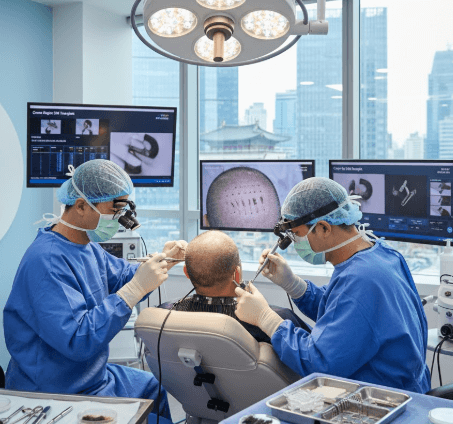
Treatment Overview
Crown-Region DHI Transplant focuses on restoring hair in the vertex or crown area of the scalp — one of the most challenging regions due to its circular growth pattern.
Using the Direct Hair Implantation (DHI) method, Korean surgeons extract and implant hair follicles simultaneously with the Choi Implanter Pen, ensuring perfect control of angle, depth, and direction to replicate natural swirl patterns.
This procedure provides natural density, seamless blending, and long-lasting coverage for men and women experiencing crown thinning or bald spots.
Purpose & Benefits
The main purpose of DHI for the crown is to rebuild natural hair flow and density in the back of the scalp while maintaining realistic hair direction.
Key benefits include:
- Natural swirl pattern and even density
- No visible scarring or stitches
- Minimal trauma and fast healing
- Permanent results with high graft survival
- Suitable for localized bald spots or thinning crowns
Ideal Candidates
Crown DHI is ideal for:
- Men with Norwood Type IV–VII hair loss (crown thinning or bald spot)
- Women with circular hair loss patterns
- Patients with stable donor hair on the back or sides
- Individuals who previously had a transplant and need crown density enhancement
- Those seeking precise, natural crown coverage with minimal downtime
Possible Risks & Complications
Crown DHI is very safe when performed by experienced Korean surgeons.
Minor, temporary side effects may include:
- Mild redness or swelling in the crown region
- Temporary shedding of newly implanted follicles (normal shock loss)
- Slight scalp tenderness for a few days
Korean clinics minimize these effects using PRP therapy, LED light healing, and regenerative scalp serums to accelerate recovery.
Techniques & Technology Used
Korea’s top DHI centers use micro-precision tools and 3D mapping systems to perfectly replicate the natural crown whorl pattern.
Key technologies include:
- Choi Implanter Pens (0.6–0.8 mm) for direct implantation
- Micromotor Extraction Tools for scar-free graft harvesting
- 3D Scalp Density Simulation for customized swirl design
- PRP (Platelet-Rich Plasma) Therapy for improved graft survival
- Low-Level Laser Therapy (LLLT) for faster healing and growth stimulation
This advanced combination ensures natural density and realistic hair direction in the most complex scalp region.
Treatment Process in Korea
Step 1 – Consultation & Design:
3D scalp imaging is used to analyze the crown pattern and design a natural swirl.
Step 2 – Extraction:
Individual follicles are extracted from the donor area using micro punches.
Step 3 – Direct Implantation:
Each graft is implanted directly using the Choi Implanter Pen, following the natural angle of crown growth.
Step 4 – Regenerative Therapy:
PRP or growth-factor injections are applied to strengthen grafts and reduce healing time.
The procedure typically takes 5–7 hours, depending on graft count (usually 1,000–2,500 grafts).
Recovery & After-Care
Recovery after Crown DHI is fast and comfortable. Most patients return to daily life within 2–3 days.
After-care guidelines:
- Avoid washing or touching the scalp for 48 hours
- Use clinic-approved shampoo after 3 days
- Avoid sun exposure and physical strain for 1 week
- Follow-up with PRP or laser sessions for stronger regrowth
- Sleep with the head elevated for the first two nights
Minor redness or crusting typically disappears within 5–7 days.
Results & Longevity
Visible regrowth begins around 3–4 months, with full crown coverage appearing after 10–12 months.
Because transplanted hair follicles are resistant to hormonal loss, results are permanent and continue to thicken over time.
Korean clinics’ precise DHI technique ensures a natural swirl, uniform density, and long-lasting aesthetic balance.
Why Korea Is a Top Destination
Korea is internationally recognized for precision-driven hair restoration and aesthetic expertise in crown design.
Why patients choose Korea:
- Surgeons skilled in complex crown pattern implantation
- Advanced DHI and regenerative technology
- Natural, dense, and permanent results
- Excellent after-care and short recovery time
- Affordable compared to Western hair transplant centers
Cost Range
The cost of Crown-Region DHI Transplant in Korea typically ranges from USD 2,500 – 5,500, depending on:
- Number of grafts required
- Surgeon expertise and clinic reputation
- Inclusion of PRP or regenerative therapy sessions
Popular Clinics in Korea
- ID Hospital – Known for artistic crown swirl reconstruction and DHI density control
- Banobagi Plastic Surgery Clinic – Experts in circular crown design using DHI and PRP
- Forhair Korea – Specialists in complex crown-region DHI with high graft survival
- Moohan Clinic – Focuses on natural swirl and density for both men and women


