
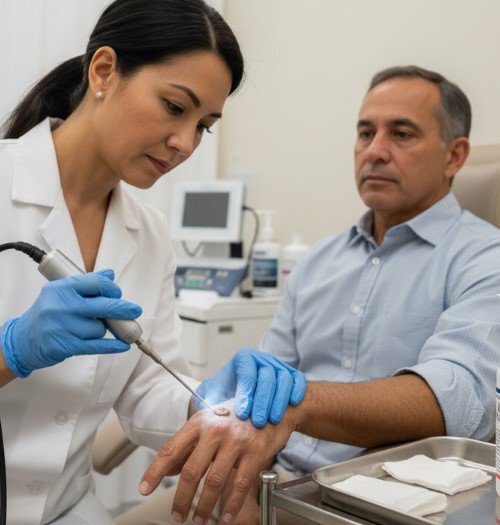
Treatment Overview
Cryosurgery (Cryotherapy) is a dermatology procedure that uses extreme cold (usually liquid nitrogen at –196°C) to freeze and destroy abnormal skin cells. In Korean dermatology clinics, cryosurgery is sometimes used for sunspot (solar lentigines) removal, seborrheic keratosis, warts, and other benign pigmented lesions.
The freezing process destroys melanin-containing skin cells, which then peel off and are replaced by new, healthier skin. While lasers are the more common choice in Korea for cosmetic pigmentation, cryosurgery remains an option for patients preferring a quick, simple treatment for isolated sunspots.
Purpose & Benefits
- Sunspot Removal: Effectively destroys UV-damaged pigmented cells.
- Quick Treatment: Sessions usually take only a few minutes.
- Minimal Equipment Needed: Simple procedure compared to lasers.
- Affordable: Less costly than advanced laser protocols.
- Multi-Use: Can also treat seborrheic keratoses, skin tags, and precancerous lesions.
Ideal Candidates
Cryosurgery in Korea is recommended for:
- Adults with isolated, stubborn sunspots (solar lentigines).
- Patients with fairer skin types (lower PIH risk).
- Individuals who want a fast, low-cost alternative to laser treatment.
- Those not requiring cosmetic blending across larger areas.
Possible Risks & Complications
Cryosurgery is generally safe, but risks are higher in Asian skin compared to laser protocols:
- Redness & Swelling: Common, lasts 1–3 days.
- Blistering/Scabbing: Treated area may blister before healing.
- Hypopigmentation: White patches may appear where pigment is destroyed.
- PIH (Post-Inflammatory Hyperpigmentation): Possible if healing is poor.
- Scarring (Rare): With overly deep freeze.
Surgical Techniques Used
- Liquid Nitrogen Spray or Cotton-Tipped Applicator: Applied directly to the sunspot.
- Freeze–Thaw Cycles: Typically 1–2 short freeze cycles of 5–10 seconds.
- Targeted Approach: Only the lesion is treated, minimizing surrounding skin damage.
Protocol: Often 1 session is enough, but resistant spots may require 2–3 treatments.
Recovery & Aftercare
Immediately: Redness, tingling, or mild pain.
1–3 Days: Blistering or scabbing may occur.
1–2 Weeks: Sunspot peels off, leaving lighter skin.
Aftercare Tips:
- Keep treated area clean and moisturized.
- Apply SPF 50+ sunscreen daily.
- Do not scratch or peel off scabs.
- Avoid saunas, hot baths, or strong exfoliants until healed.
Results & Longevity
- After 1 Session: Many sunspots lighten or disappear as scabs heal.
- After 2–3 Sessions: Stubborn spots significantly improve.
- Long-Term: Results can be permanent if sun protection is maintained, though new sunspots may form with UV exposure.
Treatment Process in Korea
Consultation & Skin Analysis
- Dermatologist confirms sunspot vs other pigmented lesions.
- Cryosurgery chosen if isolated sunspots are present.
Preparation
- Cleansing of treatment area.
- No anesthesia usually needed (short discomfort only).
Cryosurgery Session
- Step 1: Liquid nitrogen applied directly to the sunspot.
- Step 2: Skin freezes, then thaws naturally.
- Step 3: Ointment applied to soothe skin.
- Duration: 5–10 minutes.
Post-Treatment Care
- Cooling cream or ointment applied.
- Sunscreen emphasized.
Follow-Up
- Typically 1 session, but repeat may be needed for darker or larger lesions.
Unique Korean Advantages
- Precise Techniques: Korean dermatologists use controlled freeze times to reduce PIH risk.
- Combination Protocols: Cryosurgery may be paired with brightening serums or mild peels.
- Affordable Option: Cost is lower than most pigment laser programs.
- Quick Treatment: Often completed within a single clinic visit.
Cost Range (Estimated)
- Single Small Spot: USD 30 – 80
- Multiple Spots (per session): USD 100 – 200
- Package (Cryo + Brightening Add-ons): USD 200 – 400
Additional Costs:
- Consultation: USD 20 – 50
- Add-ons (whitening serums, Vitamin C/TXA drips): USD 100 – 150
Example Korean Packages:
- Basic Cryosurgery (1–2 sunspots): USD 50–100
- Advanced Program (Cryo + Whitening Serum): USD 150–250
- Premium Program (Cryo + Laser + Brightening Boosters): USD 300–500
Popular Clinics in Seoul
- Oracle Dermatology: Cryosurgery for isolated sunspots and keratoses.
- Banobagi Dermatology: Combination cryotherapy + laser for stubborn pigmentation.
- Renewme Skin Clinic: Cryosurgery with brightening serums for small UV spots.
- View Plastic & Dermatology: Cryo + fractional laser for pigment + texture.
- Chaum Anti-Aging Center: Premium cryosurgery programs with regenerative add-ons.


