
Treatment Overview
Kidney stones are hard deposits formed from minerals and salts in the kidneys, often causing severe pain, urinary obstruction, or hematuria. Accurate diagnosis is crucial for effective treatment and prevention of complications.
CT (Computed Tomography) scans have become the gold standard for kidney stone diagnosis due to their high accuracy, detailed imaging, and ability to detect even small or complex stones. Korea provides advanced CT scan services combined with expert urological evaluation for both local and international patients.
Purpose & Benefits
The primary purpose of a CT scan for kidney stones is to detect the presence, size, location, and composition of stones, ensuring precise treatment planning. Benefits include:
- High-resolution imaging for accurate stone detection
- Ability to identify stones as small as 1–2 mm
- Detection of multiple stones or complex locations
- Assessment of urinary tract obstruction or complications
- Minimally invasive and fast diagnostic procedure
- International patient-friendly services with quick results and consultation
Ideal Candidates
CT scans for kidney stone diagnosis are recommended for patients who:
- Experience severe flank, back, or abdominal pain
- Present with hematuria (blood in urine)
- Have recurrent urinary tract infections or previous kidney stones
- Require precise imaging before surgical or minimally invasive interventions
- Are high-risk individuals with metabolic disorders or family history of stones
- Medical tourists seeking accurate diagnosis and evaluation abroad
Possible Risks & Complications
CT scans are generally safe, but patients should be aware of minor considerations:
- Exposure to low-dose radiation, which is minimal but should be considered in pregnant women
- Rare allergic reactions to contrast agents if contrast CT is used
- Temporary discomfort during scanning
The benefits of early and accurate kidney stone detection typically outweigh these minimal risks. Korea’s hospitals follow strict safety protocols to minimize any complications.
Techniques & Technology Used
Korean hospitals use state-of-the-art CT technology for kidney stone diagnosis:
Non-Contrast CT Scan (NCCT) – The most common method to detect stones, providing precise images without the need for contrast.
Contrast-Enhanced CT Scan – Used in complex cases to evaluate kidney function and surrounding structures.
3D CT Reconstruction – Provides detailed visualization of stone size, location, and relation to urinary anatomy.
Low-Dose CT Protocols – Minimize radiation exposure while maintaining high diagnostic accuracy.
Integration with Urology Consultation – Radiologists and urologists review images together for accurate diagnosis and treatment planning.
These advanced CT scan techniques enable rapid and precise evaluation of kidney stones.
Treatment Process in Korea
The process for CT scan-based kidney stone diagnosis in Korea includes:
- Initial Consultation
Specialists review symptoms, medical history, and previous imaging or lab tests. - Preparation for CT Scan
Patients may be advised to avoid food or drink for a short period if contrast is used. - CT Scan Procedure
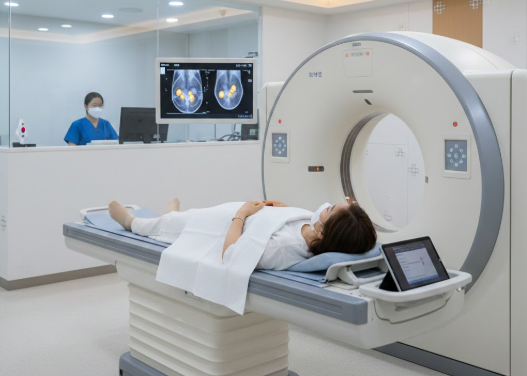
The patient lies on the CT table while high-resolution images are taken, typically lasting 5–15 minutes. - Image Analysis
Radiologists analyze the images to determine stone size, location, number, and potential complications. - Diagnosis & Treatment Planning
Urologists use CT scan results to recommend treatment:- Observation for small, non-obstructive stones
- Medication to aid stone passage or prevent recurrence
- Minimally invasive procedures such as ureteroscopy, laser lithotripsy, or percutaneous nephrolithotomy
- Follow-Up & Monitoring
Patients are scheduled for follow-up imaging and lab tests to monitor treatment progress and prevent recurrence.
Recovery & After-Care
CT scans are non-invasive and require no recovery time. After the scan:
- Patients can resume normal activities immediately
- Hydration is encouraged to support urinary health
- Follow-up appointments may be scheduled to review results and treatment recommendations
For patients undergoing subsequent procedures based on CT results, recovery depends on the chosen intervention, ranging from a few days for minimally invasive treatment to 1–2 weeks for surgical procedures.
Results & Longevity
CT scans provide immediate, accurate results for kidney stone detection. Long-term benefits include:
- Precise localization and characterization of stones
- Early identification of multiple stones or complex urinary anatomy
- Effective treatment planning, reducing recurrence and complications
- Ongoing monitoring to maintain kidney and urinary tract health
Korea’s advanced CT technology and expert urologists ensure long-lasting outcomes for patients.
Why Korea Is a Top Destination
Korea is a leading destination for CT scan-based kidney stone diagnosis because of:
- High-resolution CT imaging with 3D reconstruction
- Experienced radiologists and urologists specializing in kidney stones
- Rapid, efficient evaluation for international patients
- Minimally invasive treatment planning based on accurate imaging
- Transparent pricing and internationally accredited hospitals
- Comprehensive follow-up care for prevention of recurrent stones
These factors make Korea ideal for safe, precise, and timely kidney stone diagnosis.
Cost Range
Estimated costs for CT scan-based kidney stone diagnosis in Korea:
- Consultation: $20–$50
- Non-Contrast CT Scan: $250–$500
- Contrast-Enhanced CT Scan: $400–$700
- 3D Reconstruction and Radiologist Review: $50–$150
- Follow-Up Imaging: $100–$200
- Comprehensive Evaluation Package (Including Lab Tests & CT): $400–$900
Costs may vary depending on hospital, scan type, and additional tests required.
Popular Clinics in Korea
Top hospitals providing CT scan diagnosis for kidney stones include:
- Seoul National University Hospital
- Asan Medical Center
- Samsung Medical Center
- Severance Hospital (Yonsei University)
- CHA Bundang Medical Center
- Wooridul Urology Clinic
These institutions are recognized for advanced imaging technology, precise diagnostics, and comprehensive patient care for both local and international patients.


