
Treatment Overview
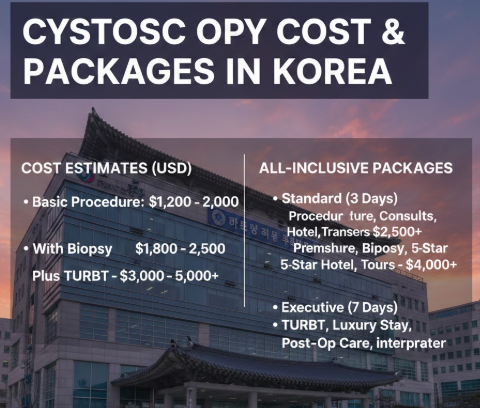
When traveling to Korea for urological assessment, understanding the cost structure and “medical‑tourism package” setup for Cystoscopy is essential. Cost and package offerings vary depending on whether the cystoscopy is diagnostic or therapeutic (e.g. biopsy, stone removal), whether it uses flexible or rigid scopes, and whether it’s part of a broader medical‑tourism service (with interpreter, hospital coordination, accommodation, etc.).
What Influences Cystoscopy Cost in Korea
Several factors influence the cost of cystoscopy for patients in Korea:
- Type of procedure: diagnostic only vs. diagnostic + biopsy or minor intervention.
- Hospital type: university hospital / tertiary hospital vs. smaller clinic or private hospital.
- Additional services: use of flexible or rigid scopes, advanced imaging or narrow‑band imaging, anesthesia type, equipment depreciation, reprocessing costs, etc.
- Support services for international patients: interpreter/translator fees, medical‑tourism coordination, lodging/hospital stay, post‑procedure care, follow-up appointments.
Because of these variables, packages for international patients can include not just the procedure, but a bundle: pre‑procedure evaluation (labs, imaging), the cystoscopy itself, post‑procedure monitoring or short hospital stay (if required), translation/interpreter support, and sometimes accommodation or transport (depending on the service provider).
Estimated Cost Range (Basic & Therapeutic)
Typical cost ranges (self‑pay, without National Health Insurance) are roughly:
| Procedure type / Setting | Approximate Cost (USD) |
|---|---|
| Basic diagnostic cystoscopy (no intervention) | ~$100 – $200 |
| Diagnostic or therapeutic cystoscopy (with biopsy, stone removal, intervention) | ~$400 – $800+ |
Some sources for foreign patients list “from $900” for cystoscopy in bladder‑cancer diagnostic or treatment packages. Because many hospitals bundle interpreter services, translation may add extra cost if not provided free — worth clarifying when you request a quote.
What a Typical International Patient Package Includes
International patient packages in Korea often go beyond just the cystoscopy procedure. A “full” package may include:
- Initial consultation and pre‑procedure evaluation (blood tests, urine tests, imaging).
- Cystoscopy procedure (flexible or rigid scope, with or without intervention).
- Biopsy / minor intervention / stone removal if indicated.
- Post‑procedure monitoring, same‑day discharge or overnight stay (if needed).
- Support services: interpreter/translator, international-patient coordinator, help with scheduling.
- Optional: accommodation arrangement, hospital‑hotel transfers, after‑care instructions and follow-up, medical record translation.
These packages are especially common in hospitals that cater to medical tourists, aiming for a smooth and hassle‑free journey for international patients.
Value Comparison: Why Korea is Attractive for International Patients
- Cost-effective: Korea often offers procedures at significantly lower costs than comparable treatments in the U.S. or Western Europe.
- High medical standards and advanced equipment: Many hospitals use high-definition cystoscopes, and follow strict hygiene, reprocessing, and safety protocols.
- Good support for international patients: Some hospitals provide interpreter services, patient coordinators, and tailored packages for foreign patients.
What You Should Do When Requesting a Quote
If you are planning to travel to Korea for cystoscopy, when contacting a hospital or medical tourism agency you should ask for:
- Breakdown of costs — distinguish between base procedure, anesthesia, biopsy/stone removal (if needed), disposables, hospital stay, and after-care.
- What’s included in the “international patient package” — is interpreter included? Is accommodation or transfer included? Is follow-up care included?
- Option of flexible vs. rigid cystoscopy — and whether there’s an additional charge for flexible scopes.
- Hospital type and level — tertiary/university hospital vs. private/smaller clinic may affect cost and quality.
- Post-procedure support and discharge plan — outpatient vs. inpatient stay, after-care, and follow-up consultations.
- Transparency on foreign-patient fees — some hospitals may charge higher for international patients to cover extra services.
Typical Price Expectation for a Foreign Patient
For a straightforward diagnostic cystoscopy (no major intervention) as an international patient in Korea, a fair estimate is $150–$250 USD. For more complex cases (biopsy, stone removal, or full-service medical-tourism packages), $400–$900+ USD is more realistic.
If combined with tests (imaging, labs), hospital stay, interpreter + coordination + accommodation, the “all-in” package price could go beyond that range depending on the hospital and services included.
Tips & Considerations for International Patients
- Request a detailed, itemized cost estimate before traveling.
- Clarify whether interpreter services, accommodation, or transfers are included.
- Ask if follow-up (post-cystoscopy check, biopsy results, after-care) is included or an extra cost.
- Discuss optional services (e.g., outpatient vs. overnight stay, basic vs. premium room) to control costs.
- Consider currency conversion when budgeting your total expenses.


