
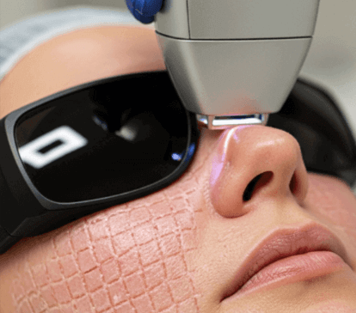
Treatment Overview
Deep CO₂ Resurfacing is an intensive fractional ablative CO₂ laser therapy performed in Korean dermatology clinics to address severe acne scars, deep wrinkles, sun damage, and significant texture irregularities. By delivering high-energy fractional CO₂ beams deep into the dermis, it vaporizes damaged tissue and stimulates collagen and elastin regeneration, creating long-term skin remodeling.
Compared to lighter resurfacing or non-ablative lasers, Deep CO₂ Resurfacing provides dramatic, transformative results, though it requires longer downtime and stricter aftercare. It is often used in combination with PRP, exosomes, or PN boosters to enhance healing.
It belongs to the Skin Concerns: Severe Scars, Deep Wrinkles, Texture, Aging family (UltraPulse CO₂, Collagen Remodeling CO₂, Mosaic Fractional, INFINI RF, Deep Pico):
- Deep CO₂ Resurfacing: Best for severe scars + deep wrinkles + dramatic results.
- UltraPulse CO₂: Best for advanced photoaging and thickened scars.
- Collagen Remodeling CO₂: Best for wrinkles + firmness + texture.
- Mosaic Fractional: Best for milder scars with shorter downtime.
- INFINI RF: Best for lifting + tightening with less recovery.
Purpose & Benefits
- Severe Acne Scar Revision: Breaks down fibrotic scar tissue.
- Wrinkle & Crease Reduction: Treats both fine and deep wrinkles.
- Texture Smoothing: Resurfaces rough, leathery, or sun-damaged skin.
- Skin Tightening: Boosts elasticity by stimulating fibroblasts.
- Pore Refinement: Shrinks enlarged pores as dermis thickens.
- Long-Term Remodeling: Continuous collagen regeneration for months.
Ideal Candidates
Deep CO₂ Resurfacing in Korea is recommended for:
- Adults with severe atrophic acne scars.
- Patients with deep wrinkles and advanced photoaging.
- Individuals with rough, leathery texture or sun damage.
- Men and women willing to accept 1–2 weeks downtime for strong results.
Comparison with other treatments:
- Deep CO₂: Best for severe scars and wrinkles.
- UltraPulse CO₂: Best for advanced resurfacing + anti-aging.
- Collagen CO₂: Best for wrinkle repair and tightening.
- Mosaic Fractional: Best for mild scars with less downtime.
- Deep Pico: Best for scars with gentler recovery.
Possible Risks & Complications
Deep CO₂ resurfacing is safe in expert Korean clinics but has higher intensity, so side effects may include:
- Redness & Swelling: Common, lasting 7–14 days.
- Crusting & Peeling: Skin renewal process.
- Post-Inflammatory Hyperpigmentation (PIH): Prevented with careful aftercare.
- Rare Risks: Infection or scarring if improperly treated.
Surgical Techniques Used
Deep CO₂ Resurfacing uses high-intensity fractional CO₂ energy:
- Laser Device: Fractional CO₂ (UltraPulse, eCO₂, or equivalent).
- Microthermal Channels: Ablate deep into dermis while sparing bridges for healing.
- Custom Depths: Deeper settings for scars/wrinkles, lighter passes for blending.
- Adjunctive Therapy: Often combined with exosomes, PN boosters, or PRP.
- Protocol: 1–2 sessions for dramatic change; maintenance every 1–2 years.
Recovery & Aftercare
- Immediately: Redness, swelling, pinpoint bleeding.
- 5–10 Days: Crusting, peeling, and new skin regeneration.
- 2–4 Weeks: Texture visibly smoother, wrinkles reduced.
- 3–6 Months: Ongoing collagen remodeling for tightening.
Aftercare Tips:
- Avoid makeup until skin heals (5–7 days minimum).
- Apply SPF 50+ daily to prevent pigmentation.
- Use hydrating, barrier-repair skincare (HA, ceramides).
- Avoid retinoids, acids, scrubs until cleared by doctor.
- Follow strict aftercare to minimize risks.
Results & Longevity
- Immediate: Fresher, tighter skin after healing.
- Short-Term (1–2 Months): Significant wrinkle and scar reduction.
- Medium-Term (3–6 Months): Progressive tightening as collagen regenerates.
- Long-Term: Results last several years; boosted with maintenance.
Treatment Process in Korea
- Consultation & Skin Analysis – Doctor evaluates scar and wrinkle severity.
- Preparation – Cleansing, numbing cream, sedation may be used.
- Laser Session – Deep CO₂ applied with customized depth/energy.
- Optional Add-Ons – PRP, exosomes, or PN boosters for faster recovery.
- Post-Care – Cooling masks, ointments, LED therapy.
- Follow-Up – 1–2 sessions usually enough for dramatic improvement.
Why Korea is a Top Destination
- Korea is globally known for advanced scar and wrinkle CO₂ laser protocols.
- Dermatologists use authentic FDA/KFDA-approved Ultra CO₂ devices.
- Clinics offer combination packages (CO₂ + regenerative boosters) for faster healing.
- Prices are lower than Western medspas for high-end resurfacing.
- Seoul is famous for scar correction and age-reversal programs.
Cost Range (Detailed Breakdown)
Pricing for Deep CO₂ Resurfacing in Korea varies by clinic and intensity:
- Single Session (full face): USD 700 – 1,200
- 2–3 Session Package: USD 1,800 – 3,000
- Deep CO₂ + Exosome/PN/PRP Boosters: USD 900 – 1,400 per session
- Premium Scar & Anti-Aging Package (Deep CO₂ + INFINI RF + Exosomes): USD 3,500 – 5,500
Additional Costs in Korea:
- Consultation: USD 20 – 50
- Add-ons (Exosomes, PN boosters, PRP): USD 200 – 600
💡 Patients often call Deep CO₂ Resurfacing the “reset button laser”, since it delivers dramatic skin renewal for scars and aging.
Popular Clinics
- Banobagi Dermatology (Seoul): Deep CO₂ for acne scars + wrinkles.
- Oracle Dermatology (Seoul): Deep CO₂ + regenerative boosters.
- Renewme Skin Clinic (Seoul): Known for strong CO₂ resurfacing programs.
- View Plastic & Dermatology (Seoul): Deep CO₂ + RF for lifting + resurfacing.
- Chaum Anti-Aging Center (Seoul): Premium Deep CO₂ with exosome care.


