
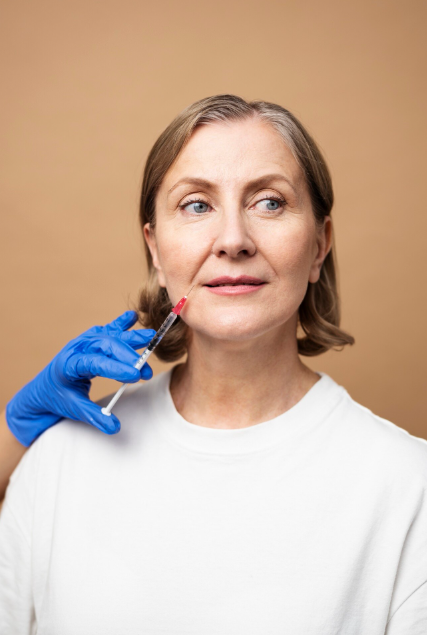
Treatment Overview
Deep Wrinkle Fillers are injectable treatments designed to correct moderate to severe wrinkles and folds, such as nasolabial folds (smile lines), marionette lines, forehead creases, and deep furrows caused by aging and volume loss. These fillers use stronger, longer-lasting formulations of hyaluronic acid (HA) or collagen-stimulating fillers like Radiesse (calcium hydroxyapatite) and Sculptra (poly-L-lactic acid), which provide both immediate smoothing and progressive skin rejuvenation.
In Korea, Deep Wrinkle Fillers are widely used under Dermatology: Skin Rejuvenation, as dermatologists specialize in precision filler techniques that soften wrinkles while maintaining natural expressions. Instead of overfilling, the Korean approach emphasizes balance, harmony, and subtle lift for elegant anti-aging results.
Purpose & Benefits
- Wrinkle Correction: Smooths deep folds such as nasolabial lines and marionette creases.
- Volume Restoration: Plumps sunken areas to reduce sagging.
- Facial Rejuvenation: Restores youthful contours in cheeks, chin, and midface.
- Skin Quality Improvement: Collagen-stimulating fillers enhance firmness and elasticity.
- Natural Lift: Softens signs of aging without altering facial identity.
- Longer-Lasting Results: Compared to fine-line skin boosters.
Ideal Candidates
- Adults with moderate to severe wrinkles or deep facial folds.
- Individuals experiencing loss of midface volume or sagging.
- Patients wanting non-surgical rejuvenation for a more youthful look.
- Men and women seeking natural, long-lasting results.
- Those who previously used HA fillers and now want stronger, longer correction.
Possible Risks & Complications
- Temporary swelling, redness, or bruising at injection sites.
- Mild tenderness or firmness in treated areas.
- Rare risks include lumps, asymmetry, or vascular occlusion (minimized with expert injectors).
- Collagen-stimulating fillers require multiple sessions for best results.
- Overfilling may cause heaviness (prevented with conservative injection methods).
Techniques Used
- Firm HA Fillers (Juvederm Voluma, Restylane Lyft): Provide immediate smoothing and lift.
- Radiesse (CaHA): Offers structure, instant correction, and long-term collagen stimulation.
- Sculptra (PLLA): Gradually restores volume and smoothness by stimulating collagen.
- Deep Injection Techniques: Fillers placed in mid-dermis to deep layers for strong support.
- Combination Therapy: Often paired with thread lifting or skin boosters for comprehensive rejuvenation.
Recovery & Aftercare
- Day 1–2: Mild swelling, redness, or bruising possible.
- Day 3–7: Wrinkle smoothing becomes more natural as fillers settle.
- Week 2–4: Collagen-stimulating fillers begin to show progressive improvement.
Aftercare Guidelines:
- Avoid alcohol, sauna, and vigorous exercise for 24–48 hours.
- Do not massage or press treated areas unless instructed.
- Use SPF daily to maintain results.
- Stay hydrated and follow dermatologist’s aftercare advice.
Results & Longevity
- Instant wrinkle correction with HA and Radiesse.
- Gradual collagen stimulation with Sculptra, improving results over 2–3 months.
- Results typically last:
- HA fillers: 9–15 months.
- Radiesse: 12–18 months.
- Sculptra: Up to 24 months (with 2–3 sessions).
- Maintenance touch-ups recommended every 12–18 months.
Treatment Process in Korea
1. Consultation & Planning
- Dermatologist evaluates wrinkle severity, facial structure, and goals.
- Selection of filler type based on desired longevity and results.
2. Treatment Day
- Cleansing and numbing applied.
- Fillers injected into targeted wrinkle or volume-loss areas.
- Duration: 20–40 minutes.
3. Post-Treatment Care
- Cooling packs or soothing mask used.
- Patients can usually resume normal activities the same day.
4. Follow-Up & Maintenance
- Review after 2–4 weeks if additional adjustments needed.
- Maintenance every 1–2 years, depending on filler type.
Why Korea is a Top Destination
- Korean dermatologists specialize in natural anti-aging artistry, avoiding an overfilled look.
- Clinics offer both HA and collagen-stimulating fillers, tailored to each patient.
- Treatments focus on facial harmony and youthful lift.
- More cost-effective compared to Western clinics, with premium standards.
- Seoul-based clinics are international-friendly, offering English-speaking support.
Cost Range
The cost of Deep Wrinkle Fillers in Korea depends on the filler type, amount used, and clinic reputation:
- Firm HA Filler (per syringe, 1ml): ₩300,000 – ₩500,000 (~USD $220–$380).
- Radiesse (per syringe/vial): ₩600,000 – ₩900,000 (~USD $450–$700).
- Sculptra (per vial): ₩700,000 – ₩1,000,000 (~USD $530–$750).
- Full-Face Deep Wrinkle Rejuvenation: ₩2,000,000 – ₩3,500,000 (~USD $1,500–$2,700).
Additional Costs:
- Consultation Fee: ₩30,000 – ₩70,000 (~USD $20–$50).
- Aftercare skincare (SPF, serums): ₩50,000 – ₩150,000 (~USD $40–$120).
Popular Clinics
- Banobagi Plastic Surgery (Seoul): Experts in anti-aging fillers for deep wrinkles.
- ID Dermatology (Seoul): Specializes in combining HA and Radiesse for strong wrinkle correction.
- View Clinic (Seoul): Known for natural rejuvenation with firm filler techniques.
- JW Plastic Surgery (Seoul): Premium anti-aging treatments with long-lasting fillers.
- Oracle Skin Clinic (Nationwide): Accessible, international-friendly with wrinkle-focused filler programs.


