
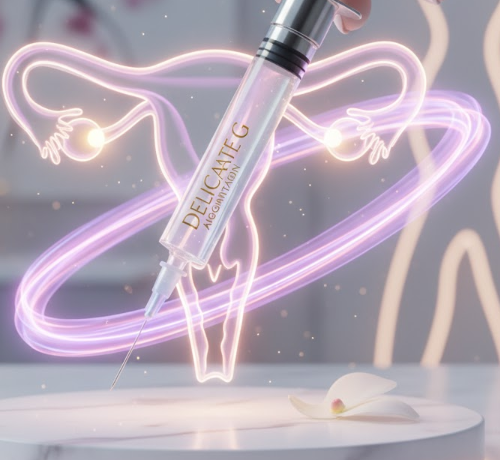
Treatment Overview
Delicate G-Spot Augmentation—also known as the G-Shot Enhancement—is a scientifically guided, minimally invasive procedure performed in Korea to revitalize and restore balance to the anterior vaginal wall tissue commonly linked with the G-spot area.
Korean specialists use biocompatible fillers, platelet-rich plasma (PRP), or exosome-based regenerative solutions to enhance collagen production, hydration, and circulation in this region.
The term “Delicate” reflects Korea’s medical philosophy: precise, natural, and balanced rejuvenation that promotes both comfort and confidence without altering anatomy or sensitivity.
Purpose & Benefits
The primary purpose of Delicate G-Spot Augmentation is to support vaginal wellness and tissue vitality through subtle regeneration.
Main benefits
- Enhanced tissue hydration and elasticity
- Improved local circulation and responsiveness
- Increased natural lubrication and comfort
- Non-surgical procedure completed in under 30 minutes
- Quick recovery and long-lasting rejuvenation
- Greater sense of confidence and feminine wellness
The Korean approach focuses on restoring harmony and function rather than over-enhancement, ensuring results feel natural and balanced.
Ideal Candidates
This procedure may be suitable for women who:
- Experience reduced responsiveness or dryness due to hormonal or age-related factors
- Prefer a non-surgical, regenerative therapy to support feminine wellness
- Wish to maintain natural anatomy while improving tissue vitality
- Value discretion, technology, and holistic patient care offered by Korean clinics
A certified OBGYN consultation ensures the treatment plan aligns with each woman’s anatomy and goals.
Possible Risks & Complications
Delicate G-Spot Augmentation is safe when performed by trained OBGYN professionals.
Temporary, mild side effects can include:
- Light swelling or tenderness for 24–48 hours
- Temporary fullness sensation
- Spot bruising or mild redness
- Rare infection or uneven absorption
Korean clinics minimize risk with ultrasound-guided precision, sterile technique, and medical-grade materials.
Techniques and Technology Used
Korea leads globally in regenerative gynecology and applies the latest medical innovations for this treatment:
- PRP (Platelet-Rich Plasma): Uses growth factors from the patient’s blood to stimulate collagen renewal.
- Hyaluronic-acid micro-fillers: Restore gentle fullness and hydration.
- Exosome Therapy: Enhances cell regeneration and tissue elasticity.
- Ultrasound-guided micro-injection: Ensures perfect accuracy and comfort.
- Cooling anesthesia systems: Provide a virtually painless experience.
Each step is carefully calibrated to achieve subtle enhancement and healthy tissue renewal.
Recovery & Aftercare
Recovery is brief and comfortable.
Aftercare guidelines
- Resume daily activities immediately; avoid intense exercise for 24–48 hours
- Refrain from sexual activity for 3–5 days
- Stay hydrated and maintain local hygiene
- Avoid heat exposure (sauna/hot bath) for 48 hours
- Return for optional LED or oxygen-therapy session to boost regeneration
Korean clinics often include post-treatment light therapy or PRP booster care for accelerated healing.
Results & Longevity
Results are typically noticed within several days, with progressive improvement over 2–4 weeks as collagen regenerates.
Longevity
- PRP or filler-based treatments: 8–12 months
- Exosome combination protocols: 12–18 months
Maintenance sessions once or twice a year help sustain hydration and elasticity.
Treatment Process in Korea
Korea’s Delicate G-Spot Protocol delivers precision and comfort through each stage:
- Private Consultation: Evaluation using ultrasound and discussion of wellness goals.
- Customized Plan: Selection of PRP, filler, or exosome therapy tailored to patient needs.
- Preparation: Application of topical anesthetic for full comfort.
- Precision Injection: Guided delivery under ultrasound imaging.
- Aftercare Program: LED therapy and clinical monitoring for optimal outcome.
The process takes under one hour and emphasizes privacy, safety, and patient confidence.
Why Korea Is a Top Destination for Delicate G-Spot Augmentation
- Renowned OBGYN specialists with expertise in regenerative and functional gynecology
- Cutting-edge biotechnology: PRP, exosome, and HA-based systems
- Natural design philosophy: Emphasis on harmony, not exaggeration
- Comprehensive patient care: Consultation → Treatment → Recovery → Maintenance
- Global reputation: Korea is a leader in aesthetic and regenerative women’s health
This balance of medical science and gentle rejuvenation defines why Korea leads the world in feminine-wellness innovation.
Cost Range
Fees vary by material and regenerative options.
Estimated range
- ₩1 200 000 – ₩3 500 000 KRW (≈ USD $900 – $2 600)
Comprehensive exosome or PRP combination packages may reach ₩4 000 000 KRW (≈ USD $2 900).
Most clinics provide transparent, all-inclusive packages covering consultation, treatment, and aftercare.
Representative Clinics in Korea
- JW Plastic Surgery & Women’s Center (Seoul): Specialists in regenerative PRP and exosome protocols.
- Girin Women’s Clinic: Experts in ultrasound-guided delicate augmentation.
- Banobagi Aesthetic Clinic: Focuses on biologic collagen stimulation and PRP wellness therapy.
- Oracle Clinic Korea: Offers non-surgical regenerative feminine programs.
- The Line Clinic: Combines 3-D planning and precision injection systems for custom results.


