
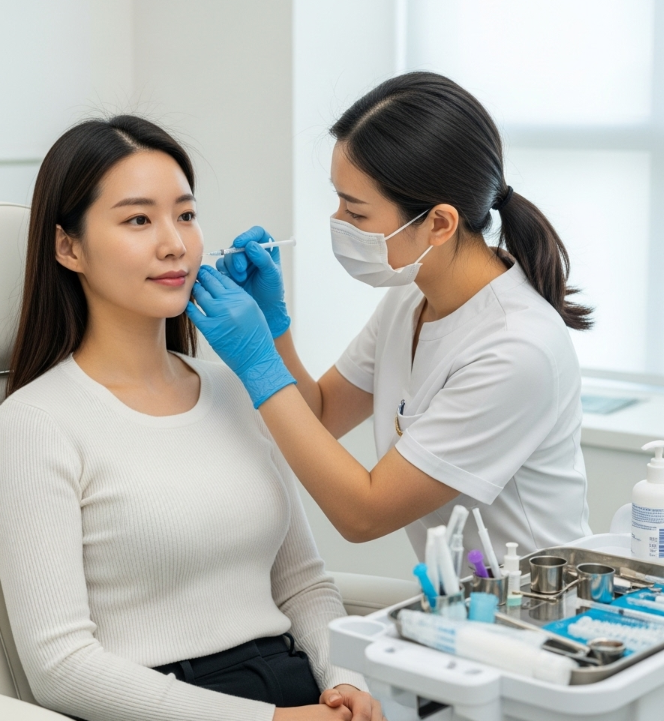
Treatment Overview
Dermal Fillers are one of Korea’s most popular and refined non-surgical anti-aging treatments, used to restore youthful volume, smooth wrinkles, and enhance facial contours. Unlike surgical facelifts, fillers provide instant results with minimal downtime. They are composed of various biocompatible substances—most commonly hyaluronic acid (HA), but also calcium hydroxylapatite (CaHA), poly-L-lactic acid (PLLA/Sculptra), and PMMA microspheres—each chosen based on patient goals and skin condition.
Korean dermatologists are world-renowned for their precision injection mapping and “layered filler technique,” which ensures natural harmony and balance rather than overfilling. Fillers in Korea are often combined with Botox, skin boosters, or thread lifting for comprehensive anti-aging results that maintain natural beauty.
Purpose & Benefits
- Wrinkle Reduction: Smooths fine lines and deep folds (nasolabial, marionette).
- Volume Restoration: Replenishes cheeks, temples, and under-eye hollows.
- Facial Contouring: Defines jawline, chin, and nose (non-surgical rhinoplasty).
- Lip Enhancement: Creates fuller yet natural-looking lips.
- Skin Rejuvenation: HA fillers improve hydration and radiance.
- Immediate Results: Visible lift and contour right after treatment.
- Customizable: Choice of filler type for different facial zones.
Ideal Candidates
Dermal fillers are recommended for:
- Adults in their late 20s–60s seeking anti-aging or contouring.
- Patients with volume loss in cheeks, temples, or jawline.
- Men and women with wrinkles or facial folds they want softened.
- Those desiring non-surgical alternatives to facelift or rhinoplasty.
- Patients seeking natural enhancement without drastic changes.
- Individuals combining fillers with Botox for a complete facial refresh.
Possible Risks & Complications
Dermal fillers are safe in Korea’s clinics, but possible risks include:
- Mild Swelling/Redness: Common, resolves in 1–3 days.
- Bruising: Temporary, minimized with microcannula techniques.
- Lumps or Irregularities: Rare, corrected with massage or hyaluronidase (for HA).
- Asymmetry: Correctable with touch-up injections.
- Rare Risks: Vascular occlusion or infection (extremely rare with skilled doctors).
Techniques Used in Korea
Korean dermatologists use advanced filler protocols to ensure natural results:
- Microcannula Technique: Minimizes bruising, improves precision.
- Layered Injection Mapping: Filler placed in deep, mid, and superficial planes for structural + aesthetic balance.
- Combination Therapy: Fillers paired with Botox, threads, or PRP for full-face rejuvenation.
- Non-Surgical Rhinoplasty: High-precision HA filler sculpting for nose bridge and tip.
- V-Line & Contour Design: Chin, jawline, and cheekbone reshaping.
- Skin Booster Filler (Diluted HA): Improves hydration, glow, and elasticity.
Recovery & Aftercare
- Immediately After: Mild redness or swelling.
- 1–3 Days: Bruising or puffiness subsides.
- 1–2 Weeks: Final results settle naturally.
- 6–24 Months: Duration depends on filler type (HA shorter, CaHA/PLLA longer).
Aftercare Tips:
- Avoid massaging or pressing treated areas (unless directed).
- No heavy exercise, alcohol, or sauna for 24–48 hours.
- Sleep with head elevated first night.
- Use SPF and maintain skin hydration.
Results & Longevity
- Immediate: Lifted, hydrated, contoured appearance.
- Short-Term (2–4 Weeks): Wrinkles smooth, facial balance improves.
- Medium-Term (6–12 Months): Results last with HA fillers.
- Long-Term (12–24 Months): Collagen stimulators like CaHA and PLLA extend longevity.
Treatment Process in Korea
- Consultation & Analysis – Doctor maps facial proportions and patient goals.
- Preparation – Numbing cream or local anesthesia applied.
- Injection Session – Precision filler placement with needle or cannula.
- Post-Care – Cooling packs applied, aftercare explained.
- Follow-Up – Optional touch-up after 1–2 weeks.
Why Korea is a Top Destination
- World-renowned expertise in natural filler techniques.
- Pioneers in layered injection mapping for harmony and balance.
- Safe, KFDA-approved filler brands widely available.
- Affordable compared to Western clinics with equal or superior quality.
- Seoul dermatology centers known for subtle, natural-looking enhancements.
Cost Range
Filler prices in Korea vary by type, brand, and area treated:
- Hyaluronic Acid (1cc): USD 300 – 600
- Calcium Hydroxylapatite (CaHA/Radiesse 1.5 ml): USD 600 – 900
- Poly-L-Lactic Acid (PLLA/Sculptra, per vial): USD 700 – 1,200
- Non-Surgical Nose Filler (1cc): USD 400 – 800
- Full-Face Filler Package (multi-syringe): USD 2,000 – 4,000
- Luxury Anti-Aging Package (Fillers + Botox + Skin Boosters): USD 3,500 – 6,500
Additional Costs in Korea:
- Consultation: USD 30 – 100
- Numbing cream/comfort care: USD 20 – 50
- Optional add-ons (exosomes, PRP, laser): USD 200 – 800
💡 Many patients describe Korean fillers as “sculpting without surgery”—delivering natural volume, contour, and radiance in under an hour.
Popular Clinics
- Banobagi Plastic & Dermatology (Seoul): Experts in natural volumization and facial contour fillers.
- Oracle Dermatology (Seoul): Global chain, popular for non-surgical nose & jawline fillers.
- JW Plastic Surgery (Seoul): Specialists in combination filler + Botox treatments.
- Renewme Skin Clinic (Seoul): Advanced filler mapping for anti-aging and scar correction.
- ID Hospital (Seoul): Leaders in 3D facial design with filler + thread lift protocols.


